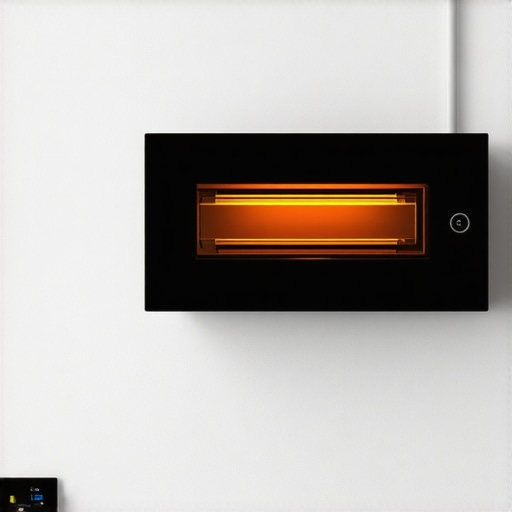
The Ghost in the Machine: Why Infrared Changes the Game
My old mentor, a guy who had been lugging heavy-duty pipe wrenches since the Carter administration, used to scream at me in the middle of a frozen crawlspace: ‘You can’t heat what you can’t touch! This is why airflow matters more than horsepower, and why radiating energy beats pushing hot air through a tin can any day!’ He was right, even if he was a cranky old bastard. Most of you think about heating as blowing hot air through a series of ‘tin’ (ductwork) until the thermostat clicks off. But in the North, where the polar vortex likes to turn your plumbing into popsicles, that convective logic is a losing battle. When we talk about slashing energy costs for 2026, we are looking at the physics of radiation over convection. Infrared heaters don’t bother warming the air molecules—which are flighty and love to escape through every crack in your siding—they heat the objects. Yourself, your floor, your couch. It is the difference between standing in the sun on a winter day and standing in the shade. The air temp is the same, but the radiation makes you sweat. Understanding this is the first step in avoiding a heat pump replacement that you might not actually need if you just supplemented your thermal load correctly.
Tip 1: The Line-of-Sight Law and Geometric Placement
Infrared heating is fundamentally different from the hydronic heating systems or forced-air furnaces I’ve spent thirty years fixing. In a standard furnace setup, the ‘Tin Knocker’ (duct installer) just needs to get air into the room. With infrared, if you can’t ‘see’ the heater, you aren’t getting the heat. I’ve seen homeowners install high-end radiant panels behind a decorative curtain or tucked into a corner behind a bookshelf. That is burning money. You have to treat an infrared heater like a light fixture. If a shadow is cast, that area is cold. To slash costs in 2026, you need to map the ‘sensible’ heat zones of your home. Focus on the areas where the human body remains stationary—the home office, the dining table, or the couch. By using voice control setup Alexa Google to manage these zones, you can keep the rest of the house at 60 degrees while your immediate environment feels like a balmy 72. This is the ‘Micro-Zoning’ revolution. Instead of the boiler running 24/7, which requires regular boiler maintenance services to prevent scaling and pump failure, you are shifting the load to targeted electrical radiation. According to the ASHRAE Handbook—HVAC Systems and Equipment:
“Radiant heating systems can provide equivalent comfort at lower air temperatures than convective systems, potentially reducing building heat loss by 5% to 25%.” – ASHRAE Standards
Tip 2: The Hybrid Integration (Airflow and Purification)
You can’t just slap a radiant heater on the wall and call it a day if your attic insulation for heating is non-existent. The biggest mistake ‘Sales Techs’ make is selling you a shiny new gadget without looking at the ‘Pookie’ (mastic) on your ducts or the gaps in your envelope. For 2026, the real pros are doing air purification integration alongside infrared. Why? Because when you stop blowing air around constantly (convection), the air becomes stagnant. You need UV light installation for HVAC to kill the biological growth that thrives in still, warm corners. I remember a job last January where the homeowner complained of a ‘sour’ smell—the classic scent of a combustion analysis gone wrong or, in this case, mold in the damp corners that the radiant heat didn’t reach. We integrated a low-CFM duct cleaning services schedule and a fireplace insert services overhaul that allowed the infrared panels to handle the baseline heat while the main system only kicked on for filtration and humidity control. This hybrid approach is the ‘secret sauce.’ You aren’t replacing the whole ‘juice’ (refrigerant) system; you are optimizing it. Check out heating service innovations transforming 2025 climate control to see how these systems are finally talking to each other. If your current tech doesn’t understand how to balance a radiant load with a heat pump replacement, they are just a parts changer, not a technician.
Tip 3: The Thermal Envelope and the Combustion Trap
If you are still running an old atmospheric-vented boiler or furnace, you are basically throwing a party and inviting the cold wind inside. Every time that burner fires, it sucks air from your house and sends it up the chimney. That air has to be replaced, usually by ‘infiltration’—cold air whistling through your windows. This is why combustion analysis is non-negotiable. If your tech isn’t sticking a probe in the flue to check the CO and O2 levels, they aren’t doing their job. To truly slash 2026 costs, you need to seal the ‘hat’ of the house with attic insulation for heating. I’ve seen R-19 fiberglass batts that looked like they’d been through a war, covered in ‘Sparky’s’ (electrician) boot prints and mouse nests. Upgrading to R-60 blown-in cellulose keeps the radiant heat you’ve just generated from bleeding out into the atmosphere. It’s about ‘Thermodynamic Zooming’—looking at the molecular level. Infrared heat excites the molecules in your floor; that floor then slowly releases that heat back into the air (secondary convection). If your floor is a concrete slab over cold dirt with no thermal break, your infrared heater is just trying to warm up the entire planet Earth. That’s a fight you’ll lose every time. For more on the technical side of making the right call, see choosing the right HVAC fixes. Remember the industry axiom:
“The most expensive equipment in the world cannot overcome a bad duct system or a leaky house.” – Industry Axiom
This is especially true when transitioning to infrared. Don’t fall for furnace repair myths debunked by industry experts; the truth is always in the physics of the envelope. If you suspect a major issue, know how to identify when furnace repair is urgent before you invest in secondary heating.