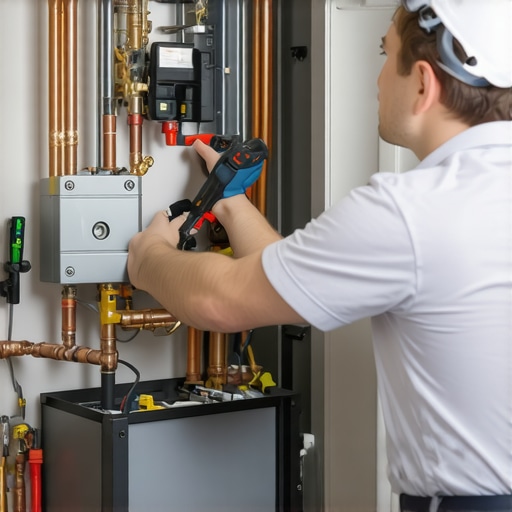
The Forensic Anatomy of a Cold House
The silence of a dead furnace at 3 AM in the middle of a January freeze isn’t just quiet; it’s heavy. It’s the sound of thermal energy escaping your walls and the frost creeping toward your pipes. As an HVAC veteran who has spent three decades dragging tool bags through crawlspaces, I’ve learned that homeowners usually panic and think their entire system is toast. They start looking at the cost of a full radiator replacement or a new biomass boiler services contract when the culprit is often a small, copper-clad stick worth less than a bag of salt. That stick is the thermocouple. My old mentor used to scream, ‘You can’t move what you can’t touch!’ This is why airflow and thermal conduction matter more than the nameplate on the cabinet. If that thermocouple can’t ‘touch’ the flame and translate that heat into a millivolt signal, your gas valve is staying shut, and you’re staying cold.
“The efficiency of a combustion system is inextricably linked to the integrity of its safety pilot circuit, ensuring that fuel flow is permitted only in the presence of a sustained ignition source.” – ASHRAE Fundamentals Handbook
In the frigid North, where attic insulation for heating is the only thing keeping your roof from becoming an ice dam factory, the furnace is the heart of the home. When that heart stops, we have to look at the ‘nervous system’ first. The thermocouple is a simple heat-to-electricity transducer. It uses the Seebeck effect—two dissimilar metals joined at one end that create a small voltage when heated. We’re talking 25 to 30 millivolts. If that signal drops, the electromagnet in the gas valve drops out, and the ‘gas’ stops flowing. It’s a safety feature, not a conspiracy to leave you shivering. Understanding this physics is the first step in [choosing the right HVAC fixes](https://heatprosservices.com/choosing-the-right-hvac-fixes-what-homeowners-need-to-know) before you get scammed into a system you don’t need.
Tip 1: The ‘Pilot Lick’ and Carbon Scouring
The most common failure I see isn’t a broken thermocouple, but a dirty one. In 2026, even with high-efficiency systems, soot happens. If the pilot flame isn’t ‘licking’ the top 1/3 of the thermocouple tip, the molecular agitation inside the copper capillary won’t reach the threshold to hold the valve open. You’ll see a lazy, yellow flame instead of a crisp blue one. Take a piece of fine-grit sandpaper or a dollar bill and scour the tip. You’re looking for the ‘suction line’ of thermal conductivity. If it’s buried in carbon, it’s insulated from the heat. This is a primary reason why [furnace repair myths debunked by industry experts](https://heatprosservices.com/furnace-repair-myths-debunked-by-industry-experts) often point to ‘broken’ parts that just needed a cleaning. If you’re also dealing with a bypass humidifier repair, check for leaks that might be dripping onto the burner assembly, causing premature oxidation.
Tip 2: The Nut, the Valve, and the ‘Tin Knocker’s’ Grip
The second tip involves the connection point. The thermocouple leads to the gas valve where it’s held by a small nut. I’ve followed ‘Sales Techs’ who over-tighten these until they snap the internal lead or under-tighten them so the circuit is intermittent. It should be finger-tight plus a quarter turn with a wrench. No more. If the connection is loose, the resistance increases, and those precious 30 millivolts disappear before they can reach the solenoid. If you’re looking at a gas line installation for furnaces, ensure the vibration from the blower motor replacement you did last year hasn’t rattled that thermocouple loose. A vibrating blower is a sign of bad static pressure—a ‘Tin Knocker’ (duct guy) would tell you that’s because your returns are choked.
“Proper gas line installation for furnaces requires precise pressure drop calculations to ensure appliance regulator stability and safety pilot reliability.” – NFPA 54 / National Fuel Gas Code
Tip 3: The ‘Universal’ Trap in High-Efficiency Systems
Don’t just grab a generic thermocouple from a big-box store and expect it to work in a modern 2026 high-performance furnace. Many of these units now use flame sensors or specialized thermocouples with higher millivolt ratings for smart thermostat setup integration. A generic part might keep the pilot lit, but the resistance could be off enough to trigger a soft-lockout in the control board. This is especially true if you are running baseboard heater repair alongside a central system or managing garage heater installation zones. If the board doesn’t see the exact voltage it expects within 15 seconds, it kills the cycle. For those with complex setups like spa heater services integrated into the home gas line, pressure fluctuations can also mimic thermocouple failure. Always check the manifold pressure before blaming the sensor. If the heat still won’t kick on, it might be time to see [how to identify when furnace repair is urgent](https://heatprosservices.com/how-to-identify-when-furnace-repair-is-urgent-and-why).
The Cold Reality of HVAC Maintenance
Maintenance isn’t about ‘topping off’ anything; it’s about verifying physics. Whether you’re dealing with radiator replacement in an old Victorian or a biomass boiler services update, the fundamentals of heat transfer remain. If your blower motor is screeching like a banshee, that’s a bearing failure. If your vents smell sour, that’s a biological growth on the coil. And if your furnace won’t stay lit, it’s usually the thermocouple or the flame sensor. Don’t let a tech talk you into a $12,000 unit when a bit of ‘Pookie’ (mastic) on the ducts and a $20 sensor would have solved the comfort issue. For more professional insights, check out [heating service hacks for comfort and savings in 2025](https://heatprosservices.com/heating-service-hacks-for-comfort-and-savings-in-2025). Keep your coils clean, your filters changed, and your thermocouples scoured. That’s how you survive a polar vortex without breaking the bank.