The Death of R-410A and the Birth of the ‘A2L’ Era
Listen, I’ve spent the better part of thirty years melting in attics and crawling through blown-in cellulose that’s older than most homeowners, and I’m telling you right now: the industry is about to hit a wall. By 2026, the R-410A ‘juice’ we’ve been using for decades is effectively dead. If you’re looking at a heat pump replacement or a new AC, you’re going to be hearing a lot about R-454B. Before you let some ‘Sales Tech’ in a starched white shirt sell you a system you don’t need, let’s talk shop. I followed a guy last month who quoted a young couple $14,000 for a full oil to gas conversion and new furnace because he claimed their 2018 unit had a ‘non-repairable refrigerant breach.’ I walked in with my sniffer, found a loose fitting on the gas line installation for the furnace, tightened it, and checked their static pressure. The unit was fine. He was just hunting for a commission. Don’t be that homeowner. Knowing the physics of R-454B is your only shield against the 2026 price hikes.
“The most expensive equipment in the world cannot overcome a bad duct system.” – Industry Axiom
1. R-454B is ‘Mildly Flammable’—And Your Unit Will Know It
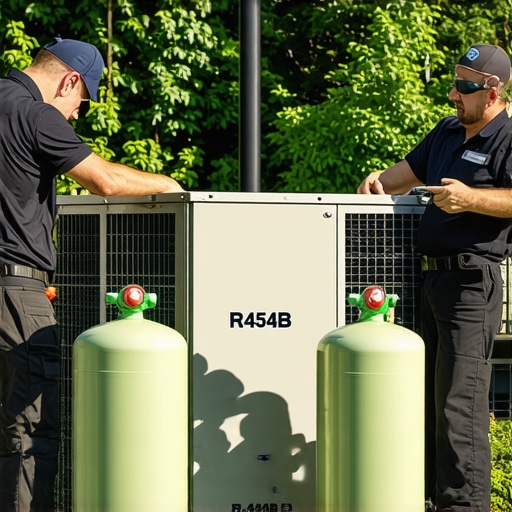
Unlike the old R-22 or R-410A, R-454B is classified as an A2L refrigerant. In plain English? It’s ‘mildly flammable.’ Now, don’t panic—your house isn’t going to turn into a Roman candle—but the engineering has changed. 2026 units will come equipped with integrated leak sensors. If that sensor detects a whiff of gas in the evaporator coil, it’ll shut the whole system down and force the blower motor to dilute the air. This makes expert AC installation more critical than ever. If your ‘tin knocker’ doesn’t seal those joints with proper pookie (mastic), and the vibration causes a rub-through, that sensor is going to lock you out on the hottest day of the year. This transition is also pushing many toward an oil to gas conversion to streamline their high-efficiency setups before the new regulations drive equipment costs up another 20%.
2. Static Pressure Testing: The ‘Blood Pressure’ of Your HVAC
If you don’t understand static pressure testing, you don’t understand HVAC. Think of your ductwork like arteries. If they’re too small, the heart (your compressor) has to work twice as hard. With the new R-454B systems, the tolerances are tighter. These units are designed to move a very specific volume of air to ensure the suction line stays ‘beer can cold’ without freezing the coil. When I do HVAC load calculation services, I’m not just looking at square footage; I’m looking at the friction loss in your vents. Most ‘bad units’ are actually just victims of choked-off returns. If you’re adding attic insulation for heating efficiency, you’re sealing the house tighter, which means your dehumidification services need to be spot-on or you’ll end up with a ‘cold swamp’ feel because the unit can’t pull the latent heat out fast enough.
[IMAGE_PLACEHOLDER]
3. The Physics of the North: Why AFUE and Heat Pumps Matter Now
In our climate, we deal with the ‘Polar Vortex’ effect. If you’re considering a heat pump replacement to R-454B, you need to know how it handles sensible heat versus the freezing point. Old-school heat pumps used to struggle when it hit 30°F. The new A2L systems are better, but they require a ‘Sparky’ to ensure the backup heat strips are staged correctly. We also look at the AFUE ratings on furnaces during an oil to gas conversion. If you’re not hitting 96% AFUE, you’re literally venting money through the roof. I’ve seen cracked heat exchangers on five-year-old units because the gas line installation for furnaces was done with undersized pipe, causing ‘flame rollout’ that cooked the metal. You need a tech who cares about the manifold pressure, not just someone who can swap a part.
4. Rebates and Maintenance: Don’t Leave Money on the Table
The government wants you off the old gas, and they’re paying for it. Through rebate application assistance, homeowners can often offset the higher cost of these new A2L units. But here’s the catch: most of those rebates require proof of HVAC maintenance plans and professional HVAC load calculation services. You can’t just ‘eyeball’ a 3-ton unit anymore. If it’s oversized, it’ll short-cycle, meaning it won’t run long enough to drop the dew point. You’ll be 72 degrees but 70% humidity—miserable. For warehouse heating solutions or large residential builds, the 2026 transition is even more complex due to the volume of refrigerant involved. Always check the 2025 heating innovations to see how these refrigerants integrate with smart zoning.
“Design heating and cooling loads shall be determined in accordance with ASHRAE/ACCA Standard 183.” – ASHRAE Standards
The Bottom Line: Don’t Wait for the 2026 Rush
The ‘Sales Techs’ are going to use the R-454B transition to scare you. Don’t let them. It’s just physics. Whether you need dehumidification services to stop the ‘sweaty duct’ syndrome or you’re finally ready for that oil to gas conversion, the key is the install. A poorly installed $15,000 unit will perform worse than a perfectly installed $8,000 unit every single time. Get your static pressure testing done, verify your gas line installation for furnaces, and make sure your tech knows the difference between latent and sensible heat. If you’re confused, contact us for a real diagnosis, not a sales pitch. We’ve been keeping the air moving since the days when R-12 was king, and we aren’t stopping now.