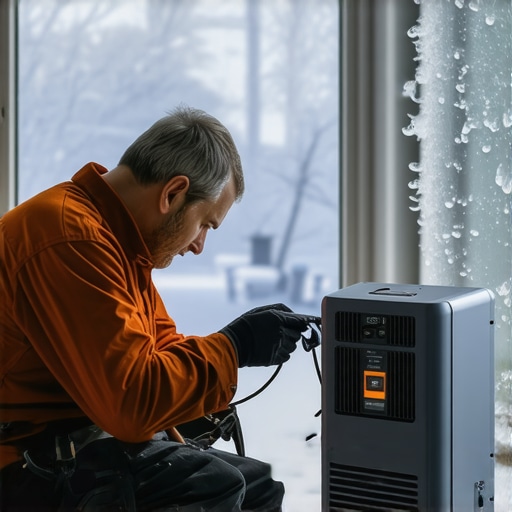
The Anatomy of a Deep Freeze: Why Your 2026 Heating is Failing
The silence of a dead heater at 3 AM in the middle of a January polar vortex has a specific frequency. It is a heavy, oppressive quiet that smells like creeping frost and impending plumbing disasters. As an HVAC veteran who has spent three decades dragging manifold gauges through crawlspaces and overhauling steam boilers that look like they belong in a Jules Verne novel, I’ve seen the same story play out a thousand times. Homeowners wait until the mercury hits zero to realize their system is gasping for air.
My old mentor, a grizzled master tech who could sniff out a refrigerant leak from three blocks away, used to scream at me, ‘You can’t heat what you can’t touch, kid!’ This wasn’t just old-man rambling; it was a fundamental law of physics. He was talking about airflow and thermal contact. If your air isn’t physically scrubbing the heat off those electric strips or the heat exchanger, you’re just spinning your wheels and burning money. This is the ‘Airflow Manifesto.’ We aren’t just ‘fixing heaters’; we are managing the thermodynamic exchange between a source and a living space. If that path is blocked, your high-efficiency unit is just a very expensive paperweight.
‘The most expensive equipment in the world cannot overcome a bad duct system.’ – Industry Axiom
1. Control Board Diagnostics & Relay Services: The Brain of the Operation
When an ice-cold room refuses to warm up, the ‘Sparkies’ (electricians) and the HVAC guys often start pointing fingers. But the truth usually lies in the control board diagnostics. In the 2026 landscape of HVAC, these boards are more complex than the computers that put men on the moon. A failing relay on a sequencer can prevent your electric heat strips from staging correctly. If the first stage kicks on but the second doesn’t, your blower is moving air that’s barely lukewarm. We use relay services to ensure that the call for heat actually translates into high-voltage action. I’ve followed behind dozens of ‘Sales Techs’ who saw a dead board and quoted a $12,000 system replacement, when the reality was a $150 relay that had pitted contacts. Identifying these failures requires a true forensic approach—testing the 24V signal from the thermostat against the line voltage output to the elements. For more on navigating these choices, see choosing the right HVAC fixes.
2. Cold Climate Heat Pumps: The Transition to R-454B
By 2026, the industry has fully shifted away from R-410A into the era of A2L refrigerants like R-454B. These cold climate heat pumps are marvels of engineering, capable of pulling ‘juice’ (heat energy) out of -15°F air. But here’s the rub: they are incredibly sensitive to charge levels. If your ‘Suction Line’ isn’t properly insulated or if your charge is off by even four ounces, the system’s Coefficient of Performance (COP) tanks. In a cold climate like Chicago or the Northeast, these systems rely on flash-injection technology to keep the compressor cool while it works overtime. If you’re feeling a chill, it might be the system’s internal sensors detecting a ‘mildly flammable’ refrigerant leak and shutting down for safety. Understanding heating service innovations transforming 2025 climate control is the only way to keep these complex beasts running.
3. Radiant Floor Heating Installation: The Ultimate Sensible Heat
If you want to kill the ‘ice-cold room’ problem forever, radiant floor heating installation is the heavy artillery. While forced air is a ‘sensible heat’ battle—moving hot air that immediately wants to rise to the ceiling—radiant heat warms the objects in the room. It’s pure physics: the Stefan-Boltzmann law in action. By warming the thermal mass of the floor, we create a heat reservoir. This prevents the ‘stratification’ where your head is at 75°F but your feet are at 60°F. When we install these, we’re looking at the PEX layout and the manifold balancing. If one loop is too long, that corner of the master bath stays like a skating rink. It’s about flow rates and GPM (gallons per minute), not just ‘turning it on.’
4. Steam Boiler Repair & Humidification: Managing the Latent Load
In older homes, the steam boiler repair is a lost art. Most ‘techs’ today look at a sight glass and panic. But steam is the king of latent heat. When water turns to steam, it absorbs a massive amount of energy (970 BTUs per pound) which it releases when it condenses in your radiator. If your rooms are ice-cold, you might have ‘air bound’ radiators where the vent is clogged. Furthermore, dry air is the enemy. A steam humidifier integrated into your system can make 68°F feel like 72°F because it slows down the evaporative cooling on your skin. If you’re ignoring your boiler, you’re ignoring the heart of the home. Check out how to identify when furnace repair is urgent to see if your boiler is screaming for help.
‘Provisions shall be made to prevent the over-pressurization of the hydronic system.’ – ASME Boiler and Pressure Vessel Code
5. Infrared Heater Installation & Duct Cleaning: The Airflow Cleanup
Sometimes the solution isn’t more power, but better delivery. Infrared heater installation is perfect for those ‘bonus rooms’ over garages that no HVAC system can ever seem to reach. But for the rest of the house, we look at the ‘lungs.’ Duct cleaning services aren’t just about dust; they are about static pressure. If your ‘Tin Knocker’ (duct installer) 20 years ago used too much flex duct or if the ‘Pookie’ (mastic) has dried and cracked, you’re losing 30% of your heat to the attic. We use manometers to measure the ‘Total External Static Pressure.’ If that number is too high, your blower motor is working itself to death and delivering half the CFM (cubic feet per minute) it should. Cleaning the ducts and sealing the joints is often more effective than upgrading the heater itself. This is why efficient HVAC repairs focus on the whole envelope, not just the box in the closet.
The 24/7 Heating Emergency Response: When to Call
If you wake up and see your breath in the living room, you need a 24/7 heating emergency response. Don’t fall for the furnace repair myths debunked by industry experts that say you should ‘wait until morning’ to see if it resets. A frozen pipe can cause $20,000 in water damage in the time it takes for the sun to come up. We look for the basics first: Is the breaker tripped? Is the ‘Sparky’s’ work still solid? If the control board shows a ‘lockout’ code, don’t keep cycling the power. That’s how you fry a transformer. In 2026, we have the tools to diagnose these issues remotely, but nothing beats a technician with a multimeter and a flashlight who knows the difference between a mechanical failure and a physics problem. Comfort isn’t a luxury; in a cold climate, it’s a matter of survival. Keep your coils clean, your filters fresh, and your ‘Pookie’ tight. That’s the only way to survive the 2026 winter.
http://Jessica%20Moore
Reading through this detailed breakdown really highlights how crucial proper airflow and system component diagnostics are, especially with the shift toward advanced refrigerants and complex control boards in 2026. I’ve seen many homeowners overlook the importance of duct maintenance—thinking that just installing a new heater will solve the problem—only to be disappointed when cold spots persist. It’s interesting how so much of the heat delivery depends on the unseen ‘lungs’ of the system, like ducts and vents. Regarding the control board diagnostics, I once had a stubborn relay that caused intermittent heating issues, and it was a simple fix with testing the relay contacts. Has anyone else encountered a situation where duct sealing or cleaning made a bigger difference than upgrading the entire heater? I’d love to hear about effective strategies others have used to improve airflow, especially in older homes with long duct runs or dried mastic joints. Proper system upkeep seems key to avoiding the kind of deep freeze scenarios described here.