The Invisible Boundary: Why Static Pressure is the Only Thing Standing Between Safety and Contamination
In the mechanical rooms of a major medical center, you don’t hear ‘comfort.’ You hear the hum of static pressure. My old mentor, a grizzly man named Stan who could troubleshoot a chiller by the vibration of the liquid line, used to scream at me, ‘You can’t cool what you can’t touch, and you can’t control what you can’t isolate!’ He was right. In the world of clinical environments, airflow isn’t just about moving air; it’s about the physics of containment. If a ‘tin knocker’ messes up a return air drop in an isolation ward, you aren’t just looking at a hot room—you’re looking at a breach. Hospital HVAC zoning is a high-stakes game of pressure gradients where we use duct design services to create invisible walls. We’re talking about positive pressure in operating rooms to keep bugs out, and negative pressure in ER waiting areas to keep the ‘gas’ from spreading. Most ‘Sales Techs’ couldn’t tell you the difference between a manometer reading and their own pulse, but when you’re dealing with infection control, every Pascal of pressure counts.
“The most expensive equipment in the world cannot overcome a bad duct system.” – Industry Axiom
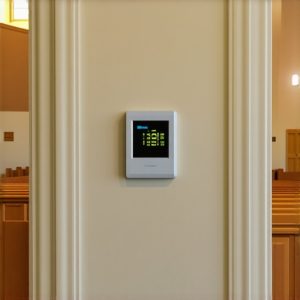
When we talk about AI-driven HVAC optimization in a hospital setting, we aren’t just talking about a fancy thermostat. We are talking about sensors that monitor the pressure differential between a hallway and a patient room. If that differential drops, the AI ramps up the VFD (Variable Frequency Drive) on the supply fan. But here’s the rub: ramping up fans costs a fortune in ‘juice.’ In the cold climates of the North, where we rely heavily on hotel boiler services and 1.5-million BTU plants to keep the coil from freezing, the energy penalty of high-volume air changes is massive. This is where cold climate heat pumps and integrated preventative maintenance contracts become the backbone of the operation. You can’t just blast the heat; you have to manage the enthalpy of the air. We use duct design services to ensure that the air isn’t just dumped into a room, but is circulated in a way that maximizes ‘scouring’—removing particles from the breathing zone and pulling them into HEPA-filtered returns.
The Thermodynamic Reality of Infection Control
Let’s talk about the ‘sour’ smell of a failing system. In a hospital, that smell isn’t just a burnt-out compressor; it’s a sign of stagnant moisture in the coils. We combat this with UV light installation for HVAC. By hitting the evaporator coil with UVC radiation, we kill the biofilm before it can aerosolize. But if your bypass humidifier repair wasn’t done right, you’re just pumping moisture into the ‘pookie’—that’s the mastic we use to seal ducts—and creating a petri dish. A real tech knows that a preventative maintenance contract is more than a clipboard and a smile; it’s about checking the static pressure drop across those HEPA filters. If the filter is loaded, the fan works harder, the energy bill spikes, and the zoning fails. It’s a chain reaction. To keep costs down, we utilize AI-driven HVAC optimization to find the ‘sweet spot’ where we maintain the required 12 air changes per hour (ACH) without turning the hospital’s budget into a burnt-out capacitor.
“Ventilation for acceptable indoor air quality requires more than just air movement; it requires precision in pressure and filtration.” – ASHRAE Standard 62.1
In the North, where the polar vortex can turn a standard unit into a block of ice, we look toward cold climate heat pumps for auxiliary areas, but the heavy lifting in a hospital still falls on steam or hot water. If a hotel boiler service tech tells you that a leak in the heat exchanger is ‘no big deal,’ they’re lying. That’s how you get CO into the air stream. While a ventless gas heater service might be fine for a garage, or fireplace insert services add charm to a home, they have zero place in a medical environment. In a hospital, every BTU must be accounted for. We often look into financing for heat pump installs for administrative wings to decouple them from the main clinical plant, saving the big boilers for the critical zones. This is how we extend the life of the system. By not overworking the main plant for non-critical rooms, we save the ‘gas’ for when the OR needs to be at 62 degrees and 40% humidity during a 12-hour surgery.
Static Pressure: The Silent Killer of Efficiency
If you’ve ever walked into a room and felt the door ‘whistle,’ you’re looking at a zoning failure. That whistle is the sound of money—and safety—leaking out. Proper duct design services eliminate these ‘dead spots.’ When I follow a ‘Sales Tech’ who tried to solve a cooling issue by just adding a bigger blower, I usually find a duct system that’s screaming in agony. You can’t force ten gallons of air through a five-gallon duct. It’s basic physics. This is why heating service innovations in 2025 are focusing on smart dampers. These aren’t your grandpa’s manual dampers. These are AI-controlled actuators that talk to the central plant. They know when a room is unoccupied and can dial back the airflow while still maintaining a minimum pressure ceiling to keep the zone ‘clean.’ This is how you control infection risks without sending the electric bill to the moon. Without these controls, the ‘Sparky’ (electrician) will be out every week replacing contactors because the system is short-cycling itself to death.
The Role of Maintenance in the Clinical Chain
You want to know the secret to a 20-year-old boiler? It isn’t luck. It’s preventative maintenance. In a hospital, we can’t afford a ‘hard start.’ We use preventative maintenance contracts to ensure that every sensor is calibrated. If a humidity sensor in the ICU is off by 5%, the bypass humidifier might over-saturate the air, leading to mold growth in the ductwork. If the UV light installation for HVAC is older than 9,000 hours, the bulbs are just expensive blue nightlights with no germicidal power. We treat the HVAC system like the lungs of the building. You wouldn’t let a surgeon operate with dirty tools, so why would you let a ‘tin knocker’ leave a duct unsealed? We use ‘pookie’ on every joint because even a small leak can depressurize a sterile zone. It’s about the details—the ‘beer can cold’ suction line, the clear sight glass, and the perfectly balanced air-and-water-side system. That is how you survive the 2025 regulatory shifts and keep the facility running without breaking the bank.