The Physics of Warm Feet: Why Your Mentor Was Right
My old mentor used to scream at me in the middle of a frozen basement in January, ‘You can’t heat what you can’t reach! Physics doesn’t care about your thermostat setting, it cares about surface area and Delta T!’ He was a mean old salt, but he was right. Most folks think heating a house is about blowing hot air through a dirty duct, but that’s just one way to skin a cat. When we talk about radiant floor heating, we are moving away from the chaotic turbulence of forced air and entering the realm of pure thermal mass. In a cold climate like ours, where the wind bites through the sheathing, understanding the difference between electric and hydronic systems isn’t just a luxury—it’s the difference between a comfortable home and a massive utility bill. If you’ve been considering a radiator replacement or getting rid of that old wood burning stove installation that leaves half the house freezing, radiant is the gold standard.
“The most expensive equipment in the world cannot overcome a bad duct system.” – Industry Axiom
The Electric Resistance Trap: High Heat, Higher Bills
Let’s talk about the ‘Sparky’ special: electric radiant heat. This involves running cables or mats under your floor finish. The physics is simple: electrical resistance generates heat. It’s basically a giant toaster under your tile. From a tech’s perspective, I love how easy it is to install during a remodel, but I hate the operating costs. If you’re just doing a small bathroom to keep your toes warm while you brush your teeth, electric is fine. But try to heat an entire 2,500-square-foot house with it, and you’ll be calling me to ask why your meter is spinning fast enough to lift off the ground. Electric systems lack the thermal inertia of water. They are fast-acting but inefficient for large-scale loads. Plus, if a wire snaps under the mortar because the subfloor shifted, you aren’t just looking at a repair; you’re looking at a sledgehammer and a very expensive afternoon. We often see these paired with heating service innovations like occupancy sensor installation to keep costs down, but they remain a secondary heat source in most northern climates.
Hydronic Systems: The Heavyweight Champion of Comfort
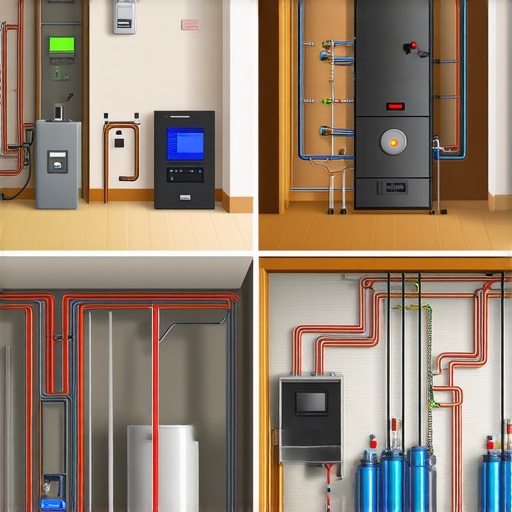
Now, if you want real comfort, you go hydronic. This is where the ‘Tin Knockers’ and the wet-heads agree. We pump heated water through PEX tubing embedded in the slab or under the subfloor. We aren’t just heating air; we are turning your entire floor into a low-temperature radiator. This is sensible heat at its finest. Because water has a much higher specific heat capacity than air, it carries energy far more effectively. We use a boiler or a high-efficiency heat pump to ‘juice’ the system. With the R-454B refrigerant transition services hitting the market, we’re seeing new air-to-water heat pumps that can run these floors with incredible efficiency. Hydronic systems allow for complex zoning system installation, meaning you can keep the bedroom at 65°F and the living room at 72°F without the ‘ghost drafts’ associated with forced air. You’ll want to check out our blueprint for cooler summers and warmer winters to see how these integrate with whole-home comfort.
“Thermal comfort is that condition of mind that expresses satisfaction with the thermal environment.” – ASHRAE Standard 55
Maintenance and the ‘Silent Killer’
Every system has a boogeyman. For hydronic radiant, it’s the mechanical room. You’ve got pumps, expansion tanks, and mixing valves. If you aren’t on one of our priority service memberships, a failed circulator pump in February will turn your house into an icebox before you can find your slippers. And because we’re often dealing with gas-fired boilers to heat that water, carbon monoxide detector installation is non-negotiable. I’ve seen cracked heat exchangers on boilers that would make your hair stand on end. Don’t fall for the furnace repair myths that say boilers are ‘set and forget.’ They need blood work—or in this case, water chemistry checks—to ensure the ‘gas’ isn’t eating the copper from the inside out. Even if you have a radiant system, you still need to think about air quality. Many people forget furnace filter replacement for their backup systems or overlook duct cleaning services for their HRV/ERV units, which are necessary because radiant floors don’t provide any air filtration or dehumidification.
Zoning and Remote Access: The 2025 Standard
In the old days, you had a mercury switch on the wall and you hoped for the best. Today, if you aren’t using remote thermostat access, you’re leaving money on the table. Radiant systems are slow to react—it can take hours to move the temperature of a concrete slab. Smart thermostats can learn the ‘lag’ of your floor and start heating two hours before you get home. This is why choosing the right HVAC fixes involves more than just picking a boiler; it’s about the controls. If you’re tired of the noise and dust of forced air, or the clanking of old pipes during a radiator replacement, radiant is the answer, but only if the physics of the house—the insulation and the windows—can support it. Don’t let a ‘Sales Tech’ tell you otherwise. Comfort is earned through proper static pressure, flow rates, and BTU calculations, not slick brochures. If you need a real diagnosis of your current setup, you know where to find us on our contact page. We’ll give you the truth, even if it’s salty. [HOWTO_SCHEMA_JSON_LD] { “@context”: “https://schema.org”, “@type”: “HowTo”, “name”: “How to Choose Between Electric and Hydronic Radiant Heat”, “step”: [ { “@type”: “HowToStep”, “text”: “Assess the square footage of the target area. Use electric for small bathrooms and hydronic for whole-home heating.” }, { “@type”: “HowToStep”, “text”: “Evaluate your primary energy source. Hydronic is best paired with gas boilers or high-efficiency heat pumps.” }, { “@type”: “HowToStep”, “text”: “Plan for zoning. Install manifold systems for hydronic to allow individual room temperature control.” } ] }