The Thermodynamic Reality of Ground-Source Energy
My old mentor used to scream at me until he was purple in the face, ‘You can’t cool what you can’t touch, and you can’t heat what you don’t own!’ He was a lead-pipe-swinging Tin Knocker from the old school who understood that HVAC isn’t about blowing air; it is about moving mass. When we talk about the truth regarding how much space a geothermal heat pump really needs, most ‘Sales Techs’—those guys who couldn’t find a suction line if it bit them—will give you a glossy brochure and tell you it fits anywhere. They are lying. Geothermal is the king of efficiency, but it is a space-hungry beast that demands respect for the laws of physics. Whether you are integrating it with hydronic heating systems or looking for boiler maintenance services to backup your loop, the footprint of your system is dictated by the thermal conductivity of your soil, not the size of your mechanical room.
“The most expensive equipment in the world cannot overcome a bad duct system—or in the case of geothermal, a poorly sized ground loop.” – Industry Axiom
The Indoor Footprint: More Than Just a Cabinet
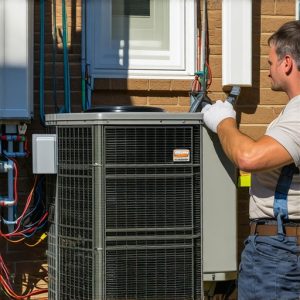
Inside the house, a geothermal water-to-air unit looks a lot like a standard furnace, but don’t let the small cabinet fool you. You need significant clearance for the manifold and the pumping station. If you are also running garage heater installation or pool heater repair off the same loop, your mechanical room is going to look like the engine room of a submarine. We aren’t just talking about a 30-inch by 30-inch footprint. You need service access. I have seen guys jam these units into closets where you couldn’t even get a multimeter on the contactor without dislocating your shoulder. That is not how we do things. Proper efficient hvac repairs require space to breathe. You also need to account for the buffer tank if you are running a water-to-water setup for radiant floors. Hydronic heating systems are the gold standard for comfort, especially in the North where annual heating inspection routines are a way of life to prevent cracked heat exchangers in backup systems.
The Ground Loop: The 10,000-Pound Gorilla
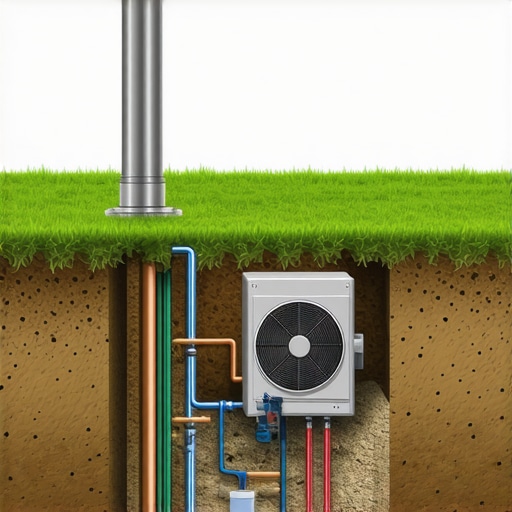
The real space requirement is outside. You have two choices: Horizontal or Vertical. If you go horizontal, you need acreage. We are talking 1,500 to 3,000 feet of pipe per ton of cooling. If you have a 3-ton house, you’re tearing up a massive chunk of your yard. If you don’t have the ‘back forty’ to dig up, you’re going vertical. This involves a drill rig sinking bores 200 to 400 feet deep. Even then, you need 15 to 20 feet of separation between those holes so they don’t ‘thermally interfere’ with each other. In cold climates like Chicago or the Northeast, the ground is your battery. If you pull too much heat out without letting it recover, you’ll end up with a permafrost block around your pipes that won’t thaw until July. This is why predictive maintenance alerts and heating service innovations are critical. You need to know if your loop temperature is trending too low before your backup boiler has to kick in and eat your savings.
“Design of the ground heat exchanger is the most critical element for the long-term performance of a GSHP system.” – ASHRAE Handbooks
The Physics of the North: Why Geothermal Loves a Boiler
In the North, we deal with the ‘Polar Vortex’ effect. When the ambient temp hits -10°F, your geothermal system is laughing because the ground is still a balmy 50°F. But, if the system wasn’t sized perfectly, or if the geofencing temperature control ramps up the demand too fast, you might need a supplemental heat source. This is where ventless gas heater services or a high-efficiency boiler come in. We often see homeowners integrate remote thermostat access to manage these transitions. It’s about thermodynamic zooming—looking at the micro-level of the refrigerant boiling point in the evaporator versus the macro-level of the soil’s BTUs. If you’re coming from a world of pool heater repair or basic furnace swaps, the complexity of a geothermal-hydronic hybrid will make your head spin. It requires an annual heating inspection to ensure the glycol levels are right and the gas/juice is flowing at the right pressures.
The Warning: Don’t Skimp on the ‘Pookie’
Airflow is still king. I don’t care if your heat comes from the center of the earth or a flaming pit of money; if your Tin Knocker didn’t seal the ducts with Pookie (mastic), you are losing 20% of your efficiency to the attic. I’ve followed behind too many ‘Sparkies’ who tried to wire a geo unit like a toaster. These systems need high-voltage protection and often 24/7 heating emergency response monitoring because if a circulator pump dies, the whole house freezes. For those looking into ac installation secrets, the biggest one is that geothermal requires more specialized labor than any other tech. It is not a DIY project. You need to understand the sensible heat vs latent heat balance, especially if you’re trying to dehumidify a basement in a humid summer while the ground loop is saturated with heat.
Final Verdict on Space
So, how much space do you need? For a 2,000 sq. ft. home: expect a 10×10 area in your basement for all the gear, and at least a 100×100 foot clear area of soil for a horizontal loop, or a driveway-sized area for vertical drilling. If you’re tight on space, stick to expert ac installation of a high-efficiency air-source heat pump. But if you have the dirt, geothermal is the last system you’ll ever buy—provided you don’t let a sales tech talk you into a ‘short’ loop. Physics doesn’t care about your budget; it only cares about the surface area of the heat exchange. Stay warm, stay cynical, and keep your coils clean.