The Silence of the Furnace: When Airflow Becomes the Enemy
You hear that high-pitched whine? That’s not just a ghost in the attic; it’s the sound of your furnace blower motor screaming for mercy. As a technician who’s spent three decades navigating crawlspaces and dragging a manifold gauge through the mud, I’ve seen thousands of blowers bite the dust. Homeowners always ask, ‘Is it the motor?’ Well, sure, the motor is dead, but the murder weapon is the six inches of grey, matted felt coating your return air ducts. My old mentor used to hammer it into my head every morning over black coffee: ‘You can’t heat what you can’t touch!’ This isn’t just some old-timer’s wisdom; it’s the fundamental law of thermodynamics. If your furnace can’t move air, it can’t transfer heat, and if it can’t transfer heat, that motor is going to cook itself into a paperweight.
“The most expensive equipment in the world cannot overcome a bad duct system. Static pressure is the silent killer of efficiency.” – ACCA Manual D
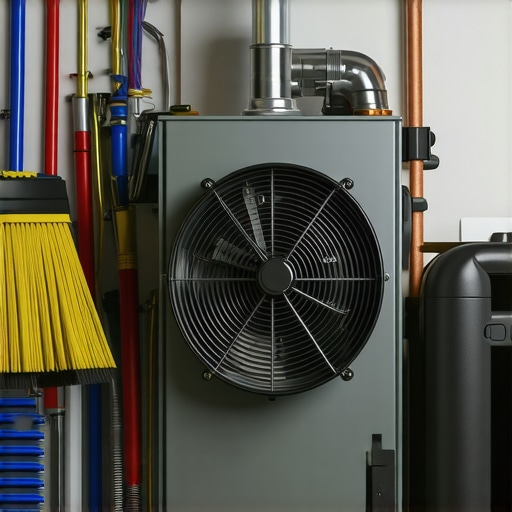
In the cold North, where boiler maintenance services and high-efficiency furnace installation are the difference between a cozy night and a frozen pipe catastrophe, we deal with extreme static pressure. When your ducts are choked with dust, pet dander, and the remnants of three decades of skin cells, the ‘squirrel cage’ fan—the part that actually moves the air—gets heavy. That extra weight increases the amperage the motor draws. Think of it like trying to run a marathon while wearing a winter parka soaked in water. You might finish, but your heart is going to explode. In the HVAC world, that ‘heart attack’ is a seized bearing or a burnt-out winding in your ECM motor. This is why dryer vent cleaning and duct scrubbing aren’t just cosmetic upgrades; they are life-support for your heating system.
The Physics of the Blower: Why Static Pressure Matters
Let’s talk about ‘Pookie’—that messy mastic sealant we use to keep your air in the pipes. If a tin knocker did a poor job on your original install, or if the sparky didn’t wire the speeds correctly, you’re already starting from a disadvantage. Now, add a layer of dust. In a church heating system, for instance, where you have massive volumes of air moving through cavernous spaces, even a slight restriction can lead to a massive spike in heat. We call this ‘Thermodynamic Zooming.’ Instead of the heat exchanger transferring its thermal energy to the air in a smooth, laminar flow, the air stays trapped. The heat exchanger temperature skyrockets, and the blower motor, sitting right in that hot air stream, begins to degrade. This is often when people call for 24/7 heating emergency response because the high-limit switch has tripped, shutting the whole thing down to prevent a fire.
If you’re in a climate where you jump from swamp cooler maintenance in the dry summer to firing up the furnace in October, the dust load is even higher. Those transition zones are brutal on equipment. I recently followed a ‘Sales Tech’—you know the type, the guy who spends more time on his hair than his torque wrench—who told a family they needed a $12,000 heat pump replacement because their system was ‘short cycling.’ I walked in, looked at the return grill, and it was so clogged with dog hair you could have knitted a sweater from it. I cleaned the blower wheel and the ducts, and that ‘dead’ system started moving 1200 CFM like it was brand new. Top HVAC repair strategies always start with the basics: clean the air, save the motor.
The 2025 Shift: High Efficiency and High Stakes
As we move into 2025, the game is changing. With the phase-out of R-410A and the rise of mildly flammable A2L refrigerants like R-454B, the sensors in your new units are more sensitive than ever. If you’re looking at a high-efficiency furnace installation, you need to realize these systems are precision-engineered. They don’t tolerate ‘dirty’ air. A 1/2 HP blower motor in a modern high-efficiency unit is often an ECM (Electronically Commutated Motor). These are ‘smart’ motors that try to maintain a constant CFM. If the ducts are dirty, the motor will ramp up its RPM to fight the resistance. It’ll succeed for a while, but it’ll pull double the ‘juice’ (amperage) and fail years before it should. This is why priority service memberships are vital; they ensure someone is actually checking the static pressure before the motor burns out.
“Ventilation systems shall be designed to minimize the accumulation of contaminants that can impede airflow or harbor biological growth.” – ASHRAE Standard 62.2
We see the same issues with pool heater repair and infrared heater installation. If the combustion air or the heat distribution is blocked by debris, the physics remains the same: heat builds up, components fail. Even something as simple as a dryer vent cleaning can prevent back-pressure that strains your home’s entire envelope. When air can’t leave, it can’t enter. It’s a closed loop. If you’re questioning how to identify when furnace repair is urgent, listen for that blower. If it sounds like a jet engine taking off, your ducts are likely the culprit. You’re not hearing ‘power’; you’re hearing a motor struggling to breathe through a straw.
The Solution: Beyond the Filter
Many homeowners think a 1-inch pleated filter from the big-box store is enough. In reality, some of those high-MERV filters actually contribute to the problem by adding too much resistance. This is where heating service hacks for comfort and savings come into play. A professional duct cleaning removes the ‘impacted’ dust that has bypassed the filter over years of operation. We’re talking about the stuff that coats the blower’s curved blades. If those blades lose their aerodynamic profile, they lose their efficiency. It doesn’t matter if you have the best boiler maintenance services in the city; if your air-side is failing, your comfort will suffer. Cleaning the ducts isn’t just about ‘dust-free’ shelves; it’s about ensuring the heat pump replacement you just paid for doesn’t end up back in the scrap yard in five years. Comfort is physics, not magic. Keep the air moving, and the motor will take care of you. Stop the air, and you’re just waiting for the breakdown call.”