The Hidden Killer in Your Basement: A Forensic Look at Heat Exchangers
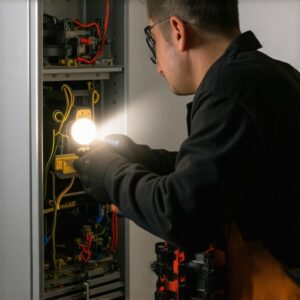
I followed a ‘Sales Tech’ last February who tried to convince a young couple they needed a $22,000 full-system overhaul because their furnace was ‘old and probably leaking.’ He didn’t even pull the blower motor to look at the cells; he just waved a cheap sniffer around the register and called it a day. I stepped in, pulled the high-limit switch, and used a borescope to show them the truth. While that tech was a liar, the danger of a cracked heat exchanger is no joke. It is the only thing standing between you and the literal fire of your burners and the poison of carbon monoxide. If that metal wall fails, the physics of your home change instantly. You aren’t just losing efficiency; you are breathing combustion byproducts.
“A cracked heat exchanger is a non-negotiable safety hazard that requires immediate decommissioning of the appliance to prevent carbon monoxide poisoning.” – ASHRAE Standard 103
In our neck of the woods, where the frost line stays deep for five months, your furnace is a beast of burden. It undergoes thousands of expansion and contraction cycles. When you have a variable speed furnace services tech check your unit, they are looking for the fatigue of metal. Think of it like a paperclip you bend back and forth until it snaps. That is what heat does to steel over twenty years. When that metal breaches, the draft inducer can no longer maintain a negative pressure environment, and the flame rollout begins. If you are noticing weird smells or odd behavior, you need to understand the mechanical anatomy of a failure before it becomes a statistic.
1. The Tell-Tale Flame Dance
A healthy furnace flame is a steady, crisp blue cone. If you peer through the sight glass and see a dancing, yellow, or wavering flame when the blower kicks on, you have a major problem. This usually means the air from the blower is leaking through a crack and pushing the flame around. This isn’t just a bad burn; it’s an atmospheric imbalance. If you see this, stop looking for how to identify when furnace repair is urgent and just shut the gas valve off. A yellow flame means incomplete combustion, which is the primary producer of CO.
2. The Smell of Formaldehyde and Acid
A cracked heat exchanger often produces a pungent, chemical odor that smells a bit like formaldehyde or a sour, acidic rot. This is the scent of incomplete combustion. It’s not the ‘dusty’ smell you get when you first turn the heat on in October; it’s a heavy, lingering stench. This is often accompanied by excessive moisture on your windows, as the combustion air—which should be vented outside—is dumping latent heat and water vapor into your living space. If your house feels like a swamp in January, you might need dehumidification services, but more likely, you have a breached furnace.
3. The ‘Clicking’ or ‘Popping’ After the Cycle
All metal expands when hot, but a cracked exchanger has a distinct, irregular ‘pop’ or ‘clunk’ as it cools down. If the crack is large, the metal will grind against itself during the contraction phase. If you hear what sounds like a tin knocker hitting a pipe in your basement every time the heat cycle ends, the integrity of the steel cells is likely compromised. This is why an annual heating inspection is vital; we can see the stress fractures before they become gaped holes.
4. Excessive Soot and Carbon Buildup
If you see black, velvety soot accumulating inside the furnace cabinet or around the burners, the furnace is ‘smoking.’ Gas furnaces should burn clean. Soot is a byproduct of a flame that is starving for oxygen or being choked by its own exhaust. When a heat exchanger cracks, the drafting process is ruined, and the ‘gas’ (as we pros call the fuel) can’t burn completely. This buildup can eventually foul your thermocouple replacement needs, making the unit fail to light altogether.
“Any visible crack or hole in a heat exchanger is a reason to replace the component or the entire furnace, regardless of CO measurements at the time of inspection.” – ACCA Standard 6
5. The Physical Corrosion of External Components
If you see rust flakes or heavy corrosion on the floor under the furnace or on the draft inducer housing, the heat exchanger is likely rotting from the inside out. In older hydronic heating systems or standard forced-air units, moisture can back up if the venting isn’t pitched correctly. This ‘acid rain’ inside your furnace eats through the metal. While some folks think they can just get pellet stove repair or use a wood burning stove installation as a backup, a rotting furnace is a primary threat that can’t be ignored.
6. The Sinus Headache That Won’t Quit
If everyone in the house has a dull headache, feels lethargic, or has flu-like symptoms that miraculously disappear when you go to work, you are being poisoned. Carbon monoxide is the silent ghost of the HVAC world. It has no smell and no color. This is why predictive maintenance alerts on modern smart systems are so critical. If your CO detector is chirping, don’t just change the batteries—get out of the house. For those in new construction heating design, ensure your sensors are hardwired and interlinked.
7. Frequent Limit Switch Tripping
The high-limit switch is a safety device that kills the burners if the furnace gets too hot. If your heat exchanger is clogged with soot or cracked in a way that disrupts airflow, the internal temperature skyrockets. If your furnace is short-cycling—turning on and off every five minutes—it might be the limit switch trying to save your life. Before you go messing with programmable thermostat programming, have a pro check the static pressure and the exchanger cells. Sometimes a dirty coil is the culprit, but often, it’s the beginning of the end for the heat exchanger.
The Math: Repairing the Unrepairable
Here is the cold truth: You cannot ‘patch’ a heat exchanger. You can’t use ‘Pookie’ (mastic) or high-temp tape on it. It’s a pressurized combustion chamber. If it’s cracked, the cell must be replaced, or more commonly, the entire furnace must be swapped. If your unit is over 12 years old, the labor to pull the entire blower and heat exchanger assembly often costs more than a new high-efficiency 96% AFUE unit. Don’t fall for the furnace repair myths debunked by industry experts that say a small crack is okay. It isn’t. Your safety is worth more than the cost of a new furnace. Check out our heating service innovations to see how modern units are built to prevent these failures better than the ‘tin cans’ of the 90s.