The Sound of Silence and the Death of Your Engine
You walk into your garage in the dead of January, expecting the familiar hum of a well-maintained environment, but all you hear is the oppressive silence of a tomb. That silence is the sound of your classic 1969 Mustang or your precision-engineered modern daily driver slowly succumbing to the brutal physics of a Northern winter. I’ve seen it a thousand times in thirty years of swinging a pipe wrench and checking manifolds. Most guys think a garage is just a box to keep the snow off. They’re wrong. Without proper climate control, a garage is a moisture-trap that eats metal from the inside out. My old mentor used to scream, ‘You can’t cool what you can’t touch!’ This is why airflow matters more than horsepower. In the heating world, that lesson translates to: if you aren’t moving the right amount of BTUs to hit the thermal mass of that vehicle, you aren’t protecting anything; you’re just wasting gas.
“The most expensive equipment in the world cannot overcome a bad duct system.” – Industry Axiom
Let’s talk Thermodynamic Zooming. When the sun hits your garage door in a cold climate like Chicago or the Northeast, the air inside warms up faster than the 4,000-pound block of steel sitting in your bay. That metal is a massive heat sink. As the air temperature crosses the dew point relative to that cold engine block, moisture doesn’t just appear—it’s pulled out of the air and onto your chrome, your brake rotors, and into your electrical connectors. This is latent heat in reverse, and it’s the primary cause of ‘garage rot.’ This is why electric heater services and gas-fired unit heaters aren’t luxuries; they are preservation tools. To prevent this, you need a system that maintains a steady temperature, which starts with professional HVAC load calculation services. You can’t just slap a ‘Space Heater 3000’ on the wall and hope for the best. You need to calculate the infiltration rate of those drafty garage doors and the R-value of your ceiling. If you over-size the unit, it short-cycles, never running long enough to actually dehumidify the space. If you under-size it, it runs until the capacitor replacement services become a weekly requirement because the start winding is cooked from constant use.
The Mechanical Anatomy of a Protected Garage
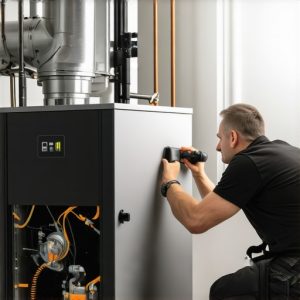
A garage heater is a simple beast, but it’s often installed by ‘Tin Knockers’ who don’t care about your car’s health. The anatomy starts with the heat exchanger. In a North/Cold climate, the enemy is the cracked heat exchanger. When cold air hits a hot exchanger too fast, the metal fatigues. I’ve seen it lead to flame rollout that char-broils a ceiling faster than you can yell for a fire extinguisher. That’s why chimney liner installation is non-negotiable for gas units; you have to get those combustion byproducts out of the building. Carbon monoxide isn’t just a threat to you; it’s acidic and will pit your car’s finish. For those with living space above the garage, crawl space heating solutions and energy recovery ventilators are critical. An ERV allows you to swap out the air—getting rid of the smells of gasoline and exhaust—without losing all the sensible heat you just paid to create. If you’re running a high-end workshop, HEPA filter systems are the only way to keep the fine dust of winter road salt from settling into your paint’s clear coat.
“Proper sizing and selection of heating equipment is critical to maintaining thermal equilibrium in non-conditioned spaces.” – ACCA Manual S
The tech side of this is where the ‘Sales Techs’ will try to burn you. They’ll see a non-functional unit and immediately quote you $8,000 for a whole new setup when you probably just have a bug-clogged pilot or a bad run capacitor. I’ve followed guys who tried to sell a whole new furnace to a guy whose only crime was not understanding programmable thermostat programming. In a garage, you don’t need 72 degrees. You need 50 to 55 degrees to keep the ‘Juice’—the battery and oil—at a viscosity that doesn’t feel like molasses. A smart thermostat allows you to ramp up the heat thirty minutes before you go out to tinker, but keeps it at a protective baseline the rest of the time. This is part of the heating service hacks for comfort and savings in 2025 that the big companies won’t tell you because it cuts into their profit margins. While you’re at it, don’t ignore the floor. A snow melt systems installation under the apron prevents you from dragging three gallons of slush into the garage every time you park, which is the number one source of humidity in a winter garage.
The Math of Repair vs. Replace
When does it make sense to pull the plug on an old heater? If you’re looking at a $500 bill for a proprietary inducer motor on a unit that’s twenty years old, you’re throwing good money after bad. Modern units have much higher AFUE ratings, meaning more heat stays in the garage and less goes out the flue. But don’t let a ‘Sparky’ or a general contractor just wire up a high-draw electric unit without checking your panel. I’ve seen garage fires started because someone didn’t realize that a 10kW heater pulls more amps than a whole kitchen. For larger commercial-style garages or even local institutions, school boiler maintenance principles apply—keep the water or air moving, or the system dies. If you want to keep your garage from becoming a swamp, check out our guide on top hvac repair strategies to extend your systems life. Also, learn how to identify when furnace repair is urgent and why, because in the middle of a polar vortex, your heater is the only thing standing between your car’s engine block and a very expensive crack. Stop using tape to seal your ducts; use ‘Pookie’—the duct mastic that actually seals the air in. Airflow is king, and in a garage, it’s the king that keeps your ’69 Mustang from turning into a pile of iron oxide.