Listen closely. If your furnace sounds like a jet engine taking off every time the thermostat clicks, you aren’t just hearing the ‘sound of warmth’—you’re hearing wasted energy and mechanical stress. I’ve spent thirty years crawling through crawlspaces and dragging my tools across frozen plywood, and if there is one thing I’ve learned, it’s that noise is a symptom of inefficiency. Most people think a loud furnace is just part of life in the cold zones. It’s not. It’s the sound of a single-stage blower slamming into a poorly designed duct system. When we talk about high-efficiency furnaces, we aren’t just talking about lower gas bills; we are talking about the physics of silence and the elimination of that ‘blast-furnace’ cycle that ruins your sleep.
The Sales Tech Scare and the Truth About Your Heat Exchanger
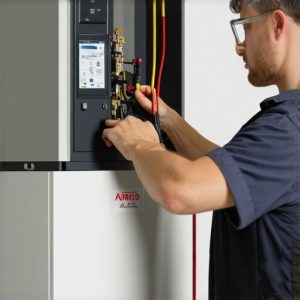
I followed a ‘Sales Tech’ last winter into a home in the suburbs. This kid was wearing a pristine uniform and carrying a tablet, looking more like a car salesman than a Tin Knocker. He had told a retired couple that their 15-year-old furnace had a cracked heat exchanger and was ‘leaking deadly carbon monoxide’—a classic scare tactic to push a $12,000 unit. When I arrived, I pulled the burner assembly and did a real inspection. The ‘crack’ was actually just a dirty flame sensor causing the unit to cycle improperly. A bit of steel wool and 20 minutes of labor saved them thousands. However, while their unit wasn’t a death trap, it was a dinosaur. It was an 80% AFUE beast that was eating them alive in fuel costs and sounded like a thresher. We eventually talked about choosing the right HVAC fixes, not because of a fake crack, but because their comfort was nonexistent.
“Equipment shall be sized to the heating and cooling loads of the building as determined by a recognized calculation procedure.” – ACCA Manual J
The Thermodynamic Zoom: Why High Efficiency is Quiet
In a standard 80% AFUE furnace, you have a single-stage gas valve. It’s either 0% or 100%. When that thing fires, it dumps a massive amount of sensible heat into the heat exchanger, and the blower fan has to ramp up immediately to move that air so the limit switch doesn’t trip. That sudden ‘whoosh’ is the sound of air being forced through ducts that probably weren’t sized for that volume. It’s a violent process. High-efficiency units, specifically those with variable-speed ECM motors and modulating gas valves, work differently. They don’t just kick the door down. They ‘sip’ the gas and ramp up the fan speed gradually. This is Demand-Controlled Ventilation at its finest. By running at 40% capacity for longer periods, the furnace maintains a steady temperature rather than the ‘hot-cold-hot’ cycle of older units. This eliminates the expansion and contraction noise of your ductwork—what we call ‘oil canning’—and makes the system whisper-quiet.
The Anatomy of the Secondary Heat Exchanger
The real secret to that 96%+ efficiency rating is the secondary heat exchanger. In an old furnace, the combustion gases are so hot that we have to vent them through a metal chimney so they don’t melt anything. That heat is just flying out of your roof. In a high-efficiency model, we run those gases through a second set of coils. We extract so much heat that the exhaust is cool enough to be vented through PVC pipe. This process creates condensation—actual water—which is why these are called ‘condensing furnaces.’ If you don’t see a drain line or a condensate pump, you don’t have a high-efficiency unit. You’re just burning ‘gas’ (refrigerant guys call it juice, but here we’re talking BTU-rich natural gas) and throwing 20 cents of every dollar out the flue.
Air Quality: HEPA Filters and ERVs
If you’re upgrading to a high-efficiency system, don’t let some Sparky tell you that a standard 1-inch pleated filter is enough. These new blowers are sensitive to static pressure. If you want real comfort, you integrate HEPA filter systems and Energy Recovery Ventilators (ERVs). An ERV is critical in modern, airtight homes. It allows you to bring in fresh outdoor air while transferring the thermal energy from the stale indoor air to the incoming stream. It’s how you keep your house from smelling like last night’s fish dinner without losing all your expensive heat. For my commercial clients, especially those in restaurant kitchen exhaust repair, managing that ‘make-up air’ is the difference between a kitchen that’s a sweatbox and one that’s actually breathable. You can see more about these systems in our heating service innovations for 2025.
“Ventilation is the process of supplying or removing air by natural or mechanical means to or from any space.” – ASHRAE Standard 62.1
Financing and the 2025 Regulatory Cliff
We are entering a new era of HVAC. With the phase-out of certain refrigerants and the push for heat pumps, financing for heat pump installs has become a major talking point. Many homeowners are opting for dual-fuel systems: a high-efficiency gas furnace paired with an electric heat pump. This gives you the ‘best of both worlds’—the scorching heat of a furnace for those sub-zero nights and the efficiency of a heat pump for the shoulder seasons. If you’re worried about the upfront cost, check out our guide on AC installation secrets which covers the financial side of these upgrades. Whether it’s gas furnace repair or a total boiler repair services overhaul, the goal is always the same: lower the static pressure, seal the ducts with ‘Pookie’ (mastic), and ensure the airflow is king.
The Maintenance Truth: Furnace Filter Replacement
I’ve seen $15,000 systems killed by a $5 air filter. A clogged filter increases the static pressure, making that expensive variable-speed motor work twice as hard until it eventually burns out its control board. Furnace filter replacement isn’t a suggestion; it’s a requirement for the life of the machine. If you’re dealing with a system that’s already struggling, you need to know how to identify when furnace repair is urgent. Don’t wait until the ‘Screech of Death’ starts coming from your inducer motor. Proper maintenance is the only way to keep your fireplace insert services and heating systems running through a polar vortex without a 2 AM emergency call-out. Remember, a quiet home is a happy home, and physics doesn’t lie about your AFUE rating.