My old mentor used to scream at me until he was purple in the face, ‘You can’t heat what you can’t touch!’ He was a grizzled tin knocker who had seen more cracked heat exchangers than I’ve had hot meals. What he meant was simple: if your airflow is garbage, your BTUs don’t mean a lick. I see it every winter in the North—homeowners hacking into their existing trunk line to try and warm up a freezing garage. They think they’re being smart, but they’re actually signing a death warrant for their main unit. You’re asking a system designed for 2,000 square feet of insulated living space to suddenly pressurize a drafty, uninsulated concrete box. That is a recipe for a massive gas furnace repair bill or, worse, emergency heating repair when the heat exchanger cracks from low return-air temperatures. When you pull 40°F air from a garage floor back into a furnace designed for 70°F return air, you’re hitting the dew point inside that furnace. That leads to condensation, and condensation leads to rust. Rust is the silent killer of the American furnace.
“The most expensive equipment in the world cannot overcome a bad duct system.” – Industry Axiom
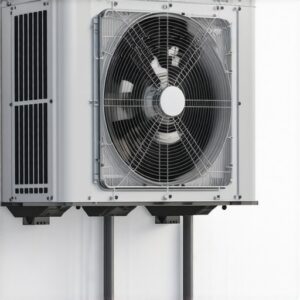
If you want to keep your garage workspace at a comfortable 65°F during a polar vortex without overworking the main furnace, you need to understand the physics of static pressure and thermal boundaries. The first thing most ‘sales techs’ won’t tell you is that your garage is essentially a giant thermal sink. If you haven’t performed HVAC duct sealing using actual Mastic—or ‘Pookie’ as we call it in the truck—you’re losing 30% of your heat before it even reaches the register. But even with perfect ducts, the main system isn’t the answer. You need a dedicated solution that doesn’t mess with the pressure balance of your home. This is where hyper-heat heat pumps come into play. These aren’t your grandpa’s heat pumps that stopped working at 40°F. Modern inverter-driven hyper-heat systems can pull sensible heat out of the air even when it’s -13°F outside. They use a specialized flash-injection circuit to maintain mass flow of the refrigerant when the ambient temps drop. It’s pure thermodynamics, not magic.
For those looking at a more permanent, high-efficiency build, geothermal heat pump systems are the gold standard, though they’re a heavy lift for a simple garage retrofit. More commonly, I recommend hydronic heating systems if you’re pouring a new slab. Running PEX tubing through the concrete and circulating hot water is the most efficient way to maintain a baseline temperature because water is 800 times denser than air. It holds onto those BTUs and radiates them upward, heating the objects in the room—including your tools and your feet—rather than just the air that’s going to leak out of the garage door seal anyway. If you’re stuck with an existing garage, you need to be looking at the R-454B refrigerant transition services coming in 2025. The industry is moving away from R-410A because of the GWP (Global Warming Potential) regulations. If you buy a cheap, leftover R-410A unit now, you might find the ‘juice’ is incredibly expensive to replace in ten years when you have a leak. Modern R-454B systems are ‘A2L’ or mildly flammable, meaning they require specific sensors and ventilation protocols that we didn’t have to worry about back in the day.
“Ventilation systems shall be designed to provide a minimum outdoor air ventilation rate.” – ASHRAE Standard 62.1
Let’s talk about refrigerant leak detection for a second. In a garage environment, where vibrations from power tools or garage doors are constant, flares and brazed joints on a mini-split can fail. If you smell something slightly sweet or oily, don’t ignore it. That’s your refrigerant escaping. Most people wait until the unit stops blowing warm air, but by then, the compressor has been running ‘hot’ and ‘thin’ for weeks, which can lead to an acidic burnout. You can avoid this by sticking to HVAC maintenance plans that actually include a subcooling and superheat check, not just a quick spray of the coils. A real tech will check the furnace filter replacement history too, because a clogged filter in a garage environment—full of sawdust and exhaust fumes—will kill the blower motor faster than you can say ‘static pressure.’ You can find more about why these small details matter in this guide on furnace repair myths.
The biggest mistake I see is the ‘short cycle.’ If you put a unit that is too large for the garage, it will ramp up, hit the set point in five minutes, and shut off. The air is warm, but the walls and floor are still ice cold. As soon as the unit stops, the air temperature plummets. This constant on-off cycle destroys contactors and puts immense stress on the compressor. You want long, slow run cycles. This is why variable-speed equipment is king for garage applications. It’s also why urgent heating repairs often happen in the first two weeks of November; people flip on a poorly sized heater, it cycles 50 times in a day, and the capacitor gives up the ghost. If you are serious about comfort, you need to seal the ‘envelope’ first. Use Pookie on every joint and ensure your garage door has a high-quality bottom seal. If you can see light under the door, you’re just trying to heat the whole neighborhood, and your wallet will feel it.