The Sound of a Dying Heart: Why Your Blower Motor is Screaming
You hear it in the dead of night when the house is finally quiet. It starts as a high-pitched whine, like a distressed jet engine, before settling into a rhythmic, metallic screech. To most homeowners, it is just a nuisance. To me, after thirty years in the trade, it is the sound of a $1000 blower motor replacement circling the drain because someone forgot that physics doesn’t take days off. I remember my old mentor, a grizzly guy named Old Man Miller, who used to stand over a basement furnace in the middle of a blizzard. He’d point his greasy finger at a choked return air drop and scream, ‘You can’t cool what you can’t touch, and you can’t heat what you can’t move!’ He was right. Airflow isn’t just a part of the system; it is the blood in the veins of your home. If your blower is struggling, your whole system is dying.
“The most expensive equipment in the world cannot overcome a bad duct system.” – Industry Axiom
1. HVAC Duct Sealing: The Battle Against Static Pressure
Most folks think a hole in a duct just means a little lost air. Wrong. It’s about static pressure. Imagine trying to breathe through a cocktail straw while running a marathon—that’s what your blower motor feels like when your ducts are leaking or restricted. HVAC duct sealing is the only way to ensure the static pressure stays within the manufacturer’s tolerances. When air escapes through unsealed joints, the motor has to ramp up its RPMs (if it’s a modern ECM motor) to meet the demand, which generates massive amounts of heat. In the HVAC trade, we use “Pookie”—a thick, gray mastic—to seal these gaps. It’s better than any tape ever made. Without proper sealing, you’re essentially asking your blower to fight a war it can’t win, eventually leading to a winding failure and a sour, ozone smell that indicates a total burnout. For more on keeping your system alive, check out these top HVAC repair strategies.
2. Combustion Analysis: Protecting the Heat Exchanger and the Motor
In a cold climate like ours, a furnace is a controlled explosion. If your fuel-to-air ratio is off, you get soot, you get carbon monoxide, and you get excessive heat. A professional combustion analysis ensures that the furnace is burning clean. Why does this matter for the blower? If the heat exchanger gets too hot because of an over-fired burner, the blower motor (which sits right in the path of that heat) absorbs that thermal energy. High ambient temperatures inside the cabinet will cook the bearings. When those bearings dry out, you get that screech. We’re talking about thermodynamic zooming here—the blower isn’t just moving air; it’s the primary cooling mechanism for the heat exchanger itself. If the airflow stops or slows, the heat exchanger cracks, and then we aren’t talking about a repair; we’re talking about a death warrant for the unit. See our guide on identifying urgent furnace repairs for more details.
3. Smart Thermostat Setup: Stop the Short Cycling
A smart thermostat setup is more than just a fancy screen on the wall. If it’s not configured correctly for your specific system—especially if you have a two-stage furnace installation—the system will ‘short cycle.’ This means the motor is constantly starting and stopping. The ‘inrush current’—the massive spike of electricity needed to start a motor from a dead stop—is where 90% of electrical wear happens. It’s like slamming your car from park to drive while the engine is revving. A properly tuned thermostat ensures longer run times and fewer starts, which preserves the life of the capacitor and the motor windings. If you’re dealing with a ductless mini-split installation, the logic is even more sensitive; these units rely on variable speeds to maintain comfort without the brutal start-stop cycles of old-school tech.
“Ventilation systems shall be designed to provide the required rate of outdoor air using energy-efficient equipment and controls.” – ASHRAE Standard 62.1
4. Wiring Repair for Heating Systems: Voltage is the Fuel
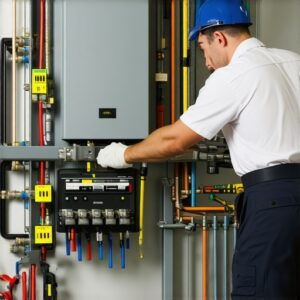
I can’t tell you how many motors I’ve seen replaced when the real culprit was a loose neutral or a corroded spade connector. Wiring repair for heating systems is a lost art. A loose connection creates resistance. Resistance creates heat. Heat drops the voltage. If a blower motor is designed to run on 120 volts and it’s only getting 105 because of a bad wire, the amperage will spike to compensate. High amps equals a dead motor. I always tell the ‘Sparky’ (the electrician) on the job that if the wire isn’t tight, the motor’s light is going out. You need a technician who actually pulls out a multi-meter and checks the ‘juice’ under load, not just someone who looks at it and says, ‘looks fine to me.’
5. The Swamp Cooler Winterization Trap
If you have a combo system, swamp cooler maintenance is the most overlooked winter move. If you don’t properly block off the roof transition, cold, damp air will migrate down into the furnace cabinet all winter. That moisture hits the cold steel of the blower housing and the motor, causing surface rust on the shaft. When you go to start that system up, that rust has locked the shaft to the bearing. You’ll hear a hum, then a ‘click’ as the thermal overload trips. By then, the damage is done. You’ve let the ‘Suction Line’ of winter dampness kill your summer blower. Keep that moisture out of the tin-work.
6. Two-Stage Furnace Logic and Motor Longevity
If you are looking at a new system, two-stage furnace installation is a game-changer—oops, I mean a significant mechanical advantage. By running at a lower speed for 80% of the time, the motor doesn’t experience the high-stress torque of a single-stage blast. It’s the difference between a marathon runner and a sprinter. The sprinter burns out; the marathoner lasts for decades. This lower speed also allows for better latent heat removal and more consistent temperatures, preventing the ‘cold blow’ feeling where the air feels chilly even when the heat is on. Learn more about choosing the right setup in our HVAC fix guide.
7. Infrared Heater Installation and Spa Heater Services: The Auxiliary Load
Finally, stop overworking your central blower by using it to heat areas it wasn’t designed for. If you’re trying to heat a garage or a shop with your home furnace, you’re killing the blower. An infrared heater installation for those fringe spaces, or proper spa heater services for your outdoor tub, ensures that your main furnace isn’t running 24/7. When a system is oversized or overworked, the blower never gets to cool down. Even a motor needs a break. If you’ve been pushing your system too hard, you might already need a blueprint for efficient repairs. If the screeching has already started, don’t wait for the smoke. Contact us before a $200 maintenance call becomes a $2,000 emergency midnight replacement.