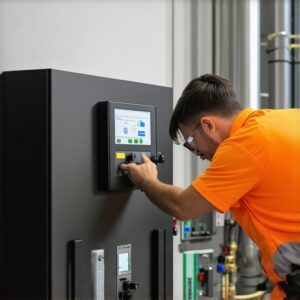

The Sound of a Frozen High-Rise: A Forensic Diagnosis of Commercial Comfort
The silence of a dead boiler in the middle of a February cold snap isn’t just quiet; it is expensive. I remember my old mentor, a grizzly veteran who smelled of pipe dope and burnt oil, screaming at me in a mechanical room in downtown Chicago. ‘Kid,’ he yelled over the hiss of a failing steam trap, ‘you can’t move heat if the air—or the steam—won’t touch the surfaces!’ He was talking about heat transfer physics. If your boiler tubes are scaled or your air handler is choked with dirt, all the horsepower in the world is just noise. In the world of commercial management, specifically for hotels where guest complaints translate directly to lost revenue and bad reviews, understanding the guts of your mechanical room is the difference between a profitable quarter and a $50,000 emergency replacement. We are going to look at the anatomy of these systems, from the grit of a steam boiler repair to the precision of refrigerant leak detection.
The Mechanical Anatomy: Steam, Steel, and Static Pressure
When I walk into a mechanical room, I don’t just see machines; I see a living organism. The boiler is the heart, the pipes are the arteries, and the air handlers are the lungs. If you are dealing with an aging property, you likely have a steam system. Steam is a beast. It relies on the latent heat of vaporization—the massive amount of energy released when steam turns back into water inside a radiator. But that process is violent. It creates ‘water hammer,’ that banging sound that wakes up guests in 4B. A proper steam boiler repair often starts with the steam traps. If a trap fails open, you are blowing live steam (and money) back to the condensate tank. If it fails closed, the radiator fills with water and the room freezes. I have seen managers spend thousands on new thermostats when all they needed was a $100 trap replacement.
“The inspection and testing of safety valves and pressure relief valves shall be conducted by personnel who are familiar with the operation of the boiler and the valves.” – ASHRAE Standard 180
Then there is the air handler repair. This is where the ‘Tin Knockers’ and the service techs meet. In a hotel, the air handler is usually buried in a tight closet or a ceiling plenum. If the bearings in that blower motor start to screech like a banshee, you have days, not weeks, before it seizes. And don’t get me started on HEPA filter systems. While everyone wants ‘hospital-grade’ air, most blowers weren’t designed for the static pressure of a HEPA filter. It is like trying to breathe through a straw while running a marathon. You need a tech who understands the fan curve, or you will burn out the motor in six months.
The Math: Repairing the Relic vs. Pulling the Plug
Commercial managers always ask: ‘Can we squeeze one more year out of it?’ Here is the forensic math. If you are still running on an old #2 oil system, you are lighting cash on fire. An oil to gas conversion is essentially bypass surgery for your building’s budget. Natural gas is cleaner, cheaper, and doesn’t require a massive tank that can leak and trigger an EPA nightmare. Plus, modern gas burners can modulate, meaning they don’t just blast at 100% and then shut off; they dial it back to match the actual load of the building. This prevents ‘short cycling,’ the primary killer of thermocouple replacement cycles and heat exchangers.
Speaking of heat exchangers, if you are in a cold climate like the Northeast or Chicago, the polar vortex is your enemy. I have seen radiant floor heating installation projects in hotel lobbies save a fortune because they keep the ‘sensible heat’ at floor level where the guests are, rather than letting it all rise to the twenty-foot ceiling. It is physics, not magic. But when those systems fail, you need predictive maintenance alerts to tell you there’s a pressure drop before the floor starts cracking. For those looking to optimize their current setup, checking out top hvac repair strategies to extend your systems life is a good start. For more urgent issues, understanding how to identify when furnace repair is urgent and why can save a manager’s reputation.
The ‘Sales Tech’ Trap and The Preventive Shield
I despise ‘Sales Techs’—those guys who show up with a shiny clipboard and a mission to sell you a new rooftop unit before they even open the service panel. They will tell you that you need a whole new system because of a tiny leak. That is why refrigerant leak detection is an art form. We use electronic ‘sniffers’ and ultraviolet dyes to find the actual hole. Most of the time, it is a $2 schrader valve or a vibration rub on a suction line that just needs a bit of silver solder. Don’t let them ‘top off the gas’ every year. It is a sealed system. If it is low, there is a leak. Period.
“No person may sell or distribute any class I or class II substance for use as a refrigerant to any person unless such person is certified as a Type II technician.” – EPA Section 608
To avoid these emergency calls, smart managers invest in preventative maintenance contracts and priority service memberships. This isn’t just a ‘filter change.’ A real tech is checking the combustion analysis on the boiler, testing the amp draw on the motors, and ensuring the thermocouple replacement parts are in the van before they fail. We use ‘Pookie’ (mastic) to seal duct leaks that are bleeding conditioned air into the chase, and we make sure the ‘Sparky’ (electrician) hasn’t left any loose lugs in the disconnect box that could cause a single-phase condition and fry the compressor. If you’re planning for the upcoming season, reading about heating service hacks for comfort and savings in 2025 is a vital step.
Conclusion: Comfort is a Controlled Burn
In the end, a hotel is only as good as its last guest’s night of sleep. If the room was a ‘cold swamp’ because the oversized AC didn’t dehumidify, or if it was a dry oven because the steam boiler was hammering, you’ve lost. Maintenance is the act of staying ahead of the entropy. Whether you are looking at preventative hvac repair tips for year-round efficiency or you need to contact us for a major oil to gas conversion, remember: the most expensive equipment in the world cannot overcome a bad maintenance plan. Stay out of the ‘Sales Tech’ trap, keep your coils washed, and respect the physics of airflow. Your bottom line will thank you.