The Death Squeal: A Forensic Diagnosis of the Evaporative Motor
If you’ve spent thirty years on sun-baked rooftops in the Southwest, you know the sound. It is a high-pitched, rhythmic screech that cuts through the hum of the desert wind. Most homeowners or warehouse managers ignore it, thinking it’s just the ‘nature of the beast’ during a heatwave. But to a seasoned tech, that sound is the mechanical equivalent of a coronary. I’ve seen more perfectly good motors cooked to a crisp because of a $15 belt than I have from actual age or electrical surges. When you are dealing with evaporative cooling in 110°F ambient heat, your belt tension isn’t just a maintenance checklist item; it is the physical leash that controls the life of your equipment. My old mentor used to scream, ‘You can’t cool what you can’t touch!’ This is why airflow matters more than horsepower. He was right. If that belt is slipping, you aren’t moving air. If it’s too tight, you are grinding the motor bearings into a fine metallic dust. We’re going to look at why this happens and how to stop the cycle of unnecessary efficient HVAC repairs before you’re stuck with a dead motor in July.
The Mechanical Anatomy: Side-Loading and Bearing Failure
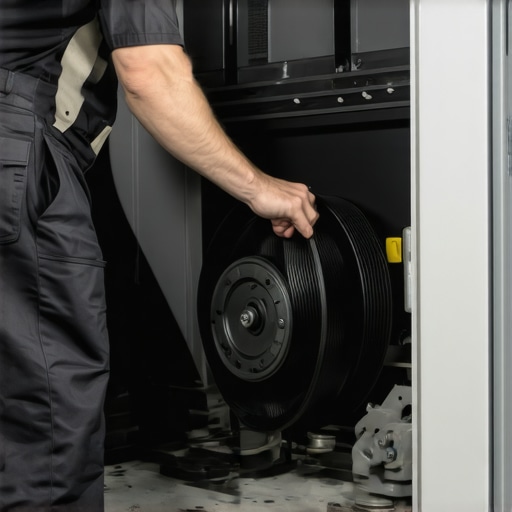
Think of your swamp cooler motor like a human heart. It’s designed to pump, but only within specific parameters. When a ‘Sales Tech’ or a DIY-er cranks down on the motor adjustment bolt to stop a belt from slipping, they are creating a massive amount of ‘side-load’ force. Most fractional horsepower motors used in evaporative coolers are designed with sleeve bearings or light-duty ball bearings. They are built to handle the torque of spinning the blower, not the lateral pressure of a guitar-string-tight belt pulling the shaft toward the blower housing. This pressure creates friction, and friction creates heat. In the Southwest, where the temperature on the roof is already 130°F, that extra internal friction is the final straw. It causes the lubricant to break down, the bearing races to gall, and eventually, the motor seized up. I’ve seen top HVAC repair strategies ignored in favor of ‘just making it tighter,’ and it always ends in a service call for a motor replacement.
“The most expensive equipment in the world cannot overcome a bad duct system or improper mechanical setup.” – Industry Axiom
Thermodynamic Zooming: Sensible Heat vs. Airflow Velocity
Let’s talk physics for a second. A swamp cooler works by converting sensible heat (the temperature you feel) into latent heat through the evaporation of water. For this to work, you need a precise volume of air (CFM) passing through the saturated pads at a specific velocity. If your belt is too loose, the blower wheel doesn’t reach its intended RPM. The air moves too slowly, the pads become oversaturated, and you get high humidity inside without the temperature drop. If the belt is too tight and the motor starts to overheat, it actually adds heat to the airstream before it even hits your vents. It’s a lose-lose situation. This is why preventative HVAC repair tips always emphasize the ‘half-inch rule’—you should be able to deflect the belt about a half-inch with moderate finger pressure. Anything less, and you’re killing the bearings; anything more, and you’re losing cooling capacity.
The Monsoon Effect and Electrical Fallout
When the Monsoon season hits in Arizona or Nevada, the humidity spikes. This is the ‘Monsoon Effect’ that kills swamp coolers. Because the air is already saturated, the water on the pads can’t evaporate as efficiently. People often respond by trying to ‘overclock’ their systems, tightening belts to force more air. But here’s what happens: a tight belt increases the amperage draw of the motor. I’ve pulled out my clamp meter and seen motors rated for 5.0 amps pulling 7.5 amps just because the belt was too tight. This extra current doesn’t just heat the motor; it cooks the wires and can pit the points on your contactor. If you don’t catch it, you’ll be looking at a contactor repair or even a full electrical failure. If your system is struggling, it might not be the belt at all; you might need professional HVAC load calculation services to see if the cooler is actually sized for the space, especially if you’ve added square footage or new windows.
Seasonal Transitions: From Evaporation to Warehouse Heating
In many commercial settings, we manage these coolers as part of larger preventative maintenance contracts. We don’t just look at the belts in the summer. As we transition into the cooler months, those same motors and blower assemblies need to be checked for the winter. In large facilities, we often pivot from cooling to warehouse heating solutions. Whether it’s electric heater services or preparing for a gas furnace repair on a roof-mounted unit, the mechanical integrity of the blower is constant. A motor damaged by a tight belt in August will fail you when you need it for heat in December. We often perform commercial furnace repair on units where the blower motor was the primary failure point, simply because it was abused during the cooling season. Keeping a log of amp draws and belt replacements is the only way to stay ahead of the curve.
“Equipment shall be installed in accordance with the manufacturer’s instructions and the requirements of this code.” – ASHRAE Standard 15
The Math: Repair ($300) vs. Replace ($1,200+)
Let’s look at the numbers. A high-quality V-belt costs about fifteen to twenty bucks. A professional adjustment takes thirty minutes. Compare that to the cost of a new 1-HP high-efficiency motor, the labor to swap it, and the potential downtime for your business. It’s not just the motor, either. A tight belt wears out the blower bearings and the pulleys (sheaves). If the pulley becomes ‘cupped’ from belt slippage, a new belt won’t help; it will just slip and squeal until it snaps. This is why we advocate for choosing the right HVAC fixes early. If you see black rubber dust inside your cooler cabinet, your alignment is off or your tension is wrong. Don’t wait for the motor to smoke. And if you are upgrading, remember that we offer rebate application assistance for high-efficiency motor swaps that can offset the cost of a full system overhaul. We can also look at air purification integration during these tune-ups to ensure the air being pulled into the building is as clean as it is cool.
Closing the Loop: Comfort is Physics, Not Magic
At the end of the day, an HVAC system—whether it’s a simple swamp cooler or a complex DX unit—is just a series of thermodynamic exchanges. You cannot cheat the physics of friction. If you’re hearing that screech or noticing a drop in cooling, don’t just send a ‘Sparky’ or a ‘Tin Knocker’ up there to tighten things down. You need a tech who understands the relationship between belt tension, amp draw, and airflow. Whether you need gas furnace repair in the winter or a dehumidification services check during a humid snap, the fundamentals remain the same. Check your belts, watch your alignment, and stop treating your motor like a pack mule. For more insights on keeping your system running through 2025, check out our heating service innovations and heating service hacks. Proper maintenance isn’t just a chore; it’s the only way to keep the ‘Juice’ flowing and the ‘Gas’ burning efficiently all year long.