The silence is what hits you first. It is a sub-zero Tuesday in February, and instead of the rhythmic click-clack of pellets dropping into the burn pot, there is only the frantic whirring of a fan or, worse, the ominous hum of a stalled motor. As an HVAC tech who has spent three decades dragging tools through snowdrifts to reach biomass boiler services and frozen vent pipes, I can tell you that a pellet stove jam is not just a nuisance; it is a mechanical failure rooted in the stubborn laws of physics. My old mentor, a man who could diagnose a modulating furnace repair just by the smell of the exhaust, used to scream at me, ‘You can’t burn what you can’t move! Friction is the thief of heat!’ This is why airflow and mechanical movement matter more than the fancy digital display on your control board. When your stove stops feeding, it is usually because the auger—the long screw that delivers the ‘juice’ to the fire—has met an immovable object or has been choked by the very fuel it’s designed to carry.
“Carbon monoxide is a silent byproduct of incomplete combustion in solid fuel appliances, often exacerbated by restricted fuel delivery and poor ventilation.” – EPA Burn Wise Regulation
In the North and Northeast, where the polar vortex turns your backyard into a tundra, pellet stoves are the workhorses. But when they fail, the danger of carbon monoxide detector installation becomes glaringly obvious. If your stove is smoldering because the feed rate is inconsistent, you aren’t just losing heat; you are risking the integrity of your home’s air. Before you call for HVAC repair, you need to understand the ‘Forensic Anatomy’ of the jam. Most ‘Sales Techs’ will try to sell you a whole new heat pump replacement the moment they see a rusted auger, but a real tech knows how to look at the torque. A pellet stove works on a simple principle: a motor turns a shaft, and that shaft pushes pellets. If the pellets have high moisture content, they expand. When they expand, they create a ‘clinker’ or a sawdust bridge that has the structural integrity of concrete. This is where the biomass boiler services expertise comes in—you have to clear the bypass and check the shear pins.
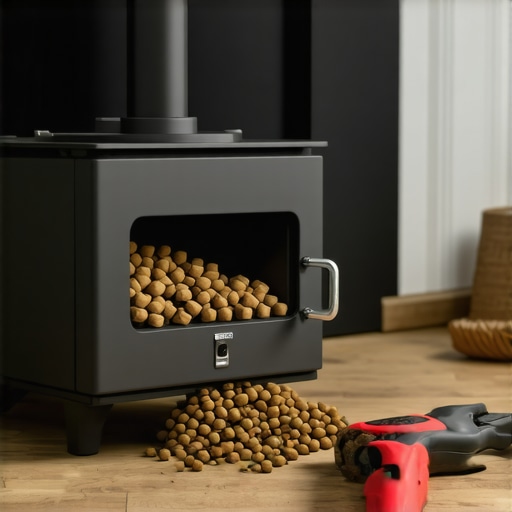
If you find yourself in a situation where the hopper is full but the pot is empty, your first step is a power-down. Do not just flick the switch; pull the plug. A ‘Sparky’ will tell you that the residual capacitor charge can still give you a nasty bite if the auger motor is shorted. Once the power is killed, you need to empty the hopper. This is a messy, dusty job that makes you wish you had one of those HEPA filter systems running in the room. Look at the bottom of the auger tube. Are the pellets crumbly? If they are turning into dust, you have a ‘fines’ problem. Sawdust accumulates in the bottom of the auger, increasing the friction until the motor reaches its limit and the thermal overload kicks in. This is why preventative HVAC repair tips for year-round efficiency always include vacuuming out your hopper every ten bags of fuel. If you ignore the ‘fines,’ you are essentially asking your motor to grind flour instead of move wood.
“The reliability of any solid-fuel heating system is directly proportional to the consistency of the fuel’s physical dimensions and moisture content.” – ASHRAE Standard 155P
Sometimes the jam isn’t the fuel; it’s the motor itself. In church heating systems or hotel boiler services where we see large-scale biomass units, the motors are heavy-duty, but residential stoves often use shaded-pole motors that have the torque of a kitchen mixer. If you’ve cleared the pellets and the auger still won’t turn, you might be looking at a dead capacitor or a stripped gear. This is the moment where you weigh the cost. If your stove is over fifteen years old, you might be better off looking into a heat pump installation as a secondary source, especially with the high efficiency of modern cold-climate units. However, if the stove is your primary heat, a motor replacement is a fraction of the cost of a full system. You can find more on this in our guide on choosing the right HVAC fixes.
For those in the humid regions of the South, pellet stoves are rare, but the logic of HVAC repair remains the same: move the energy efficiently. But here in the cold zones, we deal with ‘creosote’ and ‘ash-melt.’ If your stove stops feeding, also check the vacuum switch. Pellet stoves are designed with a safety circuit; if the venting is clogged with ash or a bird’s nest, the vacuum switch won’t close, and the ‘Sparky’ inside the control board will cut the power to the auger motor. It’s a fail-safe to prevent your house from filling with smoke. This is why carbon monoxide detector installation is non-negotiable. If you’re struggling with consistent heat, it might be time to look into heating service hacks for comfort and savings. Cleaning the vent pipe with a brush and ‘Pookie’ (mastic) on the joints ensures that the vacuum pressure stays within the required inches of water column to keep that auger spinning. Don’t let a simple jam turn into a freezing night. Clear the fines, check the vacuum, and respect the physics of the burn.