The Sound of a $5,000 Mistake
Most homeowners think the worst sound an air conditioner can make is a screeching bearing or the death rattle of a failing compressor. They’re wrong. The most expensive sound in HVAC is the quiet, rhythmic drip… drip… drip… hitting the drywall of your bedroom ceiling at 3 AM. By the time you see a yellow stain on the plaster, the damage isn’t just starting—it’s already won. I’ve spent thirty years crawling through attics that felt like the surface of the sun, and if there is one thing I’ve learned, it’s that water is more patient than any machine ever built. If you don’t have a leak detector integrated into your system, you’re essentially playing Russian roulette with your home’s structural integrity.
My old mentor, Pete—a guy who could smell a gas leak from a mile away and had more pookie on his boots than most people have on their ducts—used to scream at me, ‘You can’t cool what you can’t touch!’ This was his way of drilling the physics of airflow into my skull. He meant that if the air isn’t moving across that evaporator coil correctly, the thermodynamics fail. But he also meant that when you do touch that air, you’re pulling gallons of water out of the sky. In a Northern climate where we swing from bone-dry winters to humid summers, that water disposal is everything. If the drainage fails, that water doesn’t just disappear; it finds a path through your ceiling joists.
“The most expensive equipment in the world cannot overcome a bad duct system.” – Industry Axiom
The Mechanical Anatomy: Why Your AC is a Water Factory
To understand why a leak detector is non-negotiable, you have to understand the forensic anatomy of your cooling system. Your AC doesn’t just ‘make cold’; it removes heat and moisture. As the suction line brings the juice back to the evaporator coil, the coil’s temperature drops below the dew point. Moisture in your home’s air condenses on the fins—just like sweat on a beer can—and drips into a primary drain pan. This is where the trouble starts. In many modern AC installation setups, especially with high-efficiency hyper-heat heat pumps, the volume of condensate can be staggering.
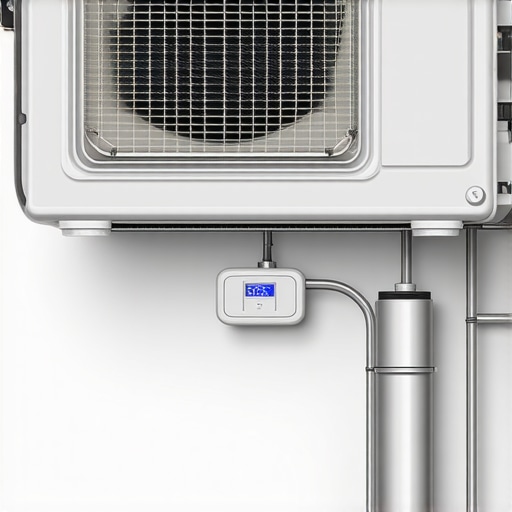
If your primary drain line clogs because of ‘white slime’ (a nasty bacterial growth) or a stray piece of tin knocker debris, the water has nowhere to go but over the edge of the pan. This is why we install a secondary emergency pan and, more importantly, a float switch or leak detector. This device is a simple, beautiful piece of physics. When water rises, the float breaks the low-voltage circuit to your condenser. The system stops. You get hot, yes, but your ceiling stays dry. Without it, you’re looking at a full-blown remediation project. I’ve seen manual J calculations that were perfect, but the installer skipped the $50 safety switch, leading to a $10,000 insurance claim. Don’t be that guy.
The North/Cold Reality: Why Humidifiers and HEPA Systems Complicate Drainage
In our region, we deal with the ‘Polar Vortex’ one month and 90% humidity the next. This means many homes have complex setups including whole-home humidifiers and HEPA filter systems. These aren’t just ‘add-ons’; they change the static pressure of your system. If you have a bypass humidifier repair that wasn’t done right, or if your HEPA filter is loaded with dust, the blower motor has to work harder. This increases the velocity of the air across the coil, which can actually ‘blow’ the condensate right off the fins and past the drain pan entirely. This is why top HVAC repair strategies always include checking the static pressure and the integrity of the drainage path.
Furthermore, if you’re running a ductless mini-split installation in a basement or a finished attic, the drainage is even more critical. Those units often rely on tiny condensate pumps that are prone to failure. Integrating a leak detector here isn’t just an option; it’s the only thing standing between you and a moldy wall. A smart thermostat setup can sometimes even be wired to alert you on your phone when the float switch has tripped, giving you a head start before the house becomes an oven.
“Proper condensate disposal is not merely a convenience, but a fundamental requirement for building structural integrity.” – ASHRAE Standard 62.1
The Physics of Failure: When Repairs Can’t Wait
I recently followed a ‘Sales Tech’—one of those guys who spends more time whitening his teeth than cleaning coils—who told a homeowner they needed a brand-new $12,000 furnace because their secondary pan had water in it. He didn’t even look at the drain line. When I got there, I found a simple blockage and a cracked P-trap. The system performance testing showed the unit was actually in great shape, it just needed a dryer vent cleaning nearby to stop lint from entering the intake and a $200 repair to the drainage system. This is the difference between a technician and a salesman. Efficient HVAC repairs are about solving the root cause, not just swapping boxes for commission.
For those in the commercial space, such as restaurant kitchen exhaust repair, the stakes are even higher. Grease and high-volume moisture can clog sensors in days. In a residential setting, it’s usually more gradual, but the result is the same. Whether it’s a bypass humidifier repair or a furnace repair issue that’s gone sideways, the drainage must be clear. If you haven’t had your system checked recently, you are likely running on luck. Luck is not a maintenance plan.
Conclusion: Protect Your Investment
At the end of the day, your HVAC system is the most complex machine you own. It’s a chemistry lab, an electrical grid, and a plumbing system all wrapped into one. Don’t let a simple drainage issue ruin your home. Make sure your next service call includes a rigorous check of your leak detectors and float switches. If you’re planning a new ductless mini-split installation or upgrading your current system, insist on integrated leak protection. It’s the cheapest insurance policy you’ll ever buy. If you’re unsure about the state of your system, check out our preventative HVAC repair tips or contact us to get a real technician—not a salesman—out to your property.