The Anatomy of a Ceiling Disaster
I’ve spent thirty years crawling through the tightest crawlspaces and balancing on rusted-out commercial rooftop units, and if there is one thing I’ve learned, it’s that water is a more patient enemy than heat. I remember walking into a high-end hotel lobby last August. The smell hit me first—that unmistakable, sour, musty stanch of wet drywall and stagnant condensate. A ‘Sales Tech’ from a big-box franchise had just left, leaving the manager a quote for $15,000 to replace the entire rooftop unit. He claimed the ‘internal seals’ were blown. It was total nonsense. I traced the leak and found a simple $40 condensate pump had died, but because there was no smart detector, the unit kept sweating, the pan overflowed, and it dumped fifty gallons of water into the ballroom ceiling. That’s the difference between a technician and a salesman. A real tech knows that smart leak detectors aren’t just gadgets; they are the last line of defense for your property.
The Physics of the Sweat: Why AC Pipes ‘Burst’
Most folks think an ‘AC pipe burst’ is like a frozen water pipe in the winter. It’s not. In our industry, especially when we are dealing with high-capacity hotel boiler services or school boiler maintenance, the issue is often about latent heat and dew points. When your evaporator coil—the part of the system that actually gets ‘beer can cold’—drops below the local dew point, it pulls moisture out of the air. This is the core of preventative hvac repair tips for year-round efficiency. If that water has nowhere to go because a Tin Knocker didn’t slope the drain lines right or the Pookie (mastic) is blocking the primary port, you get a flood. Thermodynamic zooming tells us that on a 95°F day with 70% humidity, a 5-ton unit can pull gallons of water out of the air every hour. Without a smart detector to kill the 24V signal to the contactor, that water is coming into your living room.
“The most expensive equipment in the world cannot overcome a bad duct system or a failed drainage strategy.” – Industry Axiom
The R-454B Transition and the New Stake in Leak Detection
We are currently facing the R-454B refrigerant transition services era. As we move away from R-410A, the industry is shifting to ‘mildly flammable’ (A2L) refrigerants. This isn’t just about the juice in the lines anymore; it’s about safety. These new systems require sophisticated sensors. If you are looking at ultimate guide to ac installation expert tips for 2025 success, you’ll see that leak detection is now integrated into the system’s brain. A smart leak detector doesn’t just sense water; it senses pressure drops and refrigerant escapes. If your system loses its charge, the compressor will overheat, the oil will turn acidic (you’ll smell that bitter, burnt-almond scent), and you’ll be looking at a contactor repair or, worse, a full compressor swap.
The Forensic Diagnosis: Why Smart Detectors Overrule the Float Switch
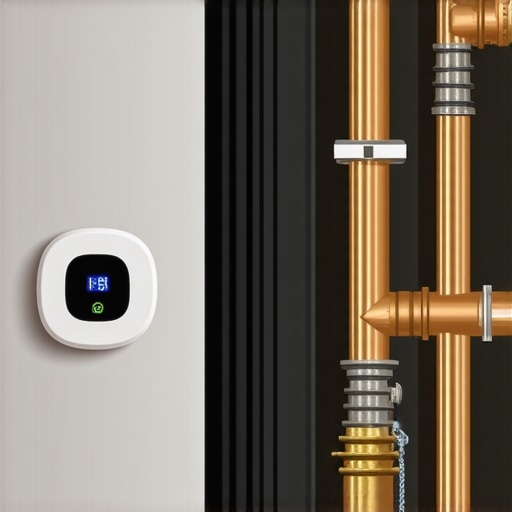
Old-school float switches are mechanical. They get stuck. Spiders build nests in them. A smart leak detector uses conductivity or ultrasonic sensors and links directly to your remote thermostat access. Imagine you are on vacation and your drain line clogs. A standard switch just shuts the unit off. You come home to a 90-degree house. A smart system sends a push notification to your phone, telling you exactly why it shut down. This is critical for zoning system installation where you might have multiple coils hidden in various attics. You need to know which one is crying for help before the ceiling gives way.
Airflow, Static Pressure, and the Silent Killer
Many ‘leaks’ aren’t leaks at all—they are the result of poor duct design services. If your Tin Knocker undersized the return air, the evaporator coil doesn’t get enough heat load. It gets too cold, the moisture freezes into a block of ice, and when it finally thaws, it bypasses the drain pan entirely. We call this ‘blow-off.’ This is why we preach that airflow is king. You can’t just slap a bigger unit on a small duct and expect it to work. That’s how you end up needing top hvac repair strategies to extend your systems life. Proper dehumidification services ensure the moisture is managed, not just created.
“Refrigerant circuits must be maintained as sealed systems; any loss of charge is a failure of mechanical integrity, not a routine maintenance item.” – EPA Section 608 Standard
The 2025 Reality: Rebates and Safety
If you’re worried about the cost of upgrading to these smarter systems, look into rebate application assistance. Many local utilities are practically giving away money to homeowners who install high-efficiency systems with smart controls because they prevent massive grid spikes caused by failing, ‘slugging’ compressors. And while you’re at it, don’t forget the winter side of the coin. If you’re running a boiler or a furnace, portable heater safety checks are a stop-gap, but they don’t replace a properly maintained central system. Whether it’s a Sparky wiring up your new smart hub or a tech checking your heat exchanger for cracks, the goal is always the same: keep the fluids where they belong.
Don’t be the person who ignores a $200 sensor and ends up with a $20,000 restoration bill. If you’re unsure if your current setup can handle a smart upgrade, contact us for a real forensic look at your system. We don’t sell boxes; we fix physics problems.