The Silence of the North: A Forensic Diagnosis of Your Dying Furnace
There is a specific kind of silence that only hits a house in the dead of a Chicago-style winter. It’s not just quiet; it’s the absence of that low-frequency hum from the inducer motor and the soft thrum of the blower. When that sound stops, your home starts losing its battle against the second law of thermodynamics. Heat moves from hot to cold, and without your furnace acting as the barrier, your living room is just an extension of the frozen sidewalk. My old mentor, a man who had more soot in his lungs than blood in his veins, used to scream at me, ‘You can’t burn what you can’t control!’ He wasn’t just talking about the fire; he was talking about the safety circuits. This is why airflow and proper sensing matter more than the raw horsepower of your burner. If your system can’t prove it’s safe, it won’t fire. Period.
The thermocouple is the unsung hero of the older gas furnace or boiler. It is a simple device—a copper lead with a bulbous end that sits in the pilot flame. But its physics are elegant. It uses the Seebeck effect: two dissimilar metals joined at one end produce a small DC voltage when heated. We’re talking millivolts—tiny, microscopic amounts of electricity that tell the gas valve, ‘Hey, the pilot is lit, it’s safe to open the main burners.’ When that little copper rod fails, your furnace is dead in the water. Most ‘Sales Techs’ will look at a dead pilot and immediately start talking about a $15,000 replacement or a complex air handler repair, but often, the culprit is a $20 part and a bit of carbon buildup. Before you call for boiler repair services, you need to understand the mechanical anatomy of what’s actually happening inside that cabinet.
“The most expensive equipment in the world cannot overcome a bad duct system.” – Industry Axiom
The Anatomy of Failure: Why Thermocouples Quit
In the cold North, we deal with cracked heat exchangers and flame rollout. When a heat exchanger develops a hairline fracture, the blower motor pushes air through that crack, disrupting the burner flame. This is where the physics of ‘flame rectification’ or thermocouple sensing comes into play. If the flame is dancing away from the sensor because of a draft, the sensor cools down, the millivolts drop, and the system shuts down to prevent you from being featured on the 11 o’clock news for a carbon monoxide leak. It’s a safety dance that keeps you alive. If you are smelling something sour or acidic, that’s not just ‘old furnace smell’—that’s a failing component or a refrigerant leak detection issue if you have a hybrid system. You can learn more about these warning signs in our guide on how to identify when furnace repair is urgent.
Testing a thermocouple requires a multimeter and a bit of patience. First, you have to ensure the pilot flame is actually hitting the top 1/3 of the element. If the pilot is weak and yellow, it won’t get the metal hot enough to generate the ‘juice’ needed to hold the valve open. This is where a Tin Knocker might tell you the ductwork is starving the unit of air, or a Sparky might point to a failing transformer replacement needs, but we’re looking at the flame first. A healthy pilot should be crisp and blue. If it’s lazy, your thermocouple is just doing its job by shutting things down. Many furnace repair myths suggest you can just ‘bend it into the flame,’ but that’s a temporary fix for a deeper problem, likely involving duct cleaning services or a clogged pilot orifice.
The Forensic Multimeter Test: Step-by-Step
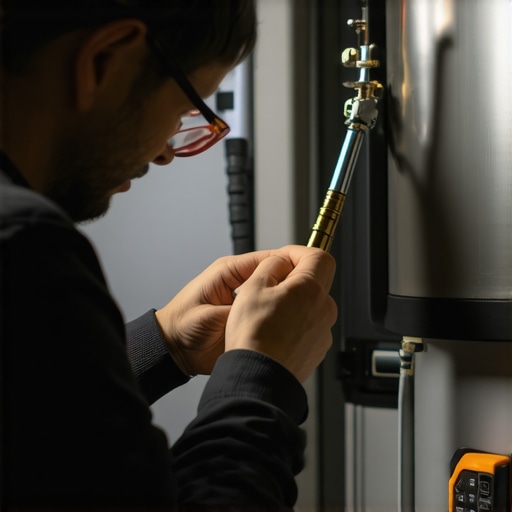
To truly test the thermocouple, you need to perform a ‘closed circuit’ and ‘open circuit’ millivolt test. Step 1: Set your multimeter to DC Millivolts. Step 2: With the pilot lit and the thermocouple connected to the valve, place one probe on the copper lead and the other on the valve body. You should see between 12 and 15 millivolts. If it’s lower than 10, the valve will likely drop out. Step 3: The ‘Open Circuit’ test. Unscrew the thermocouple from the gas valve. Light the pilot while holding the thermocouple in the flame with a pair of pliers (don’t burn yourself, use your head). Measure from the tip of the connector to the copper jacket. A healthy one will put out 25 to 30 millivolts. If you’re getting less than 20, it’s toast. Replace it. This is a far cry from the massive expense of a full radiator replacement or a propane conversion services overhaul.
“Gas-fired central furnaces shall be equipped with a listed device that will shut off the main gas supply in the event of pilot failure.” – NFPA 54 / ANSI Z223.1 National Fuel Gas Code
If the thermocouple passes but the furnace still won’t stay lit, you’re looking at a bad gas valve solenoid or a transformer replacement issue. The transformer is the heart of the control circuit, stepping down 120V to 24V. If the transformer is weak, it can’t provide the ‘oomph’ to keep the safety relays closed. This is often misdiagnosed as a bad board. Don’t be the homeowner who pays for a new control board when a $50 transformer was the culprit. For more technical insights, check out efficient HVAC repairs to see how these small parts affect the whole system’s longevity.
The Regulatory Cliff: Why Repair Matters Now
As we move into 2025, the industry is hitting a wall with R-410A phase-outs and the shift to A2L refrigerants. While this mostly affects AC units, the HVAC load calculation services we perform now are more critical than ever. An oversized furnace in a cold climate will ‘short cycle,’ heating up the heat exchanger too fast and then cooling it down rapidly. This thermal expansion and contraction is what kills the metal. It’s like bending a paperclip back and forth until it snaps. You want long, steady run times. This is why energy recovery ventilators (ERVs) are becoming standard in the North; they allow for fresh air without losing the sensible heat you’ve paid dearly for. If you’re considering a new system, look into heating service innovations to see how the tech is changing.
Ultimately, a furnace is a box that manages a controlled explosion. Whether you are dealing with a warranty service plans claim or just trying to get through a Saturday night without the pipes freezing, understanding the physics of your thermocouple is your first line of defense. Don’t let a ‘Sales Tech’ talk you into a whole new unit because of a simple sensor failure. Use the multimeter, check the millivolts, and keep your ‘juice’ flowing. If the repair gets beyond your comfort level, especially with propane conversion services or complex boiler repair services, that is when you call a professional who values airflow over a sales commission. You can find more heating service hacks on our site to keep your home running efficiently without breaking the bank.