The Death Rattle of a Pool System: Why Your Heater is a Silent Killer
I’ve spent thirty years crawling into the damp, dark corners of mechanical rooms and balancing on scorching rooftops where the ambient temp hits 110 before noon. If there is one thing I have learned, it is that water and fire are a volatile marriage, and the pool heater is the most temperamental child in the house. Most homeowners treat their pool equipment like a ‘set it and forget it’ appliance, but as an HVAC veteran, I know better. When a heat exchanger starts to fail, it doesn’t just stop heating; it starts a chain reaction of thermodynamic destruction that will eventually melt your pump seals and leave you with a multi-thousand-dollar repair bill. You see, airflow might be king in the world of wall furnace installation or modulating furnace repair, but in the pool world, flow rate and chemistry are the twin gods of survival.
The Physics Lesson: Why Heat Transfer is a Dangerous Game
My old mentor, a grizzled tin knocker who could smell a gas leak from a block away, used to scream at me, ‘You can’t heat what you can’t contain!’ He was talking about flue pipe installation, but the lesson applies perfectly to the copper or cupro-nickel coils inside your pool heater. When we talk about pool heaters, we are talking about a massive amount of BTU transfer occurring in a very small space. The heat exchanger is a series of tubes that the pool water flows through while a flame manifold blasts them with sensible heat. If your water chemistry is off, or if the unit is reaching the end of its lifespan, those tubes thin out. This is where the ‘Forensic Diagnosis’ begins. If you aren’t on a strict HVAC maintenance plan, you are basically playing Russian roulette with your equipment pad.
“The most expensive equipment in the world cannot overcome a bad duct system.” – Industry Axiom
In the North where I’ve spent my winters, the climate is a brutal enemy. We deal with boiler repair services and furnace filter replacement constantly because the expansion and contraction of metals in freezing temps is a relentless force. Your pool heater’s heat exchanger is no different. Even a tiny pinhole leak in that coil will start to introduce air into the suction line. This causes cavitation—the formation of vapor bubbles in the water that implode with enough force to pit the impeller of your pump. You’ll hear it before you see it: a sound like pebbles being shaken in a tin can. That’s not pebbles; that’s the sound of your pump being eaten from the inside out by a leaky heater.
The Forensic Diagnosis: Spotting the ‘Green Ghost’ and the Acidic Drip
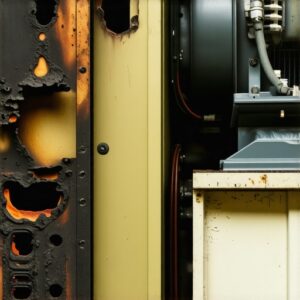
To spot a leak before it destroys the pump, you have to look for the ‘Green Ghost.’ This is the tell-tale turquoise oxidation that occurs when chlorinated water meets copper in a high-heat environment. Open the side panel of your heater—if you see green crust on the floor of the burner tray, your heat exchanger is weeping. This isn’t a ‘top off the gas’ situation; it’s a structural failure. In the same way we perform urgent furnace repairs for cracked heat exchangers to prevent carbon monoxide, a leaking pool heater exchanger can lead to improper combustion and soot buildup, which further insulates the tubes and makes the unit work twice as hard.
Check the flue pipe installation area. If you see moisture or staining around the vent, you’ve got a problem. I’ve seen restaurant kitchen exhaust repair jobs where the grease was a fire hazard, but in a pool heater, the ‘grease’ is actually scale and soot from a leaking coil. This soot blocks the airflow, leading to flame rollout—a dangerous condition where the fire literally ‘reaches’ out of the unit looking for oxygen because the internal pathways are clogged. This is why heat exchanger cleaning isn’t just a suggestion; it’s a safety requirement.
The Silent Pump Killer: Air Ingress and Pressure Fluctuations
Most ‘Sales Techs’ will tell you that a noisy pump just needs a new motor. They want that commission. But a real tech—a Sparky with a multimeter and a pressure gauge—will tell you to look at the heater. If there is a leak on the suction side of the exchanger, it pulls air into the system. This air hits the pump basket and creates a vortex that destroys the mechanical seal. Once that seal goes, water leaks onto the variable speed furnace services motor shaft, and your $1,200 pump becomes a boat anchor. Before you buy a new pump, ensure your heater isn’t the culprit by checking for bubbles in the return jets. If you see bubbles when the heater is on, but they disappear when you bypass it, you’ve found your leak.
“Standard practice for heat exchanger inspection requires visual confirmation of structural integrity.” – ASHRAE Standard 103
I remember a job where a homeowner was convinced their pump was just ‘old.’ I followed a Sales Tech who had quoted them $15,000 for a total equipment overhaul. I took one look at the pressure gauge and saw it fluttering like a heartbeat. I bypassed the heater using the Jandy valves, and the pump smoothed out instantly. It wasn’t a $15,000 problem; it was a localized leak that needed a boiler repair service approach. We replaced the header gaskets and cleaned the tubes, saving them $14,000. That is the difference between a salesman and a technician.
Preventive Maintenance: The HVAC Veteran’s Checklist
If you want to avoid a catastrophe, you need a plan. Much like portable heater safety checks, you should be inspecting your pool heater every spring before you ‘juice’ the system for the first time. Check the furnace filter replacement equivalents in your pool—namely the salt cell and the filter grids. High backpressure from a dirty filter forces water through the heater’s internal bypass at a higher velocity, which can actually ‘sandblast’ the inside of your copper tubes, leading to premature leaks. It is all about the physics of fluid dynamics. For more on how to manage these complex systems, check out these HVAC repair strategies.
In the end, comfort is physics, not magic. Whether it’s wall furnace installation or keeping a 20,000-gallon pool at 84 degrees, the rules of thermodynamics don’t change. You need flow, you need clean surfaces for heat exchange, and you need to keep the ‘gas’ (refrigerant or natural gas) where it belongs. If you ignore the signs—the green stains, the pebbles in the pump, or the soot on the flue—you aren’t just losing heat; you’re losing money. Don’t let a ‘Sales Tech’ talk you into a whole new system when a professional diagnosis of your heat exchanger could save the day. For more technical deep dives, see our ultimate guide for 2025.