The Chemistry of Destruction: Why Your Heat Exchanger is Melting
My old mentor used to scream at me in the back of a freezing service van, ‘You can’t cool what you can’t touch, and you can’t heat what you’re currently dissolving!’ This is why airflow matters more than horsepower, and in the world of hydronics, water chemistry matters more than the BTU rating of your burner. I’ve spent thirty years watching homeowners pour thousands of dollars into high-end pool heaters just to watch them weep green, acidic tears onto the concrete within two seasons. They think it’s a manufacturing defect. It’s not. It’s chemistry. When we talk about pool heaters, we are talking about a brutal thermodynamic exchange where thin-walled copper meets high-velocity, chemically treated water. If your saturation index is off, that copper isn’t a component anymore—it’s a consumable. This isn’t like identifying when furnace repair is urgent; a failing pool heater often hides its damage until the heat exchanger is a porous sponge.
“The most expensive equipment in the world cannot overcome a bad duct system—or in the case of hydronics, a catastrophic chemical imbalance.” – Industry Axiom
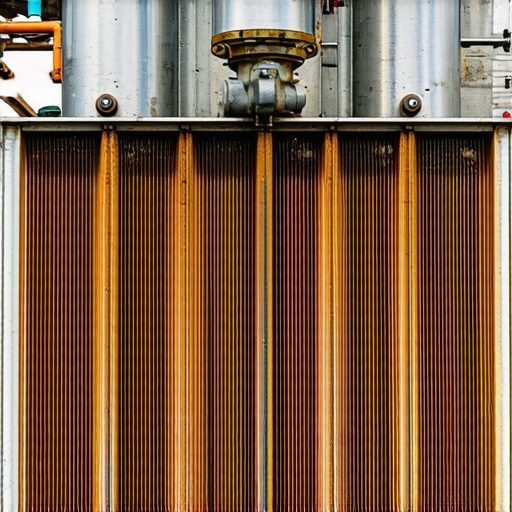
Let’s zoom into the thermodynamics of the copper heat exchanger. Copper is the king of heat transfer because of its thermal conductivity, but it’s also a reactive metal. When your pool water pH drops below 7.2, the water becomes ‘hungry.’ It seeks out minerals to balance itself. Since it can’t find limestone in your PVC piping, it goes for the softest, most accessible metal in the loop: your heater’s internal coils. This is sensible heat transfer gone wrong. As the water passes through the header, it doesn’t just pick up heat; it strips ions of copper from the tube walls. This is why you see that ‘green drip’ or staining on your pool stairs. By the time you notice the drip, the wall thickness of those tubes has likely been reduced by 50% or more. This isn’t a ‘quick fix’ situation where you just slap on some pookie and hope for the best. Once the integrity of that copper is gone, you’re looking at a full ‘gut job’ or a total replacement.
The Forensic Diagnosis: Anatomy of a Corroded Heater
When I walk up to a heater that’s ‘short cycling’ or failing to reach the set point, I don’t look at the thermostat first. I look at the ground. If I see white calcification or green oxidation, the diagnosis is already 90% complete. The heat exchanger is the heart of the system. In a modern heating system, we deal with modulating gas valves that precisely control the flame, but even the smartest gas train can’t fix a leaking coil. If you’re using a salt-chlorine generator, the risk is even higher. Salt is a catalyst for electrolysis. Without a proper sacrificial anode or a zinc bond, your heater becomes a giant battery, and the copper is the part that gets eaten. I’ve seen ‘Sales Techs’ try to sell a whole new digital control board for a leaking unit. That’s a scam. A board won’t stop water from spraying onto your burners and killing your pilot light.
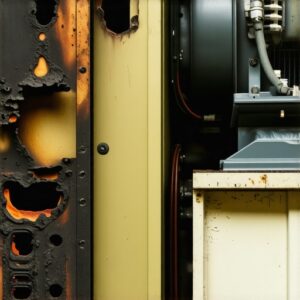
Speaking of burners, let’s talk about the ‘sooting’ effect. When a heat exchanger leaks, the water drips onto the burner trays below. This creates a sloppy, wet mess that prevents proper gas-to-air mixing. Instead of a crisp blue flame, you get a lazy, orange, soot-producing fire. This soot then coats the outside of the copper fins, insulating them. Now, you’ve got two problems: you’re leaking ‘juice’ (gas) and not transferring heat, and the acidic soot is eating the copper from the outside while the water eats it from the inside. This is why system performance testing is vital. If your combustion CO2 levels are off, it’s often because your ‘lungs’ (the heat exchanger) are choked with soot and corrosion.
The Cold Climate Factor: Winterizing or Death?
In the North, where we deal with polar vortexes, the physics of pool heaters change. We aren’t just fighting chemistry; we’re fighting the expansion of ice. If you don’t properly drain that heater, the water trapped in the headers will expand with enough force to split a cast iron manifold like a grape. This is similar to why baseboard heater repair often involves fixing burst pipes after a power failure. The ‘tin knocker’ guys don’t have to worry about water, but as a wet-head, I know that one ounce of trapped water is a ticking time bomb. When you blow out the lines, you need to use a high-volume blower, not just a shop vac. If you leave water in the low spots of the exchanger, you’ll be calling me for a ‘modulating furnace repair’ style diagnostic on a pool heater that’s literally split in half by May.
“Standard 155 governs the thermal efficiency of commercial pool heaters, but it cannot account for the corrosive impact of unbalanced Langelier Saturation Index (LSI) values on copper surfaces.” – HVAC Technical Manual
The solution isn’t magic; it’s maintenance. You need to understand the ‘Saturation Index.’ This isn’t just about pH; it’s the relationship between pH, alkalinity, calcium hardness, and temperature. As the water gets hotter inside the heater, the chemistry becomes more aggressive. This is why you should always install a manual bypass. If your water isn’t balanced, you shouldn’t be running it through the heater. Just because your ‘Sparky’ (electrician) hooked up the pump doesn’t mean the water is safe for the metal. Most homeowners fail because they think ‘clear water’ is ‘balanced water.’ I’ve seen water as clear as gin that had a pH of 6.0 and was actively digesting a $4,000 heater. Follow preventative HVAC repair tips for your whole home, but treat your pool heater like a lab experiment that wants to explode.
Preventative Tactics: Beyond the Chemical Float
First, get a real flow meter. If the water is moving too fast (erosion corrosion), it will literally scrub the protective patina off the inside of the copper. If it moves too slow, it will boil in the tubes (liming). You want that ‘sweet spot’ of velocity. Second, look into efficient HVAC repairs that include installing a check valve between your chlorinator and the heater. Without it, when the pump shuts off, a high concentration of chlorine back-flows right into the heater. That’s like pouring straight acid onto your car’s engine. Third, consider geofencing temperature control for your pool. Why run the heater at 90 degrees when nobody is home? Use heating service hacks to minimize the ‘runtime’ of the chemical-to-metal contact. The less time that hot, aggressive water is sitting in the copper, the longer the unit lasts.
If you’re already seeing the ‘green drip,’ stop the unit immediately. Don’t let a ‘Sales Tech’ talk you into a ‘stop-leak’ additive—that’s garbage that will just gum up your filter. If the leak is at the headers, you might get lucky with a gasket swap. If it’s in the middle of the coil, it’s done. At that point, you need to weigh the cost. Is it worth putting a $2,500 heat exchanger into a 10-year-old chassis? Usually, no. You’re better off looking at expert installation tips for a new, high-efficiency Cupro-Nickel or Titanium exchanger model. These materials are much more resistant to the ‘hungry water’ than standard copper. It’s the difference between a standard furnace and a stainless steel modulating furnace—one is built to survive the condensate, the other isn’t.