
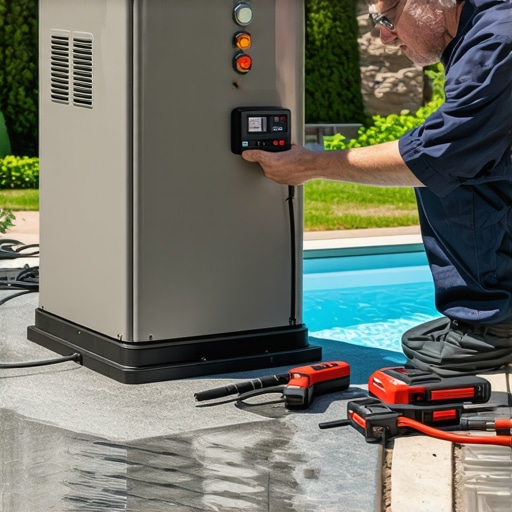
There is a specific kind of silence that only happens when a machine fails to do its job. It’s not just the absence of sound; it’s the heavy, expensive weight of a system that’s dead on arrival. You’re standing there in the cold northern air, looking at a pool that should be steaming at 85 degrees, but instead, it’s a frigid mirror. Your heater is dead. The display might be flashing a cryptic code, or it might just be sitting there, mocking you with a cold igniter. This isn’t just an inconvenience; in a climate where the mercury drops fast, a dead heater can lead to cracked pipes and a five-figure repair bill if you don’t act. I’ve spent thirty years in the dirt, crawling under biomass boiler services and wrestling with radiator replacement in century-old homes, and I can tell you: the physics of heat doesn’t care about your weekend plans.
The Physics Lesson: You Can’t Heat What You Can’t Move
My old mentor used to scream at me until he was blue in the face: ‘You can’t cool what you can’t touch, and you can’t heat what isn’t moving!’ He’d stand over a disassembled shop heater services project and point at the heat exchanger with a greasy finger. This is the cardinal rule of thermodynamics. Whether we are talking about hyper-heat heat pumps or a standard gas-fired pool heater, the principles are identical. If the airflow (or in this case, water flow) isn’t hitting the heat exchange surface at the right velocity, the system shuts down to prevent a meltdown. Airflow is king, and flow is its queen. If your pool heater won’t ignite, it’s usually because the safety circuit—the ‘brain’—is convinced that something isn’t moving right.
“The most expensive equipment in the world cannot overcome a bad duct system—or in the case of hydronics, a compromised flow path.” – Industry Axiom
When you’re dealing with an emergency heating repair, you have to look at the ‘Forensic Anatomy’ of the machine. Let’s start with the ignition sequence. It’s a dance. First, the pump pushes water. The pressure switch senses that water. Then, the blower motor kicks in to purge the combustion chamber of any lingering gas. If that blower motor replacement is in your near future, you’ll know it by the screeching of the bearings—the sound of metal screaming for mercy. Once the chamber is clear, the igniter glows or the spark snaps, and the gas valve opens. If any part of that dance misses a beat, the whole show stops.
[image-placeholder]
The Forensic Diagnosis: Why the Fire Stayed Home
When a pool heater fails to ignite, the first thing I check is the ‘Sparky’ work—the electrical path. Is the transformer sending 24 volts to the board? Is the contactor pulled in? If you’re smelling something sour or acidic, that’s not just bad luck; that’s the smell of a burned-out winding or a fried circuit board. In electric heater services, we often find that the ‘juice’ (the electricity) is being blocked by a simple $30 capacitor that’s given up the ghost. But with gas units, the culprit is often the venting. In the North, we deal with flue pipe installation issues constantly. If your flue is blocked by a bird’s nest or a sheet of ice, the back pressure will trip the rollout switch, and that unit will never fire. It’s a safety feature designed to keep you from pumping carbon monoxide into the atmosphere.
You have to understand the ‘Thermodynamic Zooming’ of the combustion process. Inside that heater, we are trying to achieve a perfect stoichiometric ratio—the right mix of air and fuel. If the chimney liner installation was done by a ‘tin knocker’ who didn’t know his math, the draft will be wrong. Without a proper draft, the flame won’t stay lit, or worse, it will soot up the heat exchanger, turning your high-efficiency unit into a paperweight. This is why choosing the right hvac fixes starts with a diagnostic, not a sales pitch.
The Anatomy of Failure: From Pressure Switches to Heat Pumps
If you’re running one of the newer hyper-heat heat pumps for your pool, the diagnosis changes. You’re no longer looking for a flame; you’re looking for a refrigerant cycle. We’re talking about moving latent heat from the cold air into the water. If the ‘gas’ (refrigerant) is low, you’ve got a leak. And remember, it’s a sealed system—if a ‘Sales Tech’ tells you that you just need a ‘top off’ every year, he’s lying to you. You need a leak detector integration to find the hole and fix it permanently. These units are incredible pieces of tech, but they are sensitive. A dirty evaporator coil will drop your COP (Coefficient of Performance) faster than a lead balloon.
For those still using traditional combustion, let’s talk about the blower. If you’re hearing a ‘thud-thud-thud,’ your blower wheel is out of balance. A blower motor replacement isn’t just about getting the air moving; it’s about protecting the heat exchanger. If the air doesn’t move, the metal gets too hot, it expands, and it cracks. Once that heat exchanger is cracked, you’re not just looking at a repair; you’re looking at a potential carbon monoxide factory. This is why we insist on top hvac repair strategies that include annual inspections of the flue and combustion chamber.
“All combustion equipment shall be vented in accordance with the manufacturer’s instructions and the National Fuel Gas Code.” – NFPA 54 / ANSI Z223.1
Repair vs. Replace: The Cold Hard Math
I followed a guy last week who tried to sell a homeowner a $12,000 biomass boiler because their current unit had a failed thermocouple. That’s the ‘Sales Tech’ scam I despise. A thermocouple is a $20 part. However, if your pool heater is ten years old, the heat exchanger is leaking ‘Pookie’ (mastic) and scale, and the manifold is rusted through, then yes, it’s time to pull the plug. The math is simple: if the repair costs more than 50% of the replacement value, and the unit is over 8 years old, buy the new one. The efficiency gains in newer 2025 models alone will pay for the difference in three seasons. But don’t let them upsell you on horsepower you don’t need. An oversized heater will short-cycle, meaning it turns on and off so fast it never reaches peak efficiency, wearing out the contactor and the igniter in record time.
For those in the North, you also have to consider the ‘Polar Vortex’ factor. When it hits -10°F, your equipment is under immense stress. If your flue pipe installation isn’t pitched correctly, the condensation will freeze and block the vent. I’ve seen it happen a hundred times. You think you need a whole new system, but all you really need is a heat gun and a technician who understands gravity. Using heating service hacks like insulating your exterior lines can save you a midnight emergency call.
The Maintenance Manifesto
You want to avoid the ‘July 4th Panic’ or the ‘Winter Solstice Freeze’? Then you have to treat your HVAC and pool heating systems like a high-performance engine. You wouldn’t drive a truck 100,000 miles without an oil change, so why do you expect your heater to run for 2,000 hours a year without a cleaning? Dust is the silent killer of blower motors. Scale is the silent killer of heat exchangers. If you’re avoiding furnace repair myths, you know that a ‘tune-up’ isn’t just a gimmick—it’s a chance to check the static pressure and the gas manifold pressure before they cause a catastrophic failure.
In the end, comfort is just physics. It’s the movement of energy from where you don’t want it to where you do. Whether it’s a shop heater, a biomass boiler, or a pool heater, the rules don’t change. Keep it clean, keep the air (or water) moving, and don’t trust anyone who tries to sell you a new unit before they’ve even taken the cabinet door off. Real technicians diagnose; they don’t just quote.