My old mentor used to scream, ‘You can’t heat what you can’t touch!’ at me while we were shivering in a drafty warehouse in the middle of January. This was back when I was a green apprentice, and I didn’t understand why the massive forced-air unit hanging from the ceiling was doing absolutely nothing to keep the guys on the floor warm. He’d point his greasy finger at the bay doors being left open by the forklift drivers and tell me that heating the air in a loading dock is like trying to fill a bucket with a hole in the bottom. This is why airflow matters more than horsepower—but in the specific context of high-traffic loading docks, the ‘airflow’ you actually want is the kind that isn’t there. You want radiant energy. If you’re trying to keep a commercial space functional when the ambient temp is dropping into the single digits, you need to stop thinking about the air and start thinking about the mass.
The Physics of Radiant Heat: Bypassing the Air
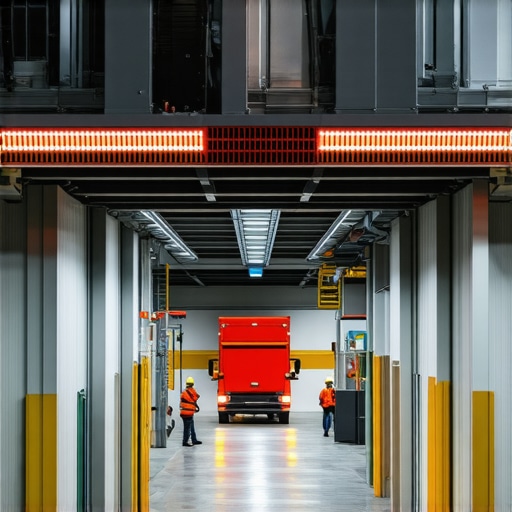
In the HVAC world, we usually talk about convection—moving air across a coil and blowing it into a room. But for infrared heater installation for high-traffic loading docks, we’re playing a different game. Infrared energy is part of the electromagnetic spectrum. It doesn’t need a medium (like air) to travel. When that heater is fired up, it sends out waves that only turn into heat when they hit an object—a concrete floor, a pallet, or a worker’s back. When a 53-foot trailer backs into a dock and the seals don’t quite catch, a standard furnace tune-up services won’t help you because the heated air is gone in seconds. Infrared stays. It’s like standing in the sun on a cold day; the air is freezing, but your skin feels warm. That is sensible heat transfer at its most efficient. This is the same principle we apply when discussing attic insulation for heating—it’s all about managing where the energy goes, not just how much ‘juice’ you’re feeding the system.
“Radiant heating systems are often more effective in large, high-ceilinged spaces because they heat surfaces directly rather than the air volume, reducing the energy lost through air infiltration.” – ASHRAE Handbook—HVAC Systems and Equipment
When I’m looking at a project involving garage heater installation or warehouse upgrades, I’m checking the ‘Pookie’ (mastic) on the joints, sure, but I’m mostly looking at the mounting height. If a Sparky (electrician) mounts an infrared tube too high, the intensity of the heat follows the inverse square law—it drops off fast. If it’s too low, you’ll melt the plastic off a pallet of electronics. It’s a surgical installation, not a ‘hang it and bang it’ job like some of these Sales Techs do. They’ll quote you a 200,000 BTU forced-air unit because the commission is higher, but they don’t understand that the moment that bay door opens, that heat is in the next county.
Why Most Loading Dock Heating Systems Fail
The biggest mistake I see? People treat a loading dock like a living room. It’s not. It’s a dynamic thermal bridge. Every time a door opens, you get a ‘piston effect’ that sucks the conditioned air right out. If you’re relying on a standard heating service that doesn’t account for this, you’re just burning money. I’ve walked into sites where the customer was complaining about a $4,000 monthly gas bill, and they had three RTUs (Rooftop Units) screaming at 100% capacity while the floor was still 40 degrees. We swapped them for high-intensity infrared burners, and the bill dropped by 40%. It’s not magic; it’s thermodynamics. You have to understand choosing the right HVAC fixes depends on the environment. In a loading dock, the ‘environment’ is essentially the outdoors with a roof over it.
The ‘Sales Tech’ Trap and Maintenance Realities
I followed a ‘Sales Tech’ once who told a warehouse manager that they needed a full AC installation and a massive furnace replacement for their office/dock combo. He quoted them $45,000. All they really needed was a localized infrared solution for the dock and a simple repair on the existing office unit. This is why I preach HVAC maintenance plans that actually involve cleaning the reflectors. If an infrared heater’s reflector is covered in warehouse dust and soot, the heat doesn’t bounce; it gets trapped in the unit and cooks the gas valve. I’ve seen cracked manifolds that looked like they’d been through a war because no one bothered to wipe them down for five years. When we perform furnace tune-up services, we’re looking for those hairline fractures that lead to carbon monoxide issues, and infrared heaters are no different. They are ‘gas-fired’ equipment, and they need respect.
“The most expensive equipment in the world cannot overcome a bad duct system—or in the case of radiant heat, a poorly designed layout.” – Industry Axiom
If you’re dealing with residential-scale cold, like a pellet stove repair or a fireplace insert services, you’re managing comfort for a small, static volume. But in a loading dock, you’re managing the survival of the workforce. Cold hands don’t move boxes fast. Remote thermostat access is a huge plus here too. I’ve seen docks where the heaters are left on all weekend because the switch is behind a pile of crates. With modern controls, you can tie those heaters into a schedule or even a motion sensor. No truck, no heat. That’s how you save the ‘gas’ (refrigerant or fuel, we use the term for both in the field) and the cash.
Strategic Installation: The Tin Knocker’s Perspective
As a veteran, I’ve worked with plenty of ‘Tin Knockers’ who hate installing infrared because it’s ‘fiddly.’ You have to worry about clearance to combustibles—specifically those overhead doors. I’ve seen more than one high-speed door melted into a puddle because some guy didn’t read the manual about the 36-inch clearance requirement. When we do a proper installation, we calculate the ‘throw’ of the heat. We want to overlap the patterns so there are no cold spots. It’s like painting a wall with light; you want even coverage. This is especially true if you have priority service memberships where the client expects zero downtime. If one unit goes down and your layout is solid, the others can carry the load. If your layout is garbage, that whole section of the dock becomes a refrigerator. We also have to talk about heating service innovations, which include newer, more efficient burners that don’t produce as much NOx, making the air quality better for the guys breathing in those truck fumes all day.
Preventing the Emergency Call
Nothing is worse than a 3 AM call because a dock heater failed and the pipes in the wet-pipe sprinkler system are about to freeze. That’s when furnace repair becomes urgent. For loading docks, I always recommend a fail-safe. If you’re not doing regular HVAC repair strategies, you’re just waiting for a disaster. Check your thermocouples, clean your burners, and for the love of everything holy, make sure your gas pressure is set correctly. If the pressure is too high, you’re over-firing the tube and shortening its life. If it’s too low, you get ‘sooting,’ and that’s a mess no one wants to clean up. Comfort is physics, not magic. Whether it’s AC installation secrets or infrared heater placement, it all comes down to how well you can manipulate energy in a space that doesn’t want to hold onto it. Don’t let a Sales Tech sell you a ‘magic’ box; hire a tech who knows why the air moves the way it does and why sometimes, the best way to heat a room is to ignore the air entirely.