
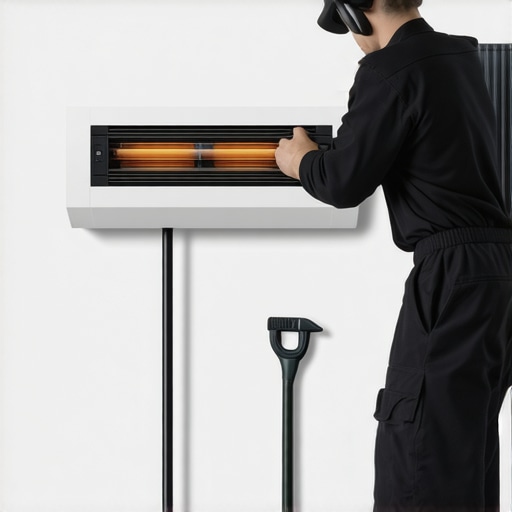
The Invisible Warmth and the Physics of Neglect
I’ve spent thirty years crawling through spider-infested crawlspaces and baking on asphalt rooftops, and if there is one thing I’ve learned, it’s that most people don’t understand heat. They think it’s a liquid you pour into a room. My old mentor used to scream at me until he was purple in the face, ‘You can’t cool what you can’t touch, and you can’t heat what you can’t see!’ This was his way of drilling the physics of radiant energy into my thick skull. When we talk about ceramic infrared heater installations, we aren’t talking about moving air like some basic forced-air furnace. We are talking about electromagnetic radiation. These units are essentially indoor suns, and when they fail, it’s usually because someone forgot that even the ‘sun’ needs a cleaning now and then.
The Anatomy of a Radiant Heart
In the cold reaches of the North, where a polar vortex can turn a garage or a warehouse into a meat locker overnight, ceramic infrared heaters are the unsung heroes. Unlike a standard heat pump where we worry about the suction line being ‘beer can cold,’ these heaters work by exciting molecules directly. But here is the catch: if that ceramic face—the heart of the machine—is caked in shop dust or grease, the thermodynamic transfer hits a wall. I’ve seen wiring repair for heating systems become a weekly occurrence because a neglected unit was overheating its own guts just trying to push heat through a layer of filth. If you’re dealing with a failing system, you might need to look into how to identify when furnace repair is urgent and why to avoid a total meltdown.
“Infrared heating systems shall be installed in accordance with their listing and the manufacturer’s instructions, specifically regarding clearances to combustibles.” – NFPA 54 / National Fuel Gas Code
The Forensic Diagnosis: Why Your Radiant Heat is Dying
When I walk onto a job site and hear the frantic click-click-click of a ceramic heater failing to ignite, I don’t just look at the gas valve. I look at the environment. In a hotel setting, where I often perform hotel boiler services, the culprit is usually latent heat and moisture, but with infrared, the enemy is ‘The Mirror Block.’ The reflectors—those shiny aluminum wings—are not there for decoration. They are precision-engineered to direct photons. When they get dull, the heat stays trapped in the unit. This is why duct cleaning services or dryer vent cleaning are often done in tandem; if the air is dirty, the surfaces get dirty. A ‘Sparky’ (that’s our term for the electrician) might tell you it’s a power issue, but 90% of the time, it’s a physics issue.
The Maintenance Ritual: Step-by-Step Survival
First, kill the juice. Never work on a hot ceramic plate; it’s a recipe for a trip to the ER. You need to inspect the ceramic tiles for ‘spiderwebbing’ or cracks. A cracked tile allows the gas to pool and burn behind the ceramic, which will warp the venturi tubes and eventually lead to a 24/7 heating emergency response call that’ll cost you triple time. Use a soft brush—never compressed air—to whisk away dust. If you blast it with 100 PSI, you’ll crack the ceramic. While you’re up there, check the wiring repair for heating systems. Heat makes wires brittle. If the insulation flakes off when you touch it, you’re looking at a fire hazard, not a heater.
Thermodynamic Zooming: The Dew Point Danger
In humid climates, we worry about the evaporator coil dropping below the dew point to remove latent heat. In the North, with infrared heaters, we worry about the opposite: condensation inside the vent pipe. If the heater isn’t burning hot enough because of a dirty burner, the flue gases cool down too fast, turning into an acidic soup that eats your vent pipe from the inside out. This is why proper thermostat installation is critical; you want long run cycles, not short-cycling. Short-cycling is the silent killer of all HVAC equipment. If you’re curious about the deeper mechanics, check out these top hvac repair strategies to extend your systems life.
“The most expensive equipment in the world cannot overcome a bad installation or a lack of maintenance.” – Industry Axiom
Beyond the Ceramic: The Total Comfort System
A ceramic heater is rarely the only tool in the shed. I often see them paired with baseboard heater repair in peripheral rooms or fireplace insert services for that aesthetic warmth. But if you really want to optimize, you need to think about the air quality too. Humidifier installation is the secret weapon here. Dry air feels colder than moist air. If you can keep the humidity at a steady 35%, you can turn that infrared heater down three degrees and never feel the difference. For those looking at the bottom line, financing for heat pump installs is a hot topic, but don’t sleep on your existing radiant tech. It’s often cheaper to fix the ‘pookie’ (mastic) on your seals than to replace the whole rig. You can learn more about these trade-offs in choosing the right hvac fixes what homeowners need to know.
The Final Word from the Attic
Don’t be the person who calls me on Christmas Eve because your shop heater is blowing soot. Maintenance isn’t a ‘sales tech’ scam; it’s a survival strategy. Whether it’s dryer vent cleaning to prevent a fire or ensuring your thermostat installation isn’t mounted on a cold exterior wall, the details matter. If you’re feeling overwhelmed, we are always here for a contact us session. Remember: physics doesn’t care about your budget, but a little bit of grease and a soft brush certainly do.