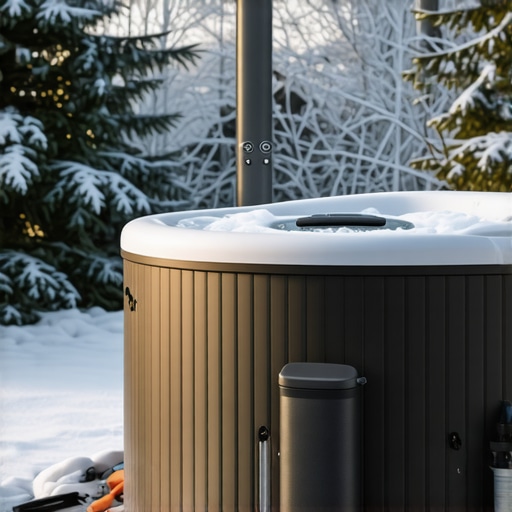
The Physics of the Frozen Manifold: Why Your Heater is a Bomb
My old mentor used to scream at me in the back of a freezing service van, ‘You can’t cool what you can’t touch, and you can’t heat what’s frozen solid!’ He was a mean old bird who’d been a tin knocker since the Eisenhower administration, but he understood the fundamental laws of thermodynamics better than any engineer I’ve met. This is why airflow and water flow are two sides of the same miserable coin. When we talk about winterizing your outdoor spa heater to prevent cracked pipes, we aren’t just talking about ‘turning it off.’ We are talking about fighting the relentless expansion of H2O. When water freezes, its volume increases by approximately 9% because of its crystalline lattice structure. In the tight copper or cupro-nickel tubes of a high-efficiency spa heat exchanger, that 9% expansion translates into thousands of pounds of pressure per square inch. It doesn’t matter how thick that metal is; the ice will win. Every. Single. Time.
“The most expensive equipment in the world cannot overcome a bad duct system—or the fundamental laws of thermal expansion.” – Industry Axiom (Modified)
The Forensic Diagnosis: Anatomy of a Winter Disaster
I’ve walked up to too many units in the spring where the homeowner thought they were safe because they ‘drained’ the pool. I look at the manifold and see a hairline fracture that looks like a lightning bolt through the cast iron or plastic header. That’s a $1,500 mistake because they didn’t understand relay services or the thermocouple replacement cycle. Most outdoor heaters use a pressure switch to prove flow before the burner fires. If you leave water in that small sensing line, it freezes, cracks, and now your safety circuit is dead. If you’re running a modern setup, you might even have a dual fuel heat pump system for your home, but the spa is often its own beast. You need to treat it with the same respect you’d give a heat pump replacement project. You have to get the ‘gas’ (the refrigerant) and the water where they belong. In a spa heater, that means out of the unit entirely.
The Winterization Protocol: A Step-by-Step Forensic Approach
First, kill the power. Don’t just flip the switch; hit the breaker. You don’t want a sparky (electrician) having to come out because you fried the control board when a stray surge hit during a blizzard. Next, you need to open the drain plugs. Most heaters have two—one on the front header and one on the rear. But here is the pro tip: don’t just let it gravity drain. Use a shop vac or a small compressor to blow out the lines. I’ve seen water hide in the low spots of the heat exchanger tubes for weeks until the first real deep freeze hits. If you’re worried about the rest of your home while you’re out there, consider how baseboard heater repair or wiring repair for heating systems might be affected by the same cold snap. Everything is connected in the thermal envelope of your property. If your spa is integrated into your home’s HVAC logic—say, through a demand-controlled ventilation system or a smart hub—you need to ensure the software knows the unit is ‘decommissioned’ for the season to prevent logic loops.
Beyond the Spa: Integrating Protection Across the System
While you’re out there freezing your tail off, it’s time to look at the bigger picture. I always tell my clients that if they are worried about their spa, they should be twice as worried about their indoor air. This is the perfect time for MERV filter upgrades. High-efficiency filters like MERV 11 or 13 can put a strain on your blower motor if your ductwork is undersized (remember what my mentor said about airflow?), but they are essential for trapping the winter dust. If you’re doing a low-GWP refrigerant retrofit in 2025, you’re already ahead of the curve, but don’t ignore the simple stuff. I’m talking about leak detector integration. A simple moisture sensor near your indoor furnace and your outdoor spa equipment can save you from a catastrophic flood. You can find more about this in our preventative hvac repair tips for year-round efficiency.
“Protection of piping from freezing shall be provided. Piping shall be protected from frost in accordance with the International Plumbing Code.” – IMC Section 305.4
The 2025 Regulatory Cliff: R-454B and Your Future Comfort
We are entering the ‘Great Transition.’ The industry is moving away from R-410A to A2L refrigerants like R-454B. This means if you are considering a heat pump replacement alongside your spa maintenance, the equipment you buy today is radically different from what you bought five years ago. These new systems are ‘mildly flammable,’ which sounds scary but really just means we need better wiring repair for heating systems and more robust sensors. It’s all about precision. Whether it’s a thermocouple replacement on an old gas heater or a low-GWP refrigerant retrofit on a new chiller, the margin for error is shrinking. If you’re confused by all these changes, you aren’t alone. Check out the heating service innovations transforming 2025 climate control for a deeper dive into why the ‘juice’ in your system is getting more expensive and more complex.
Final Thoughts: Maintenance vs. The Scam Tune-Up
Don’t fall for the ‘Sales Tech’ who walks up, looks at your spa heater, and says you need a whole new unit because there’s a bit of soot on the burners. Clean it. Blow out the heat exchanger. Check the relay services to ensure the contactor isn’t pitted. Real HVAC work is about maintenance, not just swapping boxes. If you want to keep your system running for twenty years instead of ten, you have to do the dirty work in the off-season. For more strategies on keeping your gear alive, read our guide on top hvac repair strategies to extend your systems life. Remember, the cold is coming, and it doesn’t care about your budget. It only cares about the laws of physics. “