The Chaos of the 2025 Regulatory Cliff and Your Thermostat
I’ve spent thirty years crawling through crawlspaces and wrestling with tin knockers over duct static pressure, and I’ve seen every fad from the ‘magic’ magnetic water conditioners to the current obsession with making everything app-controlled. As we stare down the barrel of the 2025 R-410A phase-out—the death of the refrigerant we’ve used for decades—homeowners are panicking about more than just the new A2L refrigerants like R-454B. They want to know if they can control their heat pump installation from their phone without some plastic hub cluttering up their router. The short answer? Yes, but you’re likely walking into a trap set by manufacturers who care more about your data than your sensible heat load.
The Physics Lesson: You Can’t Control What You Don’t Measure
My old mentor, a man who could sniff out refrigerant leak detection issues before he even pulled his gauges out of the truck, used to scream at me in the middle of a frozen basement: ‘You can’t control what you can’t touch, and you can’t touch the air if the blower motor replacement you just did isn’t moving the right CFM!’ We were working on a complex hydronic heating systems setup in a workshop that was barely hitting 40 degrees. He was right. People think an app is magic. It isn’t. It’s just a remote switch for a series of thermodynamic events. If your flue pipe installation is restricted or your ductwork is leaking like a sieve, all that ‘app-controlled’ brilliance is just a digital witness to your money burning.
“Equipment shall be sized according to the heating and cooling loads calculated using ACCA Manual J or another approved equivalent method.” – ACCA Manual S Regulation
The Hubless Reality: Wi-Fi vs. The Proprietary Bridge
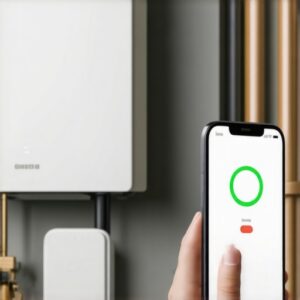
When you ask if app-controlled heating works without a hub, you’re usually asking about the difference between Wi-Fi and protocols like Zigbee or Z-Wave. A Wi-Fi thermostat connects directly to your router. No hub. Easy, right? Well, ‘easy’ is what sparkies say before they blow a transformer replacement. Direct Wi-Fi thermostats eat more power and can bog down a home network. More importantly, they often lack the sophisticated predictive maintenance alerts that a dedicated system hub provides. If you’re doing a garage heater installation, a simple Wi-Fi unit is fine. But for a full-scale 2025-compliant heat pump, you want the hub. Why? Because the hub acts as the brain that translates the complex language of the inverter-driven compressor to your phone without dropping the signal when your neighbor starts their microwave.
Thermodynamic Zooming: How Smart Tech Actually Heats
Let’s talk about IAQ improvement services and how they tie into your app. Most people think their heater just ‘turns on.’ In reality, when you slide that bar on your iPhone, you’re initiating a sequence. In a heat pump, the reversing valve shifts, the outdoor fan kicks on, and we begin pulling latent heat from the cold outdoor air. We’re talking about moving molecules, not creating heat. If you’re in a northern climate like Chicago, your app needs to be smart enough to manage the ‘defrost cycle.’ This is where the outdoor coil freezes over and the unit has to briefly switch back to cooling mode to melt the ice. Without a robust connection—often facilitated better by a hub—you might not get those critical predictive maintenance alerts telling you your defrost board is fried before your house turns into an ice box.
“The technician must ensure that the vent system is capable of conveying the flue gases to the outside atmosphere without leakage or restriction.” – EPA Section 608 / NFPA 54
The Hidden Maintenance: Beyond the App
I’ve seen ‘Sales Techs’ sell a $20,000 system because the homeowner wanted an app that looked cool, while the dryer vent cleaning was so backed up it was a fire hazard and the return air was choked with pookie (mastic) from a hack job ten years ago. Real comfort comes from physics. It comes from ensuring the suction line is ‘beer can cold’ in the summer and the discharge air temperature is hitting its delta-T in the winter. If you’re looking for heating service innovations transforming 2025 climate control, don’t just look at the screen. Look at the data the screen provides. Is your static pressure too high? Is the amperage on your blower motor creeping up? That’s what a smart system should tell you.
The 2025 Trap: Don’t Buy the Last Generation
As we transition to these ‘mildly flammable’ A2L refrigerants, the new equipment will have built-in sensors to detect leaks in the evaporator coil. These sensors are often integrated into the system’s digital backbone. If you’re looking for an ultimate guide to ac installation, you need to understand that the ‘hub’ is becoming part of the unit itself. Buying a ‘dumb’ unit now just to avoid a hub is like buying a rotary phone because you don’t like touchscreens—you’re isolating yourself from the diagnostic tools that keep your 15-year investment running. High-efficiency systems require high-efficiency communication. If you’re worried about privacy, get a local-only hub. But don’t sacrifice the health of your system for the sake of a hub-free life. Whether it’s a transformer replacement or a full heat pump installation, the goal is a system that tells you it’s sick before it dies on a Friday night in January.