The Smell of Failure: When Your Comfort Turns Sour
You walk into your living room expecting a crisp, desert-style breeze, but instead, you’re hit with the unmistakable stench of a locker room at the end of a double-header. It’s that damp, earthy, borderline-fungal odor that most folks call ‘swamp eye’ or ‘old sock syndrome.’ As a guy who’s spent three decades crawling through ductwork and balancing static pressures, let me tell you: that smell isn’t just an annoyance; it’s a biological red flag. In the dry heat of the Southwest, evaporative cooler services are the lifeblood of a home, but when the physics of airflow go sideways, your unit stops being an air conditioner and starts being a petri dish.
My old mentor, a grizzled tin knocker who could smell a cracked heat exchanger from the driveway, used to scream at me, ‘You can’t cool what you can’t touch!’ He was talking about the interaction between air and water. If the air isn’t moving across those pads correctly, or if the water is stagnant, the thermodynamics of the system break down. This is the heart of the Airflow Manifesto. Most people think HVAC is about ‘making cold,’ but it’s actually about moving energy. When your swamp cooler smells, it’s because the energy transfer is being choked by biological slime and poor maintenance.
The Physics of the Funk: Latent Heat and Biofilms
To understand why your unit stinks, we have to talk about the latent heat of vaporization. An evaporative cooler works by pulling hot, dry air through water-saturated pads. As the water evaporates, it absorbs sensible heat from the air, dropping the temperature. But here’s the catch: that water is a magnet for every bit of dust, pollen, and organic debris floating in the desert air. When that debris settles in the pan, it creates a nutrient-rich sludge. If your blower motor replacement was done poorly or if the static pressure is too high, the air doesn’t move fast enough to keep things fresh. You end up with a biofilm—a microscopic city of bacteria and mold—living on your pads and in your reservoir.
“Ventilation systems shall be designed to prevent the accumulation of moisture and the growth of microorganisms on surfaces within the air distribution system.” – ASHRAE Standard 62.1
When the unit cycles off, that moisture sits. Without proper drainage or a ‘bleed-off’ line, the mineral content in the water spikes. We call this ‘hard water’ in the trade, but it’s really just a concentrated soup of salts and organics. When you turn the unit back on, the fan blasts that concentrated odor directly into your home. This is why preventative hvac repair tips for year-round efficiency are critical; you aren’t just maintaining a machine, you’re managing a biome.
The Airflow Manifesto: Why Windows Matter
One of the biggest mistakes homeowners make is treating a swamp cooler like a central AC installation. With refrigerated air, you seal the house tight. With evaporative cooling, you have to embrace positive pressure. You are pushing a massive volume of air into the house, and that air needs an escape route. If you don’t crack the windows in the rooms you want to cool, the static pressure builds up, the airflow across the pads slows down, and the moisture content in the house skyrockets. This is where the ‘old sock’ smell gets trapped. You aren’t flushing the humidity; you’re stewing in it.
I’ve walked into jobs where the homeowner was complaining about the smell, and I found they had every window shut tight. The blower motor was screaming, struggling against the backpressure. That’s a fast track to a blower motor replacement. You have to balance the ‘throw’ of the air. If the air can’t move, the water on the pads can’t evaporate efficiently, and the unit just pumps humid, stinky air into a pressurized box. It’s basic fluid dynamics, yet it’s the most ignored part of residential comfort.
The Forensic Diagnosis: Cleaning the Gunk
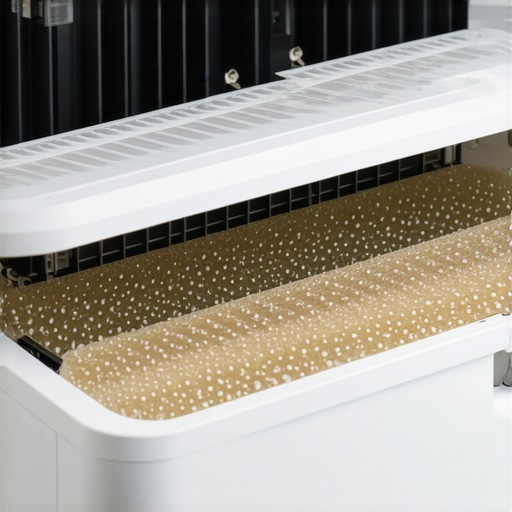
If you want to kill the smell, you have to be more than a ‘Sales Tech’ who just sprays some perfume on the pads. You have to get technical. First, we look at the pan. If there is a layer of ‘pookie’ (mastic) or scale at the bottom, that’s where the bacteria live. You need to scrub it with a zinc-based cleaner or a mild bleach solution. Second, look at the pads. If they are crunchy with mineral deposits, they are useless. They won’t hold water, and they won’t breathe. They need to be replaced with high-quality Aspen or rigid media.
“The most expensive equipment in the world cannot overcome a bad duct system or a lack of basic maintenance.” – Industry Axiom
We also need to check the pump and the distribution spider. If some of those lines are clogged, you get ‘dry spots’ on the pads. Dry spots allow hot air to bypass the cooling process, but they also allow the damp edges of the pad to grow mold without being ‘washed’ by fresh water. It’s a specialized type of evaporative cooler services that requires looking at the unit as a complete hydraulic circuit.
Transitioning Beyond the Swamp: Oil, Gas, and Smart Tech
Sometimes, the smell is a sign that the unit is undersized for the changing climate. As humidity levels rise during the monsoon season, swamp coolers lose their effectiveness. This is when many homeowners start looking at an AC installation to replace the old roof-top unit. If you’re currently running an old heating system, you might even consider an oil to gas conversion to streamline your utility bills while you’re upgrading the cooling side.
For those sticking with their coolers, integration into smart building management systems is the new frontier. We can now install sensors that monitor the saturation levels of the pads and the mineral content of the water, automatically triggering a flush cycle before the smell even starts. It’s about using data to manage the physics of the air. If you’re dealing with a 24/7 heating emergency response in the winter, you know how important it is to have a system that ‘talks’ to you. The same applies to your summer cooling.
When to Pull the Plug: Repair vs. Replace
Is it worth fixing that stinky cooler? If the cabinet is rusted through, the answer is no. If the ‘Sparky’ (electrician) tells you the wiring is shot, or if the blower housing is vibrating like a jet engine, you’re throwing good money after bad. A furnace repair services call might reveal that your ductwork is too small for a modern AC, but it might be perfect for a refurbished swamp cooler. You have to look at the total cost of ownership. A new wall furnace installation might save you money on the heating side, allowing you to splurge on a high-end evaporative system with an automatic purge pump.
Ultimately, your comfort is a product of physics, not magic. Whether it’s steam humidifiers in the winter or biomass boiler services for a larger estate, the goal is always the same: controlling the environment. If your cooler smells like old socks, it’s because you’ve lost control of the biology inside the box. Clean the pan, replace the pads, open a window, and for heaven’s sake, don’t let the water sit stagnant for a month. If you need help, don’t call a salesman; call a technician who knows what ‘beer can cold’ actually means and understands that airflow is the king of the castle. For more specialized advice, you can always contact us to get a real tech on the line. “