I’ve spent thirty winters crawling through crawlspaces and balancing on joists in frozen attics, and if there is one thing that haunts an old tin knocker more than a collapsed return air duct, it is the silence of a house where the combustion gases have gone sideways. You see, I was raised in this trade by a man who didn’t care about shiny trucks or sales quotas. My old mentor used to scream, ‘You can’t cool what you can’t touch, and you can’t breathe what you’ve poisoned!’ This is why airflow matters more than horsepower, and it is exactly why I get cynical when I see a homeowner trusting their life to a $15 plastic battery-powered puck they bought at a big-box store. In the world of real mechanical engineering, we don’t ‘hope’ things work; we hardwire them so they have no choice but to work.
The Forensic Diagnosis: Why Your Combustion Anatomy is Failing
In a cold climate, your home is a sealed pressure vessel. When we perform a gas furnace repair or a complex steam boiler repair, we aren’t just looking at the flame; we are looking at the draft. Your furnace is a beast that breathes. It takes in oxygen, mixes it with fuel, and exhales the byproduct. If that heat exchanger has a microscopic hairline fracture—something a ‘Sales Tech’ might miss while he’s busy trying to sell you a 16-SEER upgrade—that ‘exhale’ enters your living room. Carbon monoxide (CO) is the ultimate ghost. It has no smell, no taste, and no color. You won’t smell it like you smell the acidic, sour rot of a burnt-out compressor or the metallic tang of an overheated blower motor. You just go to sleep. This is why identifying when furnace repair is urgent isn’t just about comfort; it’s about life-safety physics.
“The most expensive equipment in the world cannot overcome a bad duct system, nor can it compensate for the failure to properly vent combustion byproducts.” – Industry Axiom
The problem with battery-only units is twofold: voltage drop and sensor degradation. Most homeowners forget the batteries until the ‘chirp’ starts at 3 AM. But more importantly, a battery-powered unit is an island. If a cracked heat exchanger in your basement starts dumping CO into the plenum, the detector in the basement goes off. But will you hear it in the third-floor master suite behind a closed door and a white noise machine? Probably not. A hardwired system, especially one integrated into smart building management, uses an interconnect wire. When one senses the reaper, they all scream. It’s a collective alarm system that acknowledges the physics of air travel through your 120-volt ‘Sparky’ installed circuitry.
Thermodynamic Zooming: The Cold Climate Reality
In regions where the mercury hits sub-zero, we deal with ‘Tight House Syndrome.’ We install heat recovery ventilators (HRVs) and demand-controlled ventilation because we’ve sealed the envelopes so tight that the house can’t ‘burp’ anymore. When the atmospheric pressure outside shifts during a polar vortex, your chimney or flue can actually experience ‘backdrafting.’ This is where your hot water heater—usually the most neglected appliance in the house—fails to vent because the furnace is competing for air. Without a preventative maintenance contract, your water heater’s draft hood becomes a source of CO. I’ve seen homeowners try to solve this with bypass humidifier repair or by adding more insulation, but if you don’t have a hardwired detector to tell you the oxygen-to-CO ratio is shifting, you’re flying blind.
“All fuel-burning appliances shall be inspected annually to ensure the integrity of the heat exchanger and the adequacy of combustion air.” – ACCA Manual J / NFPA 54
When I’m out on a call for hot water heater repair in the dead of January, I’m checking the ‘spillage’ at the draft hood. If I see soot or signs of flame rollout, I know that house is a ticking clock. Most people think they need a new unit. Often, they just need the venting corrected. But in the meantime, I won’t leave that house unless there is a hardwired CO detector. Why? Because batteries are for flashlights, not for breathing. A hardwired unit with a 10-year sealed lithium backup is the only thing that satisfies the Psychrometric Logic of a modern HVAC system. It’s about heating service innovations that actually matter, like transforming 2025 climate control through integrated safety protocols.
The Math of Survival: Repair vs. Replace
I get it. A hardwired detector requires a technician or an electrician. It’s more expensive than the stick-on-the-wall version. But let’s look at the mechanical anatomy. A standard battery-operated sensor uses an electrochemical cell that dries out over time. When it sits in a basement with high humidity (where you might need dehumidification services), the sensor life is cut in half. Hardwired units are often higher quality because they have to meet more stringent UL standards for permanent installation. If you are investing in app-controlled heating systems, it’s a joke to not have those sensors tied into your network. Imagine getting a push notification on your phone while you’re at work that the CO levels in your mechanical room are climbing. That is the difference between a gas furnace repair bill and a funeral bill.
We also have to talk about the ‘Pookie’ (mastic) on your ducts. If your return air is leaky and located near your furnace or boiler, it can actually pull flue gases into the air stream and distribute them through the ‘Suction Line’ of your ventilation. This is why preventative hvac repair tips always include checking the seal of the plenum. You can read more about year-round efficiency and safety here. If your ‘Tin Knocker’ didn’t seal the return properly, and you have a backdrafting boiler, you are essentially pumping poison into every bedroom. A battery-powered unit in the hallway might not catch it until the levels are already dangerous. Hardwired units near the source and in sleeping areas, interconnected, are the only way to beat the physics of indoor air pollution.
The Final Word from the Attic
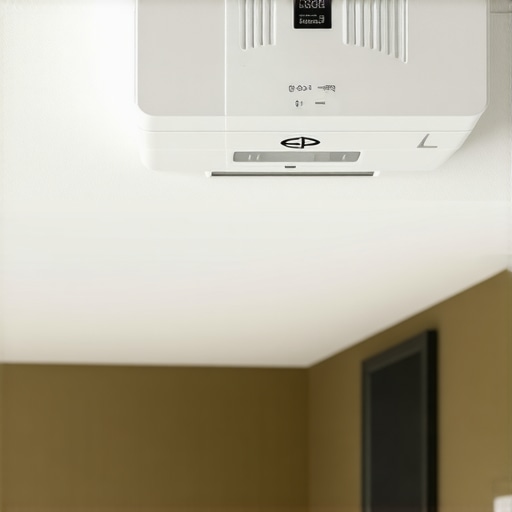
Stop listening to the sales techs who want to sell you a UV light for $1,000 before they’ve even checked your CO levels. Comfort is physics, not magic. If you have a steam boiler or a furnace, you have a controlled fire in your house. Respect that fire. Get a professional to handle your steam boiler repair and ensure your safety net is hardwired into the bones of the building. You wouldn’t trust a battery-powered heart monitor if you could have one plugged into the wall, would you? The same logic applies here. Don’t fall for the furnace repair myths that say a simple tune-up replaces the need for robust monitoring. Stay safe, keep the juice flowing to your detectors, and remember: airflow is king, but clean air is the kingdom.”,”image”:{“imagePrompt”:”A close-up, high-detail professional photograph of a modern hardwired carbon monoxide detector being installed on a ceiling, with the green ‘power’ LED illuminated, showing copper wiring in the background and a technician’s hand using a precision screwdriver. The lighting is crisp and industrial.”,”imageTitle”:”Hardwired Carbon Monoxide Detector Installation”,”imageAlt”:”A professional HVAC technician installing a hardwired CO detector with interconnected wiring.”},”categoryId”:0,”postTime”:””} Ready.