The Silence of a Winter Breakdown: A Forensic Diagnosis
There is a specific kind of silence that happens at 3 AM in the middle of a February freeze that tells a seasoned tech exactly how much the homeowner is about to sweat—not from heat, but from the repair bill. I remember following a ‘Sales Tech’—one of those guys who carries a shiny iPad and a pristine uniform but wouldn’t know a manifold gauge from a meat thermometer—into a drafty Victorian home last winter. He’d already quoted the homeowner $12,000 for a full furnace and air handler repair replacement because the ‘compressor was grounded.’ I walked in, smelled the lack of ozone, and heard that tell-tale 60-cycle hum. It wasn’t a dead compressor; it was a $40 run capacitor that had given up the ghost because the motor was fighting against a restrictive, undersized return duct. That ‘Sales Tech’ was looking for a commission; I was looking for the truth in the physics of the circuit.
“The most expensive equipment in the world cannot overcome a bad duct system.” – Industry Axiom
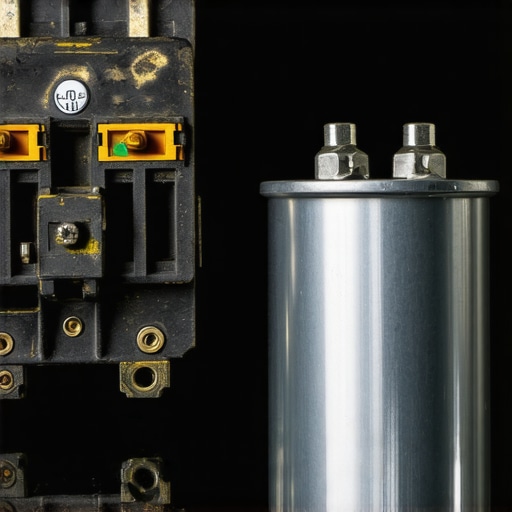
In the frigid climates of the North, where furnace repair services are the only thing between a cozy living room and a burst pipe, understanding the electrical anatomy of your unit is vital. Whether you are managing a church heating systems with massive air volumes or a residential split system, the primary culprits of electrical failure are the contactor and the capacitor. They are the grunt workers of the HVAC world, taking the brunt of the high-amperage surges every time the thermostat calls for heat. When they fail, your system either stays dead or, worse, tries to start until it toasts the motor windings.
The Capacitor: The Electrical Spring of Your System
Think of a capacitor as a temporary storage tank for ‘juice.’ It isn’t a battery; it’s more like a spring that’s been compressed and is ready to snap. In a SEER2 compliant upgrades, the capacitors are precisely matched to the motors to ensure maximum efficiency. A capacitor’s job is to create a phase shift in the electrical current, providing the extra torque needed to get a heavy blower fan or compressor spinning from a dead stop. This is what we call ‘starting torque.’ If that capacitor is dead, the motor will sit there and hum, drawing ‘locked rotor amps’ (LRA) until the internal thermal overload trips. You can smell it—a faint, metallic heat emanating from the motor. When I perform static pressure testing, I often find that capacitors fail early because the motor is working too hard to push air through dirty filters or attic insulation for heating that has migrated into the return plenum.
The Contactor: The High-Voltage Gatekeeper
While the capacitor provides the ‘kick,’ the contactor is the switch that allows the 240 volts of ‘gas’ to flow into the components. It’s a heavy-duty relay. When the thermostat sends 24 volts to the contactor coil, a magnetic field is created that pulls a set of silver-plated contacts together. Over time, these contacts ‘pit’ or ‘weld’ due to the arc flash that occurs every time they close. A stuck contactor is a nightmare; it can keep your outdoor unit running even when the indoor fan is off, leading to a block of ice that could melt and flood your mechanical room. This is why 24/7 heating emergency response is critical; if a contactor welds shut on a heat pump in a defrost cycle, it can destroy the compressor in hours. I’ve seen this happen in large-scale church heating systems where the sheer frequency of cycles wears the mechanical components of the contactor down to a nub.
“Designers shall provide a means to verify that the airflow rate is within 10% of the design value.” – ASHRAE Standard 62.1
Thermodynamic Zooming: Why Humidity and Airflow Matter
In cold climates, we also deal with humidifier installation issues. If your furnace is short-cycling because of a bad capacitor, your humidifier never has the ‘run time’ necessary to actually evaporate water into the air stream. This leaves your house feeling colder than it actually is because dry air accelerates evaporative cooling on your skin. Furthermore, demand-controlled ventilation systems rely on these electrical components to modulate air based on CO2 levels. If the ‘Sparky’ who wired your house didn’t account for the inrush current, you’ll be replacing contactors every two seasons. Even if you have a pellet stove repair as a backup, your primary air handler needs to be healthy to distribute that heat. If you suspect your system is struggling, you should learn how to identify when furnace repair is urgent and why to prevent a total electrical meltdown.
The Forensic Breakdown: Repair vs. Replace
When I’m out on a call, I look for the ‘Pookie’—that gray mastic sealant—around the duct joints. If a system is leaking air, the motor runs longer to meet the setpoint, which heats up the capacitor’s dielectric fluid until the top of the ‘can’ bulges out like a soda in a freezer. That’s a dead giveaway. A stuck contactor, however, is often found by the ‘tin knocker’ who notices the suction line is ‘beer can cold’ while the furnace is in a heating lock-out. For homeowners, it is essential to follow preventative HVAC repair tips for year-round efficiency to avoid these component-killing scenarios. If you’ve been told you need a whole new system, remember my story about the $40 fix. Many furnace repair myths debunked by industry experts point back to simple electrical failures being misdiagnosed as catastrophic mechanical ones.