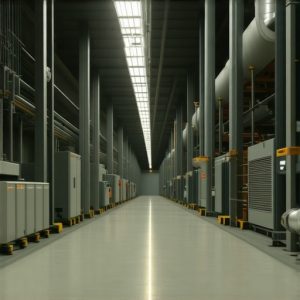
The sound of a failing 100-ton chiller isn’t just a noise; it is the sound of a bank account bleeding out in real-time. I have spent three decades crawling through the bowels of industrial basements and balancing air on church heating systems where the dust is older than the parishioners. Most building owners think ‘smart management’ is just a fancy thermostat you can poke at with your phone. They are wrong. My old mentor used to scream at me until his face turned the color of a fresh brick: ‘You can’t cool what you can’t touch!’ He was talking about airflow, but the logic applies to every BTU moving through a commercial structure. This is why airflow matters more than horsepower, and why a smart system that doesn’t understand thermodynamics is just an expensive paperweight.
“The most expensive equipment in the world cannot overcome a bad duct system.” – Industry Axiom
When I walk into a facility for a forensic diagnosis, I don’t look at the computer screen first. I look at the mechanical anatomy. I look for the ‘Pookie’—that gray mastic sealant—slopped over leaking joints by some ‘Tin Knocker’ who was in a hurry to get to lunch. If your building management system (BMS) says you are losing 20% efficiency, it isn’t a software glitch; it is likely a thermodynamic debt you are paying because of poor attic insulation for heating or a radiator replacement that was done without balancing the valves. In cold climates, the enemy is the polar vortex. We are seeing a massive shift toward cold climate heat pumps, which are a miracle of engineering, but they are unforgiving. If the wiring repair for heating systems wasn’t done by a pro, those sensors will trip the moment the ambient temperature drops below zero, leaving you with a frozen coil and a massive repair bill.
Let’s talk about the ‘Sales Tech’ scam. I recently followed a guy into a local community center who told them they needed a complete $80,000 boiler overhaul because of ‘efficiency losses.’ I spent ten minutes looking at the diagnostic board and found a $40 relay failure and a blocked flue. This is why furnace repair myths are so dangerous for commercial budgets. A smart building management system would have flagged the specific electrical drop across that relay before the unit even shut down. That is the difference between proactive HVAC repair and reactive bankruptcy. You have to understand the psychrometrics. In the North, we fight cracked heat exchangers and flame rollout. When a heat exchanger cracks, it isn’t just an efficiency problem; it is a carbon monoxide death trap. Smart sensors can detect the change in combustion gas ratios long before a human smells the trouble.
“Properly sized equipment, based on accurate heat loss calculations, is the foundation of energy efficiency.” – ACCA Manual J
If you are still relying on old-school pellet stove repair for secondary spaces or outdated evaporative cooler services for your warehouse, you are fighting a losing battle against the laws of physics. Smart management integrates every piece of the puzzle. It knows that your hot water heater repair needs aren’t just about the tank; they are about the circulation pumps and the thermal envelope. If your ‘Sparky’ didn’t wire the VFDs (Variable Frequency Drives) correctly, your blowers are running at 100% when the building only needs 30%. That is burning ‘juice’—refrigerant and electricity—for no reason. Even something as simple as dryer vent cleaning in a commercial laundry or multi-unit housing can bottleneck your entire airflow strategy. If the air can’t leave the building, the new air can’t get in to be conditioned. That is basic fluid dynamics. For more on this, check out these heating service innovations. We are moving into an era where 2025 regulations will make R-410A obsolete, and the new A2L refrigerants will require even tighter monitoring. Smart management isn’t a luxury anymore; it is the only way to keep the doors open when the utility bill arrives.