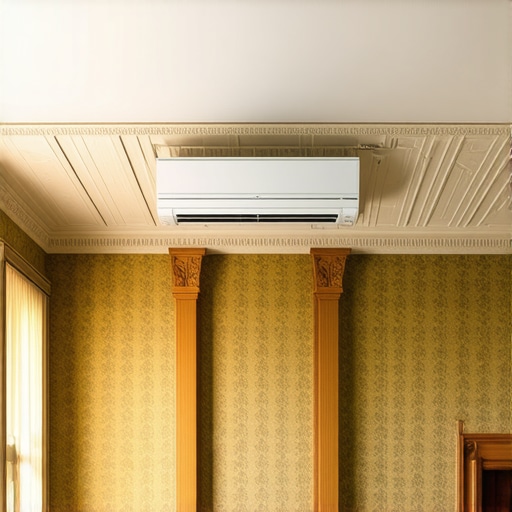
You walk into a 1920s Victorian in the middle of July. The downstairs parlor feels like a tomb—heavy, damp, and smelling of old floor wax—while the upstairs master bedroom is a literal kiln where the humidity hangs so thick you could carve it with a putty knife. This isn’t just a comfort issue; it is a fundamental failure of physics. Most homeowners think they just need a bigger unit or to ‘top off the juice,’ but as a guy who has spent three decades dragging his knees across rock wool insulation in 130-degree attics, I can tell you that is a load of garbage. If your ‘service tech’ walks in with a jug of R-410A before he even looks at your ductwork, he is not a technician; he is a salesman in a clean uniform, and you should show him the door. The reality is that 90% of cooling problems in historical homes stem from the fact that these structures were never designed for forced-air systems. The original builders didn’t leave room for a tin knocker to run a 14-inch return, so you end up with undersized flex duct choked down to the size of a dryer vent. This is where static pressure testing becomes the most important tool in my bag. If the air can’t move, the heat can’t leave.
“The most expensive equipment in the world cannot overcome a bad duct system.” – Industry Axiom
My old mentor, a man who could hear a failing bearing from three houses away, used to scream at me, ‘You can’t cool what you can’t touch!’ He was talking about the surface area of the evaporator coil. In these old houses, when you try to force air through tiny, restrictive ducts, the static pressure spikes, the blower motor works itself to death, and the air velocity across the coil drops. When that happens, the coil temperature plummets, often below the freezing point. Instead of efficiently removing latent heat—that’s the humidity that makes your skin feel like wet wool—the coil just turns into a block of ice. This is the ‘Airflow Manifesto’ in action. If you want to fix a historical home without tearing out the lath and plaster to install a massive zoning system installation, you have to stop thinking about ducts and start thinking about ductless mini-splits. A mini-split doesn’t fight the house; it works with the specific thermal load of each room. It uses an inverter-driven compressor that doesn’t just bang on and off like a hammer; it modulates. It’s like a dimmer switch for your cooling. It keeps the suction line ‘beer can cold’ while precisely matching the heat load of the room, ensuring that the evaporator coil stays just below the dew point for maximum dehumidification without ever freezing up.
In the northern climates where we deal with brutal winters, the historical home presents a secondary, more lethal set of challenges. I’ve seen gas furnace repair jobs that would make a building inspector weep. Old masonry chimneys are often crumbling, leading to dangerous drafting issues. If you are still relying on an atmospheric furnace with a pilot light relighting ritual every November, you are sitting on a ticking clock. This is why carbon monoxide detector installation is not an upsell; it is a life-saving necessity. When we do a chimney liner installation, we are often just trying to keep the exhaust from eating through the mortar and leaking CO into the bedroom. A ductless heat pump system, especially the cold-climate models, bypasses this entire hazard. It provides emergency heating repair reliability by removing the combustion element from the living space entirely. No flame rollout, no cracked heat exchangers, and no acidic, sour smell of a compressor burnout because the system is designed to operate at 100% capacity even when the ambient temp outside is well below zero. When I find a contactor repair issue on a 20-year-old gas guzzler, I often have to have the ‘talk’ with the homeowner about the urgent signs of furnace failure. Sometimes, throwing $500 at a relic is just burying money in a grave.
“Proper ventilation must be provided to ensure that the combustion products of gas-fired appliances are exhausted to the outdoors.” – ASHRAE Standard 62.2
Let’s talk about the ‘Pookie’—that gray mastic we use to seal ducts. In a historical home, even if you have ducts, they are usually leaking 30% of your conditioned air into the crawlspace or the attic. You are paying to cool the squirrels. Ductless systems eliminate the ‘Tin Knocker’ struggle entirely. By mounting a sleek air handler directly on the wall or ceiling, we avoid the nightmare of static pressure testing failures. We aren’t fighting the friction of 50 feet of leaky, dirty metal. We are delivering ‘the gas’ directly to the point of use. This is the pinnacle of demand-controlled ventilation. Why cool the guest room when nobody is in it? You can learn more about these AC installation secrets that most big-box companies won’t mention because they’d rather sell you a massive central unit with a higher profit margin. Even if you have a shop heater services requirement for a carriage house or a detached garage, mini-splits are the only logical choice. They are quiet, they don’t require a gas line, and they don’t require you to cut a hole in a 100-year-old roof for a vent stack. In 2025, with the transition to A2L refrigerants, these systems are becoming even more efficient, though you need a tech who actually understands the chemistry, not just some kid who knows how to use a crimper. This is about the future of climate control. Physics doesn’t lie, even if the salesman does. Stop trying to force a 21st-century central air system into a 19th-century envelope. Go ductless, save the plaster, and finally stop sweating through your shirts in your own living room. It’s not magic; it’s just better engineering.