My old mentor used to scream, ‘You can’t cool what you can’t touch!’ This was back in the early nineties, standing on a blistering gravel roof with the sun beating down so hard you could smell the tar melting. He wasn’t talking about some abstract theory; he was talking about the literal contact between dry, desert air and the water-soaked media of an evaporative cooler. If your airflow is restricted or your water distribution is uneven, you aren’t cooling—you’re just moving hot, dusty air around and wasting electricity. In this industry, I’ve seen too many ‘Sales Techs’ try to pivot a simple swamp cooler repair into a $15,000 multi-family heating upgrade or a high-efficiency furnace installation when the client just needed a fresh set of pads and a cleared distributor line. I despise that. Real HVAC work is about physics, not commissions.
The Thermodynamics of the ‘Swampy’: Sensible Heat vs. Latent Heat
In a dry climate like ours, we deal with sensible heat—the kind you feel on your skin. Evaporative cooling works by using the heat in the air to evaporate water, which lower the air’s temperature. We call this ‘wet-bulb depression.’ When I’m checking a unit, I’m looking at the spread between the ambient air temperature and the air coming out of the registers. If you aren’t getting at least a 20-degree drop, your system is failing the physics test.
“The most expensive equipment in the world cannot overcome a bad duct system.” – Industry Axiom
This applies to coolers more than anything. If your duct design services weren’t handled right the first time, or if your ‘tin knocker’ cut corners on the plenum, that air is just going to bottle up and create backpressure.
The Forensic Diagnosis: Anatomy of a Dry-Summer Prep
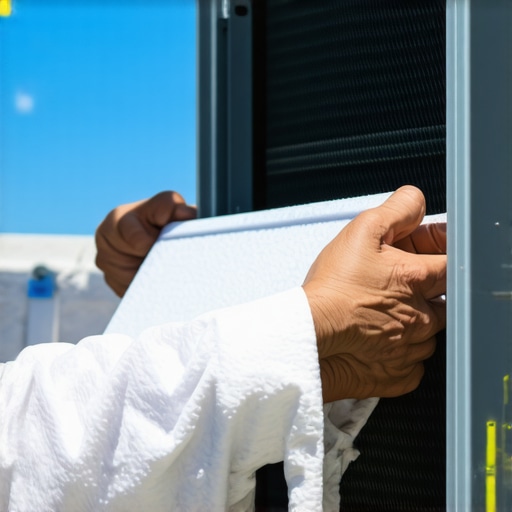
When I walk up to a unit, I’m listening first. I want to hear the steady hum of the motor, not the screech of a failing bearing. If I hear that metal-on-metal whine, I know the oil ports have been ignored for a decade. Next, I’m looking at the pads. If they are caked in white calcium, they are ‘dead.’ They can’t hold water, and they can’t let air pass. It’s like trying to breathe through a brick. I’ve seen people try to ‘wash’ these pads, but once the scale is that thick, you’re just wasting time. Replace them with high-quality Aspen or rigid media. While you’re at it, check the ‘Pookie’—that’s the mastic sealant—around the roof jack. If it’s cracked, you’re leaking cooled air onto the roof instead of into the house.
The Water System: The Lifeblood of the Cooler
The pump is the heart, and the distributor lines are the arteries. If the pump is rattling, it’s likely sucking up debris from the bottom of the pan. I always recommend a preventative maintenance contract that includes a deep scrub of the reservoir. You wouldn’t drink out of a stagnant pond, so why would you want your house’s air passing through one? Check the float valve. If it doesn’t shut off, you’re sending gallons of water down the overflow and straight into your sewer bill. If it’s stuck closed, your pads go dry and your compressor-less ‘AC’ becomes a giant, expensive fan. This is where a bypass humidifier repair specialist often finds work in the winter, but the principles of water-flow management remain the same year-round.
Why Airflow is King (And Why You Shouldn’t Close Your Vents)
I see this mistake every year: homeowners closing bedroom vents to ‘save air.’ In an evaporative system, that is a death sentence for efficiency. These systems are 100% outdoor air. You have to give that air a way to escape—usually through a cracked window or an Up-Duct. If you don’t, you create static pressure that bogs down the blower motor.
“Proper ventilation is the cornerstone of indoor air quality and thermal comfort.” – ASHRAE Standards
For those looking for more sophisticated solutions, energy recovery ventilators can help manage air exchange, but in the heat of a dry summer, the swamp cooler needs to breathe. If you’re transitioning a multi-family property, you might even consider cold climate heat pumps as a supplement for those humid monsoon days when evaporative cooling stops working because the air is too ‘fat’ with moisture to take on any more.
The Winter Hangover: Crawl Spaces and Furnaces
Don’t forget that your cooling efficiency is often tied to your heating system’s health. If you have a high-efficiency furnace installation, the blower motor is likely shared with your cooling setup. If that blower is coated in dust from a winter of neglect, it won’t move the CFM required for summer. I’ve crawled into enough tight spots to know that crawl space heating solutions and ductwork often get mangled by ‘Sparkies’ or plumbers who don’t care about your static pressure. A crushed duct in the crawl space means your master bedroom will never stay cool, no matter how cold the ‘juice’ is in a traditional AC or how wet the pads are in a cooler.
The Master Tech’s Final Verdict
If your cooler is older than fifteen years and the pan is rusting through, stop throwing money at it. We are seeing a massive shift toward advanced AC installation techniques, including biomass boiler services for the winter and inverter-driven heat pumps for the summer. But if you’re sticking with the swampy, do it right. Clean the pan, replace the pads, oil the motor, and ensure your ‘Pookie’ is tight. Anything less is just inviting a mid-July breakdown when it’s 110 degrees and every tech in town is three weeks out on calls. Trust the physics, respect the airflow, and don’t let a Sales Tech talk you into a humidifier installation you don’t need when your cooler is literally a giant humidifier. Keep it simple, keep it clean, and keep it cool.