The Anatomy of an Exchange: Why Metals Fail Under Pressure
I remember my old mentor, Big Sal, standing over a 500,000 BTU industrial burner with a look of pure disgust. He used to scream, ‘You can’t heat what you can’t touch!’ This was his way of saying that if a layer of soot or scale is insulating your heat exchanger, you’re just burning money and venting it out the flue. Heat exchanger cleaning isn’t just about ‘making it look pretty’; it is a fundamental requirement of thermodynamics. In the freezing winters of the North, where furnace tune-up services are the difference between a functional facility and a frozen pipe catastrophe, the heat exchanger is the heart of the system. If that heart is clogged, the whole body fails.
The technical process of heat exchanger cleaning involves more than a vacuum and a brush. It requires understanding the metallurgical stress of constant expansion and contraction. When your industrial heater services team arrives, they are looking for the ‘thermal fingerprint’ of the unit. In cold climates like Chicago or the Northeast, heat exchangers deal with massive temperature swings. This causes the metal to fatigue. If the exchanger is covered in combustion byproducts, the heat can’t escape into the air stream efficiently. This leads to hot spots, metal crystallization, and eventually, the dreaded crack that leaks carbon monoxide into the building. This is why identifying when furnace repair is urgent often starts with a combustion analysis during a cleaning.
“The most expensive equipment in the world cannot overcome a bad duct system or a fouled heat transfer surface.” – Industry Axiom
Thermodynamic Zooming: The Physics of Heat Transfer
Let’s talk about latent heat and the delta T. In a furnace or a steam boiler, the heat exchanger’s job is to transfer energy from the combustion gases to the distribution medium—whether that’s air or water. When soot builds up—even a layer as thin as 1/16th of an inch—it acts as an insulator. This increases the stack temperature and lowers the AFUE (Annual Fuel Utilization Efficiency). You’re effectively paying for the ‘juice’ (fuel) but losing the ‘gas’ (heat) out the chimney. During professional heat exchanger cleaning, we use specialized chemicals and high-pressure air to strip these deposits. This allows for maximum molecular contact between the hot metal and the cold air or water. For those managing steam systems, steam boiler repair often involves descaling the internal tubes to prevent the metal from overheating and sagging, a condition we in the trade call ‘bagging.’
Industrial Heater Services and the Steam Factor
In industrial settings, we aren’t just dealing with small residential units. We are looking at massive plants where steam humidifiers and heavy-duty boilers keep the environment stable. A fouled exchanger in a steam system doesn’t just lose efficiency; it risks a high-pressure failure. If you’ve ever heard the screech of a failing bearing or the bang of water hammer in a steam line, you know the sound of a system under stress. This is where predictive maintenance alerts come into play. By using app-controlled heating systems and remote thermostat access, we can monitor the temperature drop across an exchanger in real-time. If the delta T starts to shrink, we know the exchanger is fouling before the building even gets cold. This is the hallmark of modern preventative HVAC repair tips that actually save money.
The Process: From Degreasing to Combustion Analysis
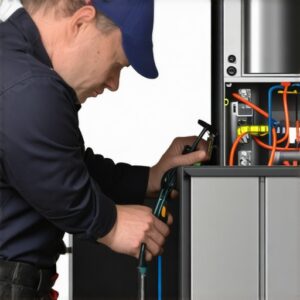
The forensic cleaning of a heat exchanger follows a strict protocol. First, the ‘Sparky’ (electrician) ensures the power is locked out. Then, we disassemble the burner assembly to access the heat exchanger’s primary and secondary surfaces. For industrial units, we often use a technique involving alkaline degreasers to break down carbonized oils. We then use bore brushes and high-CFM vacuums to remove the debris. But we don’t stop there. A true tech performs a flue gas analysis. We check the CO2, O2, and CO levels. If the CO is high, the combustion is ‘lazy’ and incomplete, often caused by poor airflow or a cracked exchanger. We use a high-intensity lamp or even a smoke test to look for hairline fractures. If a crack is found, we don’t ‘patch’ it with ‘Pookie’ (mastic). We discuss heat pump replacement or a full furnace swap because a cracked exchanger is a death sentence for the equipment and a safety hazard for the occupants.
“Proper maintenance of heat transfer surfaces is critical to prevent the formation of toxic combustion byproducts and ensure structural integrity.” – ASHRAE Standards
The 2025 Transition: Controls and Rebates
As we move into 2025, the technology is changing. We are seeing more app-controlled heating systems that integrate with building management software. These systems provide predictive maintenance alerts that can tell a facility manager exactly when the next cleaning is due based on run-time and load, rather than just a calendar date. For those looking to upgrade, rebate application assistance is a massive part of our service. Many local utilities offer significant kickbacks for switching to high-efficiency systems or for documented industrial heater services that prove an increase in AFUE through professional cleaning. When we look at heating service innovations for 2025, it’s clear that the combination of old-school cleaning and new-school sensors is the winning strategy. Whether it is a simple furnace tune-up services call or a complex steam boiler repair, the goal is always the same: keep the metal clean, the airflow moving, and the combustion contained.
The Airflow Manifesto: Why Cleaning Isn’t Optional
If you ignore your heat exchanger, you’re asking for a ‘Red Tag’ from the gas company. In the North, where the polar vortex can drop temps to -20°F, a failed heater isn’t an inconvenience; it’s a liability. Cleaning the exchanger ensures that the air passing over it picks up the maximum amount of heat. This reduces short-cycling—where the unit turns on and off too frequently—which is the number one killer of blowers and control boards. If you’re considering top HVAC repair strategies, start with the heat exchanger. It is the most overlooked component because it’s hidden behind panels and ‘Tin Knocker’ (ductwork) work. But as any ‘Master Tech’ will tell you, the physics don’t lie. Clean metal transfers heat; dirty metal burns out. Don’t be the guy who waits for the CO alarm to go off before calling for industrial heater services. Get the cleaning done, check the sensors, and make sure your ‘juice’ is actually warming the building, not just the sky.