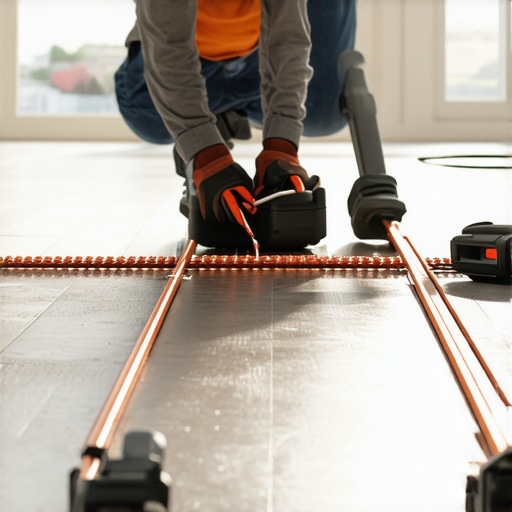
The Physics of Heat and the Ghost of My Mentor
My old mentor, ‘Grizzly’ Bob, used to scream at me during my apprenticeship in the mid-90s: ‘You can’t cool what you can’t touch, and you can’t heat what you don’t respect!’ He was a man who understood the sheer, unyielding physics of thermodynamics better than most PhDs. He knew that energy is lazy; it always takes the path of least resistance. When we talk about radiant floor heating in 2026, we aren’t just talking about laying some plastic tubes and calling it a day. We are talking about managing thermal mass and sensible heat in a way that respects the laws of nature. If you screw up a hydronic install, you aren’t just dealing with a cold room; you are dealing with a structural nightmare that can cost tens of thousands to rectify. I’ve seen ‘Sales Techs’—those guys who care more about their commission than a combustion analysis—try to sell high-end boilers for systems where the slab wasn’t even insulated. It’s like putting a Ferrari engine in a lawnmower. It doesn’t matter how much ‘juice’ you pump into the system if the house is literally bleeding heat into the frozen earth below.
“The most expensive equipment in the world cannot overcome a bad distribution system, whether it be ducts or hydronic loops.” – Industry Axiom
1. The Thermal Bridging Trap: Heating the Worms Instead of the Living Room
The biggest mistake I see, and it’s only getting worse with the 2026 energy codes, is a failure to properly isolate the slab. If you don’t have a thermal break between your radiant slab and the exterior foundation, you are effectively trying to heat the entire planet. This is ‘thermodynamic zooming’ at its finest: heat moves toward cold. Without an edge insulation barrier, that expensive energy travels sideways through the concrete and out into the sub-zero air. I’ve walked onto jobs where the heating service call was for ‘floor not getting warm,’ only to find the BTU output was sufficient but the heat was migrating out of the building envelope faster than the pump could cycle. In 2026, smart building management systems will flag this as a major efficiency loss, but by then, the concrete is poured, and you’re stuck. Always insist on high-density foam at the edges. Don’t let a ‘Tin Knocker’ tell you it’s unnecessary; they deal with air, not the brutal thermal conductivity of stone and water.
2. Flue Pipe Installation and the Propane Conversion Oversight
When we move into high-altitude or rural installs, propane conversion services become a staple. But here is where the ‘Sparkies’ and the amateurs get tripped up: the venting. A high-efficiency boiler for a radiant system produces acidic condensate. If your flue pipe installation isn’t pitched perfectly back to the unit, that liquid sits in the PVC and eventually chokes out the inducer motor. I’ve smelled that acidic, sour scent of a failing heat exchanger more times than I care to admit. It’s a sensory red flag. In 2026, with stricter EPA mandates, the tolerances are tighter. If the vent isn’t cleared and the gas pressure isn’t tuned for propane after a conversion, you’ll get soot buildup that turns your heat exchanger into a paperweight within two seasons. Proper furnace repair often starts with looking at the venting before you ever touch the gas valve.
[IMAGE_PLACEHOLDER]
3. Ignoring the Mass of Church Heating Systems and Large Auditoriums
Radiant heat is a different beast when you’re talking about church heating systems. You have massive ceilings and even bigger floor areas. The mistake here is treating a 5,000-square-foot sanctuary like a master bathroom. You cannot ‘quick heat’ a slab. If the system is designed without a two-stage furnace installation or a modulating boiler, you end up with massive temperature swings. The slab takes six hours to get up to temp, and once it’s there, it keeps radiating heat long after the thermostat clicks off. It’s a lagging indicator. I’ve seen HVAC repair guys try to ‘fix’ this by cranking the limit switch, which just stresses the PEX. You need sensors embedded in the slab, tied into a smart building management platform that predicts the weather. If a cold front is hitting at 6 AM, that floor needs to start drinking ‘juice’ at midnight.
4. The Low-GWP Refrigerant Retrofit Confusion
As we head into 2026, the industry is reeling from the R-410A phase-out. We are now dealing with A2L refrigerants like R-454B. While radiant floors are hydronic (water-based), many are now being paired with air-to-water heat pumps for cooling and heating. The mistake is ignoring low-GWP refrigerant retrofits when planning your mechanical room. These new systems require ‘leak sensors’ and specific ventilation because the refrigerants are ‘mildly flammable.’ If you’re an old-school guy who thinks he can just swap a 20-year-old chiller for a new low-GWP unit without updating the safety protocols, you’re in for a world of pain during inspection. It’s not just about expert AC installation; it’s about understanding the chemical evolution of the trade.
“Hydronic heating systems shall be balanced to ensure flow rates meet design specifications for optimal heat transfer.” – ASHRAE Standard 155P
5. Manifold Neglect and the Airflow Myth
One of the weirdest things I hear from homeowners is that they want to close off loops in rooms they don’t use. Look, radiant floor heating is a balanced ecosystem. When you start messing with the manifold without understanding the GPM (gallons per minute), you throw the whole pump curve off. It’s like the myth of closing vents in a forced-air system—it doesn’t save money; it just kills the blower motor. In hydronics, it causes cavitation in the circulator. You’ll hear that distinct ‘gravel in a blender’ sound. That’s the sound of money leaving your wallet. Whether you’re doing a radiator replacement or a full floor install, the water chemistry matters too. If you don’t treat the ‘gas’ (the water/glycol mix), you’ll get oxygen permeation that eats your boiler from the inside out. I’ve seen pool heater repair calls that turned out to be the same issue—improper pH levels destroying the copper coils. If you want efficient HVAC repairs, you have to look at the fluid, not just the metal. 2026 demands precision. If you’re still using ‘Pookie’ (mastic) to seal a high-efficiency flue or ignoring the friction loss in a PEX loop, you’re not a technician; you’re a liability. Comfort is physics, not magic, and physics doesn’t take days off. If you need a pro who knows the difference between a capacitor and a contactor by the smell of the burnout, it’s time to contact us and get it done right the first time.