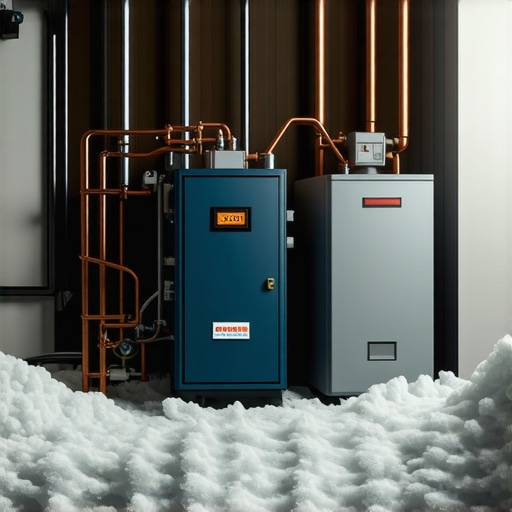
The Ghost in the Foundation: Why Your Crawl Space is Killing Your Comfort
I’ve spent thirty winters crawling through the tightest, dampest, and most bone-chilling under-dwellings in the Northeast. You know the smell—that mix of wet earth, old timber, and the metallic tang of a rusting furnace. Most homeowners treat their crawl space like a tomb: out of sight, out of mind. But as a veteran technician who has seen more cracked heat exchangers than I have birthdays, I’m here to tell you that your crawl space is the lungs of your home. If those lungs are freezing, your whole house is gasping for air. My old mentor, a grizzled tin knocker who could smell a gas leak from the curb, used to scream at me, ‘Kid, you can’t heat what you can’t contain!’ He was right. You can throw the biggest furnace in the world at a drafty house, but if the thermodynamics of your foundation are broken, you’re just burning money to heat the worms. This is the core of the Airflow Manifesto: comfort isn’t about horsepower; it’s about pressure, seal, and the relentless physics of the stack effect.
“The most expensive equipment in the world cannot overcome a bad duct system.” – Industry Axiom
When the temperature drops in 2026, don’t be the person calling for an emergency furnace repair because your pipes froze in a crawl space that was never balanced. We need to look at the anatomy of the freeze. In a cold climate, your crawl space becomes a massive heat sink. The ‘Stack Effect’ pulls cold air in through the vents and cracks, pushing your expensive, warm air out through the attic. It’s a vacuum you’re paying to run. If you want a warmer 2026, you stop thinking about ‘turning up the heat’ and start thinking about HVAC load calculation services. We don’t guess in this trade; we measure. A proper Manual J calculation tells us exactly how many BTUs you’re losing to that frozen dirt patch under your living room. Without it, you’re just a ‘Sales Tech’ trying to upsell a bigger unit that will short-cycle itself into an early grave.
Solution 1: The Oil to Gas Conversion and Combustion Analysis
If you’re still running an old oil dragon, you’re fighting a losing battle against efficiency. Making the jump with an oil to gas conversion is the single biggest move you can make for crawl space health. Why? Because modern gas furnaces allow for much tighter control over the thermal envelope. But here’s the veteran’s secret: the conversion is only as good as the combustion analysis performed afterward. I’ve seen rookies slap a gas burner in and walk away, leaving the unit to soot up and rot out because the oxygen-to-fuel ratio was off. You want to see the blue flame dance, not lick the sides of the cabinet. Proper combustion ensures that the heat exchanger is actually transferring energy to your air, not just sending it up the flue. When we do this, we also run control board diagnostics to ensure the sequence of operations is tight. If your inducer motor starts screaming like a banshee, that’s a bearing failure waiting to happen. Catching it early is the difference between a $200 part and a $4,000 midnight emergency.
Solution 2: Radiator Replacement and Hydronic Balance
For those of you in older homes with boiler systems, the crawl space is often where the ‘main’ lines run. If those pipes are bare, you’re heating the dirt before the water ever reaches your floors. Radiator replacement isn’t just about the cast iron unit in your bedroom; it’s about the delivery system. If the water returning to the boiler is too cold, you get ‘thermal shock,’ which can crack a boiler section faster than you can say ’empty wallet.’ We look at the flow. Is the circulator pump sized right? Are we using enough ‘Pookie’ (that’s mastic to you civilians) to seal any penetrations where those pipes enter the living space? If your feet are cold but the thermostat says 72, your radiant floor heat is escaping through the floor joists. You need to trap that heat where it belongs. Using warranty service plans to keep these hydronic systems flushed is the only way to prevent the acidic sludge that eats pumps from the inside out.
“Design of the distribution system is as critical as the selection of the heating source itself.” – ACCA Manual J Standards
Solution 3: Thermocouple Replacement and Pilot Integrity
I can’t tell you how many times I’ve crawled into a freezing space just to find a $15 part has shut down a $10,000 system. Thermocouple replacement is the bread and butter of keeping older ‘standing pilot’ systems alive during a polar vortex. If that little copper rod isn’t sensing heat, it’s going to shut the ‘juice’ (gas) off for safety. It’s a simple fail-safe, but in 2026, we’re seeing more electronic igniters. These ‘Sparky’ components are finicky. If your crawl space is too humid—perhaps because you didn’t get a humidifier installation balanced with a dehumidifier—those electrodes will corrode. This leads to ‘lockout.’ You’re sitting upstairs wondering why the house is 50 degrees while the furnace is sitting in the crawl space clicking hopelessly. This is why we emphasize top HVAC repair strategies that include cleaning your flame sensors and checking for ‘ghost’ grounds in the wiring.
Solution 4: Kitchen Exhaust and Pressure Management
You might wonder what a restaurant kitchen exhaust repair has to do with your house, but the physics are identical. High-volume exhaust pulls air out of a building. If you don’t have ‘make-up air,’ that air has to come from somewhere—usually the crawl space. If you’ve got a powerful range hood in your kitchen, you are literally sucking freezing air from under your house up through the floorboards. We see this in high-end remodels all the time. They put in a professional-grade hood and suddenly the floor is an ice rink. We solve this by balancing the static pressure. We look at the ductwork like a set of veins. If one is clogged or leaking, the whole system suffers. Check your efficient HVAC repairs guide; it’ll tell you that sealing the return air drop is more important than almost any other ‘tune-up’ a sales tech will try to sell you. Stop the vacuum, stop the freeze.
Ultimately, a warmer 2026 isn’t found in a glossy brochure for a new AC unit. It’s found in the gritty details of manual J calculations and the sweat of a tech who actually understands that ‘suction line’ temperature and static pressure are the only things that matter. Don’t let a ‘Sales Tech’ tell you that you need a whole new system when all you need is a balanced envelope and some proper combustion analysis. For more on how to avoid the common traps, look into choosing the right HVAC fixes before the first frost hits. Keep your crawl space dry, your ducts sealed with Pookie, and your thermocouple clean. That’s how you survive a winter without a service call.