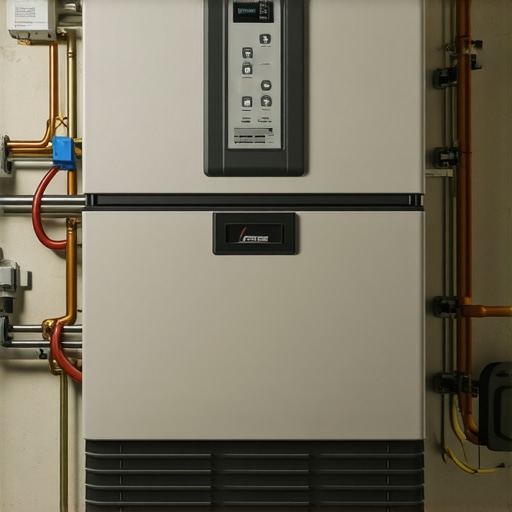
You hear that? That rhythmic, low-frequency drone coming from your basement or utility closet? It is 2:00 AM in the middle of a January cold snap, and your furnace blower motor has been screaming for three hours straight. The air coming out of the registers is lukewarm, but the fan refuses to die. Most homeowners think the thermostat is possessed. A ‘Sales Tech’ will tell you that the whole unit is shot and try to slide a $12,000 invoice across your kitchen table. But if you have spent thirty years crawling through spider-infested crawlspaces like I have, you know exactly what is happening: the limit switch has clocked out of the shift.
My old mentor used to scream at me until he was purple in the face: ‘You can’t cool what you can’t touch, and you can’t heat what you can’t move!’ He would stand over a furnace with a manometer and a look of pure disgust, hammering home the idea that airflow is the only thing that matters. This is why airflow matters more than horsepower. If the air isn’t moving across that heat exchanger at the exact cubic feet per minute (CFM) the engineers intended, the temperature spikes, and that little silver disc—the limit switch—pops open to save your house from becoming a bonfire. Eventually, after too many ‘trips,’ the switch fails closed or open, and you are left with a ghost in the machine.
“Safety limit controls shall be provided to prevent the discharge of air at a temperature in excess of 200°F (93°C) and shall be of the type that will automatically reset.” – ASHRAE Standard 15 (Modified for Residential Heating)
In the frigid North, where we deal with cracked heat exchangers and the constant threat of carbon monoxide, the limit switch is the unsung hero of the mechanical room. It is a simple bimetallic strip or a thermistor in newer AI-driven HVAC optimization setups that acts as the ‘brain’s fuse.’ If your furnace won’t stop running, it is usually because the system has entered a ‘limit lockout’ or the switch itself has welded its contacts together. Before you call a tin knocker to tear out your ducts or a sparky to rewire the house, let’s talk about the cold, hard physics of limit switch replacement and furnace survival in 2026.
Tip 1: The Diagnostic Dead-End (Don’t Just Swap the Part)
The biggest mistake I see ‘green’ techs make is swapping a limit switch without asking why it died. A limit switch is a safety device; it does not fail for no reason. In my three decades on the job, 90% of failed switches are caused by restricted airflow. If you are dealing with wall furnace installation or even complex shop heater services, the first thing you check is the static pressure. Think of it like a heart attack; you can fix the heart, but if the arteries are clogged with pookie (mastic) and dust, you will be back in the ER in a week. Before replacing the switch, check your filters. A high-MERV filter that hasn’t been changed in six months is a furnace killer. If you are noticing a sour, metallic smell—that’s the heat exchanger getting too hot. This is a primary reason how to identify when furnace repair is urgent and why you cannot ignore a cycling fan.
Tip 2: The Multi-meter Truth and Capacitor Health
In 2026, we are seeing more integrated boards that use AI-driven HVAC optimization to monitor ‘rate of rise’ in temperature. However, the old-school continuity test still reigns supreme. You pull the two wires—usually low voltage—and check for ohms. But here is the veteran secret: check the blower capacitor while you are in there. A weak capacitor (which is why capacitor replacement services are so common) causes the blower motor to spin at 80% speed. You won’t hear the difference, but the sensible heat won’t be stripped off the exchanger fast enough, causing the limit to ‘ride the edge’ until it fails. If you’re doing a pellet stove repair or working on a high-efficiency furnace, the tolerances are even tighter. Don’t be the guy who ignores the preventative maintenance contracts and ends up with a warped heat exchanger because of a $5 capacitor.
“The most expensive equipment in the world cannot overcome a bad duct system.” – Industry Axiom
Tip 3: The 2026 Sensor Shift and Airflow Audits
We are entering an era where ‘dumb’ bimetal switches are being replaced by digital sensors. When performing limit switch replacement on a 2025 or 2026 model, you need to ensure the sensor probe is calibrated to the specific AFUE rating of the unit. If you are also managing restaurant kitchen exhaust repair or snow melt systems installation, you know that pressure differentials are everything. A dirty blower wheel—covered in a fine velvet of pet dander and skin cells—moves less air. This is where duct cleaning services actually become a mechanical necessity rather than just an aesthetic one. If the air can’t reach the ‘suction line’ of your comfort, the furnace will overheat. Make sure you are using preventative hvac repair tips for year-round efficiency to keep that airflow path clear. If your fan won’t stop, the board might be seeing a ‘limit open’ fault and is running the fan to cool down a heat exchanger that it thinks is melting.
The ‘Sales Tech’ Trap and Real Solutions
I have followed too many ‘Sales Techs’ who see a limit switch issue and tell a homeowner they need a whole new system because ‘the parts aren’t made anymore.’ That is a load of gas. Most limit switches are universal or easily sourced. However, if your heat exchanger is cracked—which we check for using a combustion analysis—then yes, it is time for a wall furnace installation. You have to know the difference between a safety failure and a terminal illness. For more on the reality of the trade, check out furnace repair myths debunked by industry experts to avoid getting fleeced. Whether you are looking for shop heater services or residential help, remember that comfort is physics, not magic. Keep your ‘juice’ levels right, your filters clean, and your ductwork sealed with pookie, and that furnace will outlast the mortgage. If you’re stuck in the cold, don’t wait for the ‘Ghost in the Machine’ to fix itself. Reach out and contact us before a small switch becomes a big disaster.