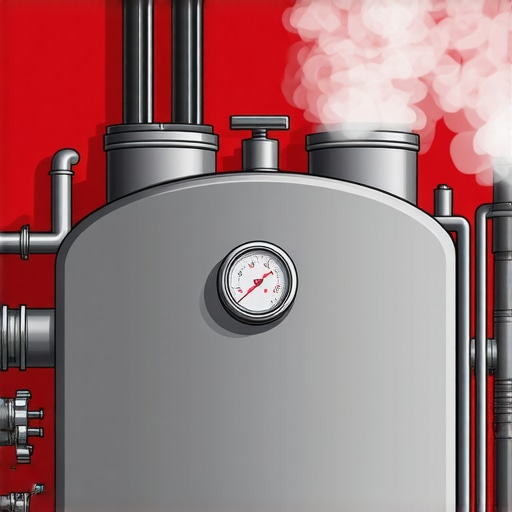
The Ghost in the Pipes: Why Silence is Your Boiler’s Best Friend
There is no sound quite like the middle-of-the-night gunshot of a steam boiler ‘banging.’ To a homeowner in a freezing Northern winter, it sounds like the house is coming apart. To a 30-year veteran like me, it sounds like money being set on fire. That violent clanging—technically known as water hammer—isn’t just a nuisance; it’s the physical manifestation of steam colliding with trapped condensate. My old mentor used to scream, ‘You can’t heat what you can’t touch!’ This was his way of teaching us that if the steam can’t reach the radiator because of a blockage or a slug of water, the physics of the entire system collapses. Airflow and fluid dynamics are king, whether you’re dealing with a 1920s cast iron beast or a modern modulating furnace repair scenario. When that steam hits a wall of cold water, it implodes, creating a vacuum that sucks more water toward it at 30 miles per hour. That’s the ‘bang’ you hear. If you don’t address it by 2026, you aren’t just looking at a noise problem; you’re looking at a cracked heat exchanger or a total system failure.
“The most expensive equipment in the world cannot overcome a bad duct system—or in the case of steam, a poorly pitched pipe.” – Industry Axiom
1. The Pitch and Slope: Why Your ‘Tin Knocker’ Was Right
The first rule of steam is that what goes up must come down. Steam rises to the radiators, and condensed water must trickle back to the boiler. If your house has settled or a ‘handyman’ messed with the pipe hangers, you’ll get ‘bellies’ in the line. This is where new construction heating design principles save lives. If a pipe isn’t pitched at least one inch for every 20 feet, water pools. When the steam rushes past that pool, it picks up a ‘slug’ of water and slams it into the next elbow. This is why identifying when furnace repair is urgent is critical before a pipe literally bursts. I’ve seen 80-year-old pipes shattered like glass because of water hammer. You need to grab a level and check every horizontal run. If it’s flat, you’re in trouble.
2. Control Board Diagnostics and the Modulating Transition
While old steam systems are mechanical, the 2026 landscape is forcing us to integrate app-controlled heating systems even into hydronic loops. If you’ve upgraded to a high-efficiency unit that feeds your steam, your control board diagnostics are your first line of defense. Modern boards can detect if the burner is ‘short-cycling’—firing for two minutes then shutting off. Short-cycling is the ‘silent killer’ of boilers. It prevents the system from ever reaching a steady state, meaning the steam never gets dry enough to move quietly. If your ‘Sparky’ (electrician) didn’t wire the low-water cut-off correctly, the board might be tripping on safety protocols you don’t even know exist. For those moving away from old oil systems, propane conversion services offer a cleaner-burning alternative that plays much nicer with modern modulating gas valves, allowing for heating service hacks for comfort and savings in 2025 and beyond.
3. The Heat Exchanger Cleaning and Water Chemistry Trap
I despise ‘Sales Techs’ who walk into a basement, see a little rust, and try to sell a $15,000 system. Often, a banging boiler just needs a deep heat exchanger cleaning and a ‘skim.’ Over time, oils and pipe dope from repairs get into the boiler water, causing it to foam. Foam prevents steam from breaking the surface of the water, which leads to ‘surging’—the water level bouncing up and down wildly. You have to skim that oil off the top. If you don’t, you’re just wasting gas and stressing the metal. This is the core of top hvac repair strategies to extend your systems life. A clean boiler is a quiet boiler. I’ve followed guys who quoted a full heat pump replacement for a house that just needed $50 worth of boiler chemicals and a proper blow-down. Don’t be the victim of a ‘parts changer’ who doesn’t understand the latent heat of vaporization.
“Effective steam distribution requires the complete removal of air from the system to allow steam to occupy the heat-emitting surfaces.” – ASHRAE Standards
4. Refrigerant Leak Detection and the Hybrid Future
You might wonder why I’m mentioning refrigerant leak detection in a boiler article. The reality of 2026 is the ‘Hybrid System.’ Many homeowners are installing air-source heat pumps alongside their steam boilers to handle the ‘shoulder seasons’ (Spring and Fall). When the temperature is 45°F, you don’t need to fire up the massive iron boiler; you use the heat pump. However, these dual-fuel setups require precise solar thermal heating integration or high-SEER heat pump tech. If your secondary system has a leak, it’s not just about ‘topping off the juice’—which is a scam, by the way, because it’s a sealed system—it’s about environmental compliance. Understanding efficient hvac repairs means knowing when to let the boiler rest and when to let the heat pump take over.
5. The Venting Crisis: Why Radiators ‘Scream’
If your boiler is banging and your radiators are screaming like a banshee, your air vents are clogged. A steam system is an air-evacuation system. Before steam can get into the radiator, the air has to get out. If the vent is painted over or clogged with mineral deposits, the air gets trapped, the steam compresses it, and you get—you guessed it—more banging. This is one of those furnace repair myths debunked by pros: you don’t need a bigger boiler; you need faster vents. For large homes, spa heater services often use similar small-scale hydronic logic; if the air can’t escape, the water can’t heat. Check your ‘Pookie’ (mastic) and seals around the vents. If they aren’t ‘beer can cold’ in the summer or ‘piping hot’ in the winter, the flow is restricted.
The Final Verdict: Repair or Replace?
When is it time to pull the plug? If your boiler’s section is cracked or if you’re seeing flame rollout due to a blocked chimney, it’s over. But if it’s just noise, it’s usually physics. Don’t let a tech talk you into a $20,000 new construction heating design when a few hours of pipe pitching and a new control board will do. Heating is about thermodynamics, not sales quotas. For more on making the right call, see choosing the right hvac fixes. Remember: a quiet house is a healthy house. If the banging doesn’t stop, contact us before the 2026 freeze sets in. We deal in iron and steam, not high-pressure sales tactics.