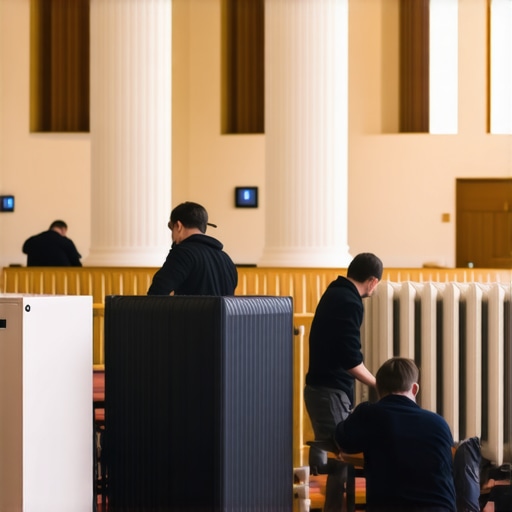
The Silence of the Sanctuary: A Forensic Diagnosis
There is a specific kind of silence that greets you when a 50-year-old boiler gives up the ghost in a sanctuary on a Saturday night. It’s a heavy, cold silence that smells like dust and impending failure. Most guys walk in and start quoting a six-figure replacement before they even check the sight glass. They see a church and think ‘payday.’ I see a church and think ‘physics problem.’ My old mentor, a man who could hear a bad bearing through three brick walls, used to scream at me, ‘You can’t cool—or heat—what you can’t touch!’ He was talking about the boundary layer of air, but in these massive sanctuaries, he was talking about the stack effect. You can pump all the BTU energy you want into the room, but if your airflow is junk, that heat is just congregating at the rafters while the deacons’ toes are freezing in the front row. Churches and large warehouse heating solutions share the same fundamental enemy: stratification. If you don’t control where the air goes, you’re just heating the roof shingles.
“The most expensive equipment in the world cannot overcome a bad duct system.” – Industry Axiom
1. The Hydronic Heart: Restoring the Flow
In many of these older buildings, we aren’t dealing with forced air; we are dealing with hydronic heating systems. These systems are beautiful when they work, but they are often neglected until a pipe bursts. I’ve seen churches where the ‘maintenance man’ just kept adding more ‘juice’ (water) to a leaking loop, diluting the glycol and inviting internal corrosion. By 2026, the tech has moved on to smarter pumps. We aren’t just looking at ‘on/off’ circulators anymore. We are looking at delta-P logic that senses when a zone is satisfied and slows the flow. This prevents that banging sound—the thermal expansion ‘hammer’—that interrupts the sermon. If your radiators are stone cold at the far end of the hall, you don’t need a bigger boiler; you need to balance the flow and check your air separators.
2. The Steam Humidifier and Wood Preservation
People forget that a church isn’t just a building; it’s an instrument. You’ve got a $100,000 pipe organ and pews made of solid oak. When you crank the heat in a northern winter, the relative humidity drops to desert levels. The wood shrinks, the organ goes out of tune, and the pews start to creak like a haunted house. This is where steam humidifiers become mandatory. Unlike those cheap bypass pads that grow mold, a dedicated steam canister injects pure vapor into the airstream. It’s the difference between a dry, scratchy throat and a comfortable environment. From a thermodynamic perspective, moist air holds heat better than bone-dry air. You can actually lower the thermostat by two degrees and feel warmer if the humidity is dialed in at 35%.
3. The 2026 Regulatory Cliff: SEER2 and R-454B
We are currently staring down the barrel of the biggest refrigerant transition since we moved away from R-22. If your church is planning a renovation, you need to understand the R-454B refrigerant transition services. The old gas is going the way of the dodo, and the new A2L refrigerants are ‘mildly flammable.’ That means new sensors, new leak detector integration, and new training for any sparky or tin knocker who touches the unit. Don’t let a ‘sales tech’ dump an old R-410A system on you just because it’s ‘on sale.’ You’ll be paying triple for the gas in five years. You need SEER2 compliant upgrades that are designed for the next decade of EPA mandates.
“Standard 62.1-2022 provides the minimum ventilation rates and other measures intended to provide indoor air quality that is acceptable to human occupants.” – ASHRAE Standards
4. Geofencing and Smart Controls for Erratically Used Spaces
A church is a thermal nightmare because it’s empty 80% of the week. You can’t just leave the heat at 70 degrees, but if you let it drop to 50, it takes twelve hours to recover the thermal mass of the stone walls. This is where geofencing temperature control comes in. Using smart sensors, the system can ‘look’ at the calendar and start a gradual ramp-up on Saturday night. It’s not just about a schedule; it’s about predictive logic. I’ve seen urgent furnace repair calls that were actually just thermostats being out-smarted by a sudden cold snap. By integrating sensors, we can ensure the basement classrooms and the main hall are ready exactly when the first person walks through the door.
5. Specialized Solutions: From Garages to Solar Integration
Sometimes the fix isn’t in the main sanctuary. I recently worked on a parish that had a detached workshop. A simple garage heater installation solved their ‘ice block’ storage problem for pennies on the dollar. More importantly, we are seeing a massive push for solar thermal heating integration. If you have a massive south-facing roof, you can use the sun to pre-heat your hydronic return water. It’s not magic; it’s just capturing sensible heat before your boiler has to burn a single therm of gas. And if the upfront cost is scary, look into financing for heat pump installs. There are more grants and rebates for non-profits right now than I’ve seen in 30 years in the trade.
Ultimately, comfort in a large building is a battle against the elements. You need to stop leaks before they start by ensuring leak detector integration is part of your preventative maintenance. Don’t let some guy with a bucket of pookie (mastic) and a roll of silver tape tell you he can fix a 15% efficiency loss. You need real airflow math. If you’re ready to stop guessing and start measuring, contact us today to get a real tech on your roof, not a salesman.