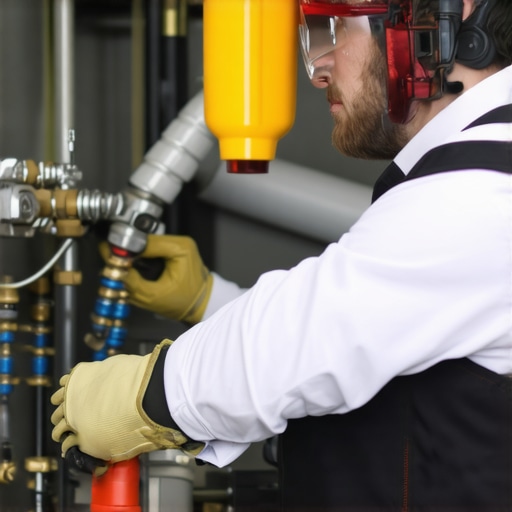
I have spent three decades crawling through frozen mud in Michigan basements and sweating in crawl spaces where the spiders are big enough to have names. If there is one thing that gets my blood pressure up more than a ‘Sales Tech’ trying to push a fifteen-thousand-dollar unit on a family that just needs a flame sensor cleaning, it is a hack job on a gas line. In 2026, with the push toward high-efficiency modulating furnaces and strict AFUE requirements, your gas line installation is no longer just a ‘hook it up and hope’ situation. It is a matter of precision physics and, frankly, not blowing your house off its foundation. Most furnace repair services I get called out for in the dead of winter aren’t actually equipment failures; they are delivery failures. If the furnace can’t breathe and it can’t eat, it won’t run. And gas is the food.
The Anatomy of a Sales Tech Scam: A Forensic Lesson
I followed a ‘Sales Tech’ last winter into a home where an elderly couple was shivering. The previous guy—a kid in a shiny shirt who probably had never touched a pipe wrench until his two-week ‘boot camp’—had told them their heat exchanger was ‘compromised’ and they needed a full replacement immediately. Total quote? $18,000 for a new system and ductwork. I walked in, smelled that familiar faint scent of mercaptan, and pulled out my digital manometer. I found a tiny leak at a union that had been installed without a drop of pipe dope. Ten minutes of tightening and a $20 service fee later, their furnace was purring at a perfect 3.5 inches of water column. That kid wasn’t a technician; he was a predator. This is why you need to understand the mechanics of your gas delivery. Whether you are dealing with furnace repair services or a fresh install, the gas line is the foundation of safety.
“Gas piping shall be sized and installed so as to provide a supply of gas sufficient to meet the maximum demand of all appliances served without undue loss of pressure.” – NFPA 54: National Fuel Gas Code
Mistake 1: The Missing or Improper Sediment Trap (The ‘Drip Leg’)
I cannot tell you how many ‘Tin Knockers’ skip the sediment trap because they think it’s ‘old school.’ In the world of high-efficiency 2026 equipment, this is a death sentence for your gas valve. A sediment trap is a simple tee and a nipple that uses gravity to catch moisture and debris before it hits the delicate internals of your furnace. If that junk gets into a modulating gas valve, you are looking at an expensive modulating furnace repair. The gas isn’t perfectly clean; there are bits of scale from the iron pipe and moisture that can freeze. Without that trap, those particles act like sandpaper on the valve seats. If your tech doesn’t install a proper 3-inch nipple below the tee, they are setting you up for a ‘No Heat’ call in three years.
Mistake 2: BTU Starvation from Undersized Piping
People love to save money by using 1/2-inch CSST (Corrugated Stainless Steel Tubing) for long runs because it’s easy to pull through a crawl space. But here is the thermodynamic reality: friction loss is real. If you have a 100,000 BTU furnace and a water heater on the same line, and you’ve run 50 feet of 1/2-inch pipe, that furnace is going to ‘starve’ when the temperature hits zero. When the unit starts up, the gas pressure drops, the flame gets lazy, and the control board starts throwing codes. You’ll be calling for control board diagnostics when the real problem is that your pipe is too small. I see this often in crawl space heating solutions where accessibility issues lead to lazy plumbing. Always check the pressure at the gas valve under full load; if it drops below the manufacturer’s spec, your pipe is a straw trying to feed a fire hose.
Mistake 3: Improper Use of Sealants (The Pookie and Tape Problem)
Gas threads require a specific type of sealant. I’ve seen guys use ‘Pookie’ (duct mastic) or standard white plumber’s tape. This is a recipe for a disaster. You need yellow PTFE tape or a high-grade pipe dope that is resistant to petroleum products. But here is the pro tip: never put dope on the first two threads. Why? Because when you tighten that fitting, the excess dope gets pushed into the pipe, where it eventually breaks off and clogs the orifice. In 2026, our orifices are smaller than ever to meet efficiency standards. A single fleck of dried pipe dope can cause a flame rollout or a partial clog that triggers your predictive maintenance alerts. It’s about the details—hand-tight plus two turns with the pipe wrench, no more, no less.
“Failure to provide adequate combustion air and proper venting for gas-fired appliances can lead to the accumulation of carbon monoxide, a colorless, odorless gas that can be fatal.” – ASHRAE Standard 15
Mistake 4: Ignoring the Importance of a Carbon Monoxide Detector Installation
Every time you touch a gas line, you are altering the combustion system of the home. I don’t care if you are doing hotel boiler services or a small residential furnace; a carbon monoxide detector installation is mandatory, not optional. If that gas line isn’t pitched correctly, or if the pressure is too high (over-firing), you produce lethal amounts of CO. A common mistake is not checking the manifold pressure. If it’s too high, you crack the heat exchanger. If it’s too low, you get incomplete combustion. Both lead to the ‘silent killer.’ I always tell my apprentices: if you wouldn’t sleep in that house tonight with the work you just did, don’t you dare pack up your tools. Safety is the only metric that matters in the North when the wind is howling and the snow melt systems installation is buried under two feet of powder.
The Forensic Verdict: Repair vs. Replace
So, your gas line is a mess—what do you do? If the line is old black iron and it’s leaking at multiple joints, it’s often cheaper to pull a new run of CSST (properly sized!) than to try and hunt down every leak in a 50-year-old system. If you are looking at a $800 repair on an old line versus a $1,200 new run, take the new run. It’s about long-term reliability. We see this in specialty installs too, like pool heater repair or evaporative cooler services where the environment is harsh. Gas line integrity is non-negotiable. Don’t let a ‘Sales Tech’ scare you into a new furnace if your gas pressure is the only thing that’s wrong. Get a manometer, check the ‘juice,’ and make sure the ‘Tin Knocker’ who did the install actually knew their physics. Comfort is a science, and in 2026, we have the tools to get it right the first time.
{“@context”:”https://schema.org”,”@type”:”HowTo”,”name”:”Gas Line Inspection for Furnaces”,”step”:[{“@type”:”HowToStep”,”text”:”Verify gas pressure using a digital manometer at the inlet of the gas valve.”},{“@type”:”HowToStep”,”text”:”Inspect the sediment trap for proper length and orientation to ensure debris collection.”},{“@type”:”HowToStep”,”text”:”Apply yellow PTFE tape or pipe dope to threads, excluding the first two threads.”},{“@type”:”HowToStep”,”text”:”Perform a leak test using an electronic gas sniffer or certified bubble solution.”},{“@type”:”HowToStep”,”text”:”Install a carbon monoxide detector within 10 feet of the furnace area for safety.”}]}