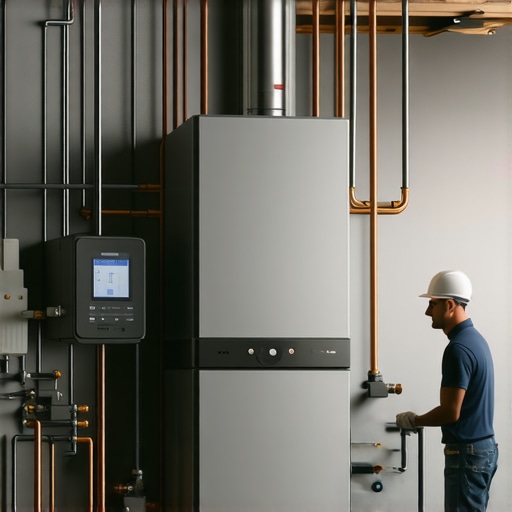
The HVAC industry is staring down a regulatory cliff, and if you are still clinging to the old ways of ‘bang-on, bang-off’ heating, 2026 is going to be a rude awakening. We are witnessing the death of the R-410A era, and as we pivot into the R-454B refrigerant transition services, the entire anatomy of residential comfort is being rewritten. For the homeowner, this isn’t just about a new box in the basement; it is about surviving the transition to ‘mildly flammable’ A2L refrigerants and the high-efficiency demands of a modern grid. As a technician who has spent three decades dragging manifolds through crawlspaces, I can tell you that the single-stage furnace is becoming a dinosaur, and for good reason.
The Physics of Comfort: A Mentor’s Lesson
My old mentor, a grizzled tin knocker who could smell a cracked heat exchanger from the driveway, used to scream at me, ‘You can’t heat what you can’t touch!’ He was talking about the surface area of the heat exchanger and the velocity of the air moving across it. This is the fundamental flaw of the cheap single-stage furnaces that sales techs love to push. Those units are binary; they are either 100% on or 100% off. When they kick on, they blast the heat exchanger with a massive flame, the metal expands with a loud ‘oil canning’ thud, and they shove a wall of 140-degree air into your living room. The thermostat hits the target, the fire dies, and the metal shrinks. It is violent, inefficient, and it destroys the longevity of the equipment. If you are tired of those wild temperature swings, you need to understand choosing the right HVAC fixes before you commit to another decade of discomfort.
“Proper sizing and installation of HVAC systems are critical to achieving energy efficiency and occupant comfort. The most expensive equipment in the world cannot overcome a bad duct system.” – Industry Axiom (ACCA Manual J)
The Two-Stage Advantage: Thermodynamic Zooming
Why are homeowners switching in 2026? It comes down to the gas valve and the inducer motor. A two-stage furnace has a high and a low setting. Most of the time—about 80% of the winter—your home only needs a gentle nudge of heat to maintain temperature. On its low stage, the furnace runs at roughly 65% capacity. This allows for longer run times, which sounds counterintuitive for saving money, but it is actually the secret to efficiency. Longer run times mean the air is constantly being filtered and moved, preventing the ‘stratification’ where your head is hot and your feet are freezing. When the ‘Polar Vortex’ actually hits, the second stage kicks in to provide that 100% capacity. This prevents the short-cycling that kills compressors and control boards alike. Speaking of which, modern control board diagnostics have become so advanced that they can practically tell us which ‘Sparky’ wired the thermostat wrong before we even open the cabinet.
The Regulatory Cliff: R-454B and the 2026 Shift
We are currently navigating the most significant shift in HVAC history since the phase-out of R-22. The transition to R-454B (an A2L refrigerant) means that new systems are equipped with leak sensors and mitigated airflow protocols. If you are planning multi-family heating upgrades, you cannot ignore these changes. The new equipment is designed to handle the different pressure-temperature relationships of these gases. If you try to slap an old coil on a new furnace, you are asking for a disaster. This is why HVAC load calculation services are no longer a ‘luxury’—they are a requirement. You cannot guess the ‘tonnage’ by looking at the square footage anymore. If you do, you’ll end up with an oversized unit that short-cycles, leaving your home damp and your energy bills astronomical. We see this often in commercial settings too, where a restaurant kitchen exhaust repair reveals that the entire building’s pressure is out of whack because someone didn’t account for the makeup air.
The Anatomy of a Modern Installation
When we install a two-stage system, we aren’t just swapping boxes. We are looking at the ‘Pookie’ (mastic) on the plenums to ensure zero leakage. We are performing system performance testing to measure the static pressure. High static pressure is the ‘silent killer’ of blower motors; it’s like trying to breathe through a cocktail straw while running a marathon. For those interested in the nitty-gritty, you should look into expert tips for 2025 success. We also look at the integration with app-controlled heating systems. In 2026, your furnace should talk to your phone, notifying you of a failing pressure switch before your pipes freeze. Whether it is a standard furnace or a specialized pool heater repair, the logic remains the same: precise fuel-to-air ratios and managed thermal stress.
“The designer shall use the cooling load to select the evaporator coil and the heating load to select the furnace capacity.” – ASHRAE Standard 62.2
The Financial Trap: Why Cheap is Expensive
I followed a ‘Sales Tech’ last week who quoted a family a ‘bargain’ single-stage unit. He didn’t mention that the utility rebates for two-stage and modulating furnaces actually make the net cost lower in many cases. He didn’t mention that the warranty service plans on these high-end units often cover labor for the first five years, whereas the cheap ‘builder grade’ units leave you high and dry when the ‘gas/juice’ leaks out. To avoid these traps, I highly recommend reading up on AC installation secrets. Real HVAC maintenance plans are about more than just changing a filter; they involve checking the flame rectification (microamps), cleaning the condensate trap (where the ‘sour’ smell of mold lives), and ensuring the heat exchanger hasn’t developed the dreaded hairline cracks that lead to carbon monoxide issues. If you suspect your current unit is on its last legs, knowing when furnace repair is urgent can literally save your life.
Conclusion: Don’t Buy Yesterday’s Tech
If you are in a cold climate, the 2026 switch to two-stage technology isn’t a luxury—it is a necessity for energy management and indoor air quality. From preventative HVAC repair tips to the final ‘beer can cold’ check on the suction line during a summer start-up, every step of the process matters. Don’t let a ‘trunk slammer’ or a high-pressure salesman talk you into a system that will be obsolete before the decade is out. Get a real Manual J, demand a two-stage burner, and ensure your ductwork is sealed with Pookie, not duct tape. If you’re ready to upgrade properly, contact us today for a technical assessment that treats your home like the thermodynamic system it is.