The Regulatory Cliff: Why Your 2025 Heating Strategy Is Already Obsolete
Listen, I’ve spent thirty years crawling through damp crawl spaces and dragging my knuckles across jagged ductwork, and I’m telling you right now: the industry is about to hit a wall. As we barrel toward 2026, the R-454B refrigerant transition services are no longer just a bullet point in a trade magazine; they are the new reality. If you’re still thinking about a standard heat pump to handle a brutal northern winter, you’re missing the forest for the trees. The 2025-2026 shift toward A2L refrigerants—which are ‘mildly flammable’—means every installation is getting more complex, more regulated, and significantly more expensive. This is why smart money is moving toward hydronic solutions like snow melt systems and radiant floor heating installation. My old mentor, a grizzly veteran who could diagnose a bad blower motor replacement just by the vibration in the floorboards, used to scream at me, ‘You can’t cool what you can’t touch, and you can’t heat what you don’t control!’ He was talking about the physics of thermal mass. While forced-air systems struggle to push lukewarm air against a 10°F draft, a snow melt system uses the ground itself as a thermal battery.
“Hydronic snow melting systems provide a high degree of safety and significantly reduce the labor associated with snow removal.” – ASHRAE Applications Handbook
The ‘Sales Techs’ out there—the guys in the shiny white shirts who couldn’t tell a capacitor from a contactor—will try to sell you a high-efficiency furnace with a fancy sticker. But they won’t tell you about the static pressure nightmare that happens when your outdoor unit gets buried in a drift, causing the compressor to scream until the internal thermal overload snaps. In the North, the enemy isn’t just the cold; it’s the ice. Ice dams on your roof and black ice on your driveway are mechanical failures of your home’s envelope. By integrating snow melt systems into your 2026 winter plan, you’re not just being lazy about shoveling; you’re protecting the structural integrity of your property. We’re seeing a massive surge in heating service innovations transforming 2025 climate control, and hydronics are at the forefront because they don’t rely on blowing dusty air through ‘Pookie’-smeared tin. Instead, they use a mixture of water and propylene glycol—the ‘juice’—circulating through oxygen-barrier PEX tubing to turn your driveway into a radiant radiator.
Thermodynamic Zooming: The Physics of Melting Ice
When we talk about snow melt, we’re talking about latent heat. To turn one pound of 32°F ice into 32°F water, you have to inject 144 BTUs of energy. That’s before you even raise the temperature of the water by one degree. Most residential systems fail because they weren’t sized for this ‘slug’ of energy. This is where a proper efficient HVAC repairs mindset comes in. You need a boiler with a high AFUE rating and an Energy Star heating certification to handle that initial load without cracking the heat exchanger. If your boiler is cycling on and off like a heartbeat on caffeine, you’re going to be looking for a furnace repair is urgent call faster than you can say ‘polar vortex.’ We look at the ‘sensible heat’ of the pavement—the actual temperature you can feel—and calculate the bridge between the sub-grade and the ambient air. It’s not magic; it’s a math problem involving flow rates and Delta T.
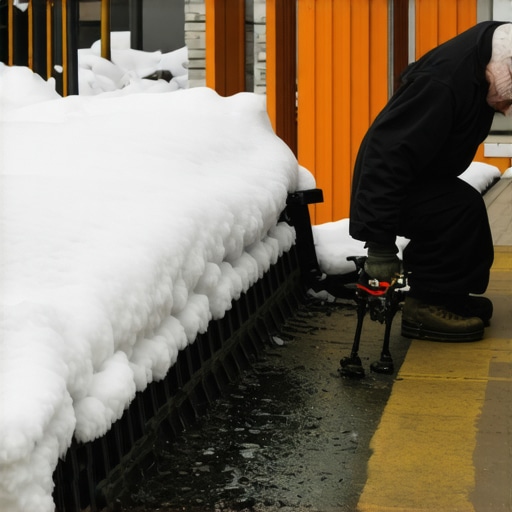
I remember a job last January where a client had a ‘Tin Knocker’ install a standard furnace in a renovated garage, but neglected the floor. The furnace was running 24/7, the blower motor replacement was inevitable because of the high static, and the owner was still shivering. I walked in, felt the ice-cold concrete sucking the heat right out of the room, and told him, ‘You’re trying to fill a bucket with a hole in the bottom.’ We eventually went in with radiant floor heating installation and a snow melt loop for his walkway. Suddenly, the furnace barely had to kick on. This is the future: the integration of furnace repair myths debunked by actual physics. Many homeowners think snow melt is a luxury, but when you factor in the cost of salt damage to your masonry and the liability of a slip-and-fall, the ROI starts to look a lot better than a $15,000 ‘Sales Tech’ special. [IMAGE_PLACEHOLDER]
The A2L Refrigerant Transition: Why Hydronics are Safer
The R-454B refrigerant transition services are making everyone nervous because the new ‘Gas’ requires specialized leak sensors and potentially spark-proof electrical components. If you’re worried about a ‘Sparky’ (electrician) having to rewire your whole mechanical room for a new AC, you should consider that hydronic snow melt systems are inherently decoupled from these refrigerant headaches. A boiler-based hydronic system is a closed loop of water. There’s no risk of a refrigerant leak in your bedroom or under your driveway. Furthermore, with programmable thermostat programming that uses outdoor reset curves, your system knows the snow is coming before the first flake hits the ground. It pre-heats the slab to 38°F, so the snow melts on contact rather than piling up and requiring a massive energy spike to clear. This is the difference between a pro setup and a DIY disaster. Even your choosing the right HVAC fixes should include a look at your crawl space heating solutions, as frozen pipes are often the first sign that your home’s thermal boundary is failing.
“The most expensive equipment in the world cannot overcome a bad duct system—or a poorly insulated slab.” – Industry Axiom
When I’m out on a call for a capacitor replacement services or a blower motor replacement, I always check the manifold of the radiant system if they have one. You can tell a lot about a technician by how they lay out their ‘PEX’ and if they used enough ‘Pookie’ to seal the penetrations. A clean manifold is the mark of a craftsman; a tangled mess of copper and zip ties is the mark of a hack who’s just looking for his next commission. For 2026, you want a system backed by comprehensive warranty service plans. Don’t let someone install a snow melt system and then disappear when the first sensor fails. You need a tech who understands that these systems are living, breathing organisms that require annual maintenance—checking the glycol PH levels and ensuring the circulator pumps aren’t cavitating.
HVAC Repair and the Longevity of Modern Systems
The North/Cold climate zone is brutal on equipment. We see flame rollout issues from clogged vents and cracked heat exchangers from years of stress. If you’re already investing in top HVAC repair strategies, adding a snow melt system is the logical next step in home automation. You can even tie in whole-home humidifiers to the same boiler system via a heat exchanger, ensuring that while your driveway is clear of ice, your indoor air isn’t as dry as a desert bone. Dry air leads to static shocks and cracked wood floors; it’s another symptom of a ‘scorched air’ heating system that hasn’t been properly balanced. In 2026, the goal is total climate control, from the tip of your driveway to the air in your master suite. This isn’t just about comfort; it’s about engineering a home that works with the laws of thermodynamics rather than fighting them. Stop listening to the ‘Sales Techs’ and start listening to the guys who actually know how to use a multimeter and a pipe wrench. Your home—and your back—will thank you when the first blizzard of 2026 hits.