The Ghost in the Basement: The Stench of Old Oil
If you have lived with an oil furnace for more than a decade, you know the smell. It is a heavy, metallic, slightly sweet but mostly oily scent that clings to the concrete walls of your mechanical room. You also know the sound of the delivery truck rolling up the driveway in a snowstorm, the driver dragging a heavy hose across your frozen lawn, and the inevitable anxiety of checking the float gauge on that rusty 275-gallon tank when the temperature drops to single digits. I have spent 30 years in the trade, and I can tell you that the oil delivery cycle is a relic of a bygone era, a mechanical ball-and-chain that keeps homeowners tethered to fluctuating fuel prices and the constant fear of a ‘run-out’ at 3 AM on a Sunday.
I remember following a ‘Sales Tech’—one of those guys who wears a clean white shirt and spends more time on his iPad than with a multimeter—into a basement in the middle of a polar vortex. He had quoted this homeowner $15,000 for a new oil-fired boiler, claiming the old one was ‘leaking radiation.’ Total nonsense. I looked at the unit; the CAD cell was just fouled with soot because the nozzle hadn’t been changed in years. But as I stood there in the oil-slicked puddle, I told the owner the truth: I could fix the burner for $200, but she’d still be paying $4.50 a gallon for fuel and praying the delivery truck didn’t slide off the road. That is when we talked about the gas conversion. It is not just about the fuel; it is about the physics of combustion and the freedom of a utility pipe that never runs dry.
The Forensic Diagnosis: Why the Oil Beast is Dying
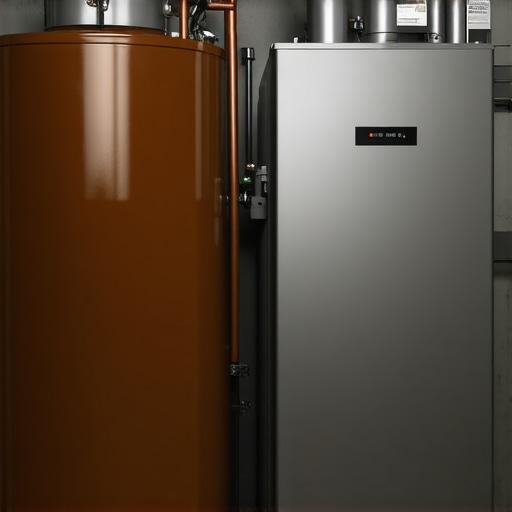
When we look at the mechanical anatomy of an oil system, we are looking at a complex, high-maintenance machine. You have the burner motor, the fuel pump, the ignition transformer, and the nozzle. It’s essentially a jet engine strapped to a heat exchanger. Because oil is a ‘dirty’ fuel, it leaves behind sulfur and carbon deposits. If you aren’t on a strict HVAC maintenance plan, that soot acts like an insulator on your heat exchanger, forcing the system to work harder to transfer sensible heat to your home. In the HVAC trade, we call this ‘fighting the scale.’
Compare that to a modern natural gas furnace. Gas is a vapor. It mixes with air almost perfectly. There are no tanks to leak, no pumps to fail, and no nozzles to clog. When you switch to gas, you move from a system that requires a ‘clean and tune’ every single year just to stay functional to one that is inherently cleaner and more reliable. In a cold climate, the difference in reliability isn’t just about comfort; it is about preventing frozen pipes. I have seen too many flooded basements because an oil pump’s coupling sheared while the family was away for the weekend.
“Proper sizing and selection of heating and cooling equipment shall be based on a building load calculation, such as ACCA Manual J.” – Industry Axiom
Most of these old oil systems were oversized by 50% or more. The ‘Tin Knockers’ of the 1970s just threw in the biggest unit they could find. When we do a new construction heating design or a conversion, we find that a smaller, more efficient gas unit actually keeps the house warmer because it runs longer cycles, providing more consistent air movement rather than the ‘blast and quit’ strategy of the old oil beasts.
The Airflow Manifesto: Why the Fuel is Only Half the Battle
You can put the most expensive gas furnace in the world in your basement, but if your ductwork looks like a spiderweb of leaky tape and crushed flex, you are still throwing money away. Airflow is king. Period. I have seen 95% AFUE furnaces delivering only 60% of their heat to the rooms because the return air drops were pulling in freezing air from the crawlspace. This is where HVAC duct sealing becomes the unsung hero of the conversion process. We use ‘Pookie’—that thick, gray mastic sealant—to bridge the gaps in the tin. If you don’t seal your ducts, you’re essentially trying to fill a bucket with a hole in the bottom.
In northern climates, where the ground freezes solid, we also see a huge uptick in the desire for snow melt systems installation. When you have a gas line already run to the house for heating, adding a boiler for a radiant snow-melt system becomes a reality. Imagine never shoveling your driveway again because the waste heat from your high-efficiency system (or a dedicated boiler) is keeping the pavement at 35 degrees. That is the kind of luxury you just can’t practically achieve with an oil-delivery setup without a massive, unsightly tank in the yard.
The Regulatory Cliff and Modern Integration
As we move into 2025, the industry is shifting hard. We are seeing app-controlled heating systems become the standard. You can’t easily monitor an oil tank from your phone without expensive third-party sensors that usually fail after two seasons. But with a modern gas furnace, leak detector integration and smart thermostats allow you to see exactly how your system is performing from anywhere in the world. If the flame sensor gets dirty, your phone pings you before the house gets cold.
“The most expensive equipment in the world cannot overcome a bad duct system.” – Industry Axiom
We are also seeing more homeowners opt for UV light installation for HVAC during these conversions. Since we are already opening up the plenum to install a new gas-compatible evaporator coil or furnace, it’s the perfect time to address indoor air quality. Oil furnaces are notorious for ‘oil canning’ and vibrating, which shakes loose all sorts of dust and debris into the air stream. A clean gas install with a sealed cabinet and UV sterilization is like giving your house a new set of lungs.
The Economics: Repair vs. Replace
Let’s talk numbers. A typical oil-to-gas conversion involves running a gas line from the street (if available) or setting up a large propane tank, and then installing the new furnace and venting it through a PVC pipe (for high-efficiency) or a chimney liner. You are looking at an investment of $6,000 to $12,000 depending on the complexity. However, the fuel savings alone often pay for the system in 5 to 7 years. When you factor in the avoided cost of a $500 ‘clean and tune’ every year and the occasional $1,000 emergency repair for a failed oil pump or burner motor, the math becomes a no-brainer.
If you are in a shop environment, shop heater services for gas units are significantly cheaper than maintaining old overhead oil units that drip on the floor and smoke out the bay. And for those in warmer northern pockets where humidity still bites in the summer, remember that your new gas furnace blower is likely a variable-speed motor that will improve your AC’s ability to remove latent heat, stopping that ‘cold and clammy’ feeling.
Final Thoughts from the Attic
Stop waiting for the delivery truck. Stop sniffing the air for oil leaks. The transition to gas heating is about more than just a different flame; it is about modernization, safety, and taking control of your home’s thermodynamics. Whether you are looking into choosing the right HVAC fixes or planning a full system overhaul, remember that airflow and proper installation trump brand names every time. Don’t let a ‘Sales Tech’ talk you into another decade of oil-fed headaches. Find a tech who knows his ‘Pookie’ from his elbow and get your ductwork sealed and your fuel source modernized. Your wallet, and your nose, will thank you.