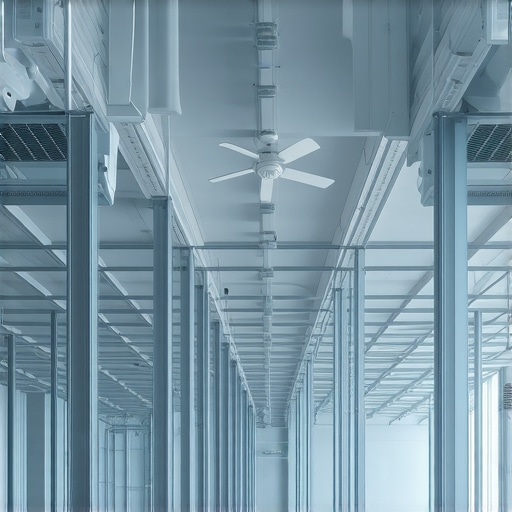
The Physics of the Void: Why High Ceilings Kill Efficiency
In thirty years of crawling through the guts of industrial HVAC systems, I have learned one immutable truth: air is lazy. It does not want to go where you tell it to; it wants to find the path of least resistance and stay there. When you are dealing with a thirty-foot clear height in a warehouse, you aren’t just heating or cooling a room; you are managing a massive, invisible fluid mass that obeys the laws of thermodynamics with brutal indifference. Most guys walk into a warehouse and see a big empty space. I see a battlefield where stratification is the enemy. My old mentor used to scream at me until he was blue in the face: ‘You can’t cool what you can’t touch!’ He would stand on a ladder, pointing at a massive 20-ton rooftop unit, and yell about surface area contact. He was right. If the air coming out of your diffusers isn’t physically scrubbing the floor and the inventory, you are just throwing money into the rafters. This is why airflow matters more than raw horsepower. You can have the biggest, baddest inverter-driven compressors on the market, but if your duct design services were handled by someone who thinks a ‘Tin Knocker’ is just a guy with a hammer, you are doomed to fail.
‘The most expensive equipment in the world cannot overcome a bad duct system.’ – Industry Axiom
The Anatomy of Stratification: Why Your Feet Are Freezing
In northern climates, where school boiler maintenance and heavy-duty heating are part of the daily grind, the biggest hurdle is the vertical temperature gradient. Heat rises. That is middle school science. But in a warehouse, that heat sits twenty feet above the heads of your pickers, while they shiver on the concrete floor. This is sensible heat doing exactly what it wants. To combat this, we have to look at the throw and spread of the air. If the air velocity drops too low before it hits the floor, it loses its momentum and floats right back up. We use new construction heating design principles to ensure the static pressure is high enough to ‘punch’ through that layer of stagnant air. It is not just about the BTU output of the furnace or the boiler; it is about the velocity at the register. When I see a system short-cycling, usually it is because a limit switch replacement is needed because the heat exchanger is getting too hot, simply because the air can’t move out fast enough. The ‘Juice’ is there, the ‘Gas’ is burning, but the air is stuck. We use HVAC duct sealing and high-grade ‘Pookie’ (mastic) to ensure every cubic foot of air we paid to heat actually makes it to the target zone.
The Thermodynamic Zoom: Latent Heat and the Coil
Let’s talk about the summer. When that inverter-driven compressor starts ramping up, we are dealing with more than just the temperature on the thermostat. We are dealing with latent heat—humidity. In a massive warehouse, a standard on-off compressor is a disaster. It hits the setpoint, shuts down, and the humidity immediately begins to climb back up. This is where the house (or in this case, the warehouse) starts feeling like a cold swamp. An inverter-driven system allows the evaporator coil to stay below the dew point for longer periods, constantly wringing the moisture out of the air. It is a slow, steady pull rather than a violent blast. This is similar to how we handle spa heater services; you don’t want a sudden spike, you want consistent thermal management. If the transformer replacement was done poorly and the control voltage is sagging, these high-tech compressors won’t even start. They need clean power to manage the complex math of refrigeration. We look for ‘beer can cold’ on the suction line, but we also look at the psychrometric chart to make sure we aren’t just cooling the air, but drying it out so the workers stay productive.
‘Proper air distribution is the delivery of conditioned air to the occupied space at a velocity and temperature that provides comfort.’ – ASHRAE Standards
Maintenance and the Mechanical Lifecycle
I’ve seen plenty of ‘Sales Techs’ try to tell a warehouse manager they need a $100,000 system overhaul when all they really had was a failed flue pipe installation or a cracked heat exchanger that was causing a safety rollout. You don’t always need new iron; sometimes you just need a transformer replacement and a tech who knows how to read a multimeter. In massive commercial settings, school boiler maintenance techniques carry over well. You check the safeties, you check the combustion, and you ensure the limit switch replacement isn’t just a band-aid for an airflow problem. For warehouses with subterranean components, crawl space heating solutions might even be necessary to prevent floor-level pipes from freezing, which would lead to a catastrophic shutdown. Whether it is a specialized spa heater services call for a luxury facility or a massive industrial air handler, the physics remain the same. You need to seal the ducts with Pookie, ensure the flue pipe installation meets code for safety, and never trust a guy who doesn’t mention static pressure within the first ten minutes of an estimate. For more on how to keep your systems running, check out preventative HVAC repair tips for year-round efficiency and understand the ultimate guide to ac installation expert tips for 2025 success. Real comfort isn’t a setting on a thermostat; it is a result of calculated duct design services and the relentless pursuit of perfect airflow.