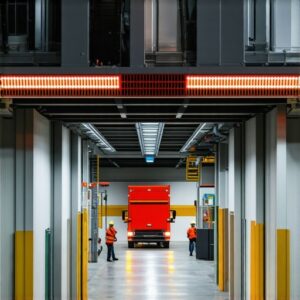
I followed a guy out to a 60,000-square-foot distribution center last February who was ready to fire his entire maintenance crew. He’d just received a $12,000 gas bill, and a ‘Sales Tech’ from a big-box franchise had told him his three main boilers were ‘end-of-life’ and needed a $90,000 replacement. I spent twenty minutes with my combustion analyzer and found that the previous tech hadn’t even looked at the burners; they were pulling 25% excess air because of a warped manifold. A $150 part and a few hours of labor saved that man nearly a hundred grand. That’s the problem with the HVAC industry today—too many guys are looking for a commission check instead of looking at the physics of the building. When your warehouse heating bills spike, it’s rarely a catastrophic equipment failure; it’s usually a failure of maintenance or a misunderstanding of how massive air volumes behave in a cold climate.
The Mechanical Anatomy of Warehouse Inefficiency
In a warehouse environment, we aren’t just heating people; we are heating concrete, steel, and inventory. This is sensible heat at a massive scale. If your shop heater services aren’t accounting for the stratification of air, you’re literally burning money to keep the ceiling fans warm. Most of these facilities rely on high-output unit heaters or massive air handlers. When bills spike, the first place I look isn’t the thermostat—it’s the control board diagnostics. A glitching board might be ‘short cycling’ the unit, firing it up for three minutes and shutting it down before the heat exchanger even reaches its steady-state efficiency. This ‘jackrabbit’ operation eats gas and kills transformers.
“The most expensive equipment in the world cannot overcome a bad duct system or improper combustion setup.” – Industry Axiom
If you’re dealing with a hydronic system, boiler maintenance services are non-negotiable. I’ve seen 2-million BTU boilers scaled up so thick that the heat transfer rate dropped by 40%. You’re paying for the ‘juice’ (gas), but it’s going out the flue pipe instead of into the water. This is why we perform a combustion analysis. I’m looking at the CO2 levels and the stack temperature. If that stack is too hot, your money is literally flying away into the atmosphere. Proper tuning ensures that the air-to-fuel ratio is tight, preventing the acidic buildup that eats through heat exchangers in the North’s brutal winters.
Airflow is King: The MERV Filter Trap
Every ‘Tin Knocker’ knows that you can’t heat what you can’t move. In a warehouse, dust is the enemy. I’ve walked into shops where the air filters were so clogged they were being sucked into the blower wheel. People think MERV filter upgrades are always a good thing, but if you put a MERV 13 filter on a system designed for a MERV 4 ‘rock catcher,’ you’re going to kill your static pressure. High static pressure makes the motor work harder, draws more amps, and eventually leads to an air handler repair that could have been avoided with a $10 pleated filter. When the motor can’t push air across the heat exchanger, the exchanger overheats. In a furnace, this leads to cracked steel; in a boiler system, it leads to localized boiling and ‘kettling.’ Check out these efficient HVAC repairs to see how we balance airflow for maximum output.
The Electrical Heart: Wiring and Transformers
Sometimes the spike isn’t in the gas bill, but the electric. I’ve seen wiring repair for heating systems become necessary because a ‘Sparky’ didn’t tighten a lug on a 460V contactor. That loose connection creates resistance, resistance creates heat, and heat melts insulation. Before you know it, you’ve got a transformer replacement on your hands because the 24V control circuit got fried by a line-voltage spike. If your warehouse heaters are hummed or buzzing, that’s the sound of a bearing failing or a coil vibrating. Don’t ignore it. If you want to avoid these emergency calls, look into preventative HVAC repair tips that keep the electrical components in check before they pop.
“Design of commercial heating systems must prioritize the distribution of air to the occupied zone to minimize wasted energy in high-ceiling environments.” – ASHRAE Standards
We also need to talk about smart thermostat setup. In a warehouse, you don’t need the whole floor at 72 degrees at 3 AM. However, many ‘smart’ systems are programmed by people who don’t understand recovery time. If you let a warehouse drop to 50 degrees overnight, your heaters will run for six hours straight just to warm up the concrete slabs the next morning. That’s not efficiency; that’s a torture test for your equipment. I recommend priority service memberships so that a pro can calibrate your setbacks to find the ‘sweet spot’ where you save money without straining the system.
The Regulatory Cliff and 2025 Standards
As we move into 2025, the industry is shifting. Whether it’s the transition to A2L refrigerants in split systems or higher AFUE requirements for gas-fired equipment, the cost of ignorance is going up. If your shop heater is more than 15 years old, you’re likely running at 70% efficiency at best. Modern condensing units can hit 95%+. For a warehouse, that 25% difference is thousands of dollars a month. You need to know how to identify when furnace repair is urgent versus when it’s time to scrap the unit and go for a high-efficiency replacement. When I see ‘Pookie’ (mastic) slathered over a cracked heat exchanger, I know the client has been scammed by a ‘Sales Tech’ who didn’t want to explain the physics of why that unit is a literal death trap.
The Forensic Diagnosis: When to Pull the Plug
If you’re facing a $4,000 repair on a $10,000 unit, the math is simple. But in a warehouse, the math includes the ‘cost of downtime.’ If your boiler goes down and your wet-pipe sprinkler system freezes, you’re looking at a multi-million dollar disaster. This is why we push for combustion analysis and regular maintenance. It’s not about the $200 service fee; it’s about the insurance policy that your building will still be standing in February. If you’re unsure about your current system’s health, contact us for a real tech to come out, not a salesman in a clean uniform. We’ll look at the ductwork, check the gas pressure, and tell you exactly why your bills are spiking—physics doesn’t lie.