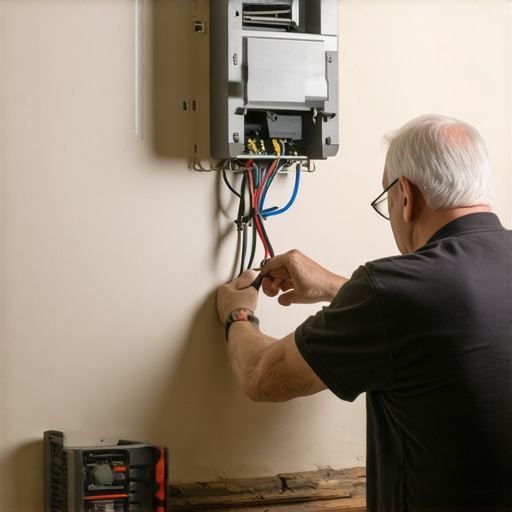
The Sound of Silence: When Your DIY Project Kills the Heat
There is a specific kind of silence that happens in a 1920s craftsman home during a January freeze. It is not the peaceful silence of a sleeping family; it is the heavy, suffocating silence of a dead boiler and a cracked pipe waiting to happen. I remember standing in a basement in the middle of a polar vortex, the homeowner looking at me with a ‘smart’ thermostat in his hand and a look of pure regret on his face. My old mentor, a man who could smell a gas leak from the curb, used to scream at me, ‘You can’t heat what you can’t control, and you can’t control what you don’t understand!’ This is why airflow and control logic matter more than any fancy touch-screen interface. Homeowners think they are just swapping two wires. In an older home, they are often playing Russian Roulette with their transformer replacement budget.
“The most expensive equipment in the world cannot overcome a bad duct system or improper control wiring.” – Industry Axiom
The Physics of Control: Why Older Homes Resist the Future
In the North, where we rely on cold climate heat pumps and hydronic heating systems, the thermostat isn’t just a switch; it’s the brain of a thermodynamic operation. In older homes, the wiring wasn’t designed for the power-stealing circuitry of modern Wi-Fi devices. When you try to force a modern ‘smart’ brain onto a vintage skeletal system, you often end up with ‘ghost’ signals. This is where thermodynamic zooming comes in. You see, the thermostat’s job is to manage the sensible heat—the temperature you feel—but it also manages the cycle rate which impacts the equipment’s ability to handle latent heat during the humid summer months. If you miswire that DIY unit, you might force the system into ‘short cycling,’ where the compressor kicks on and off so fast it never hits its stride, leaving the air damp and the contactor repair bill high.
The Transformer Trap and the 24V Nightmare
Most modern thermostats require a ‘C’ or common wire to provide constant 24V power. Most homes built before 1980 don’t have one. The ‘Sales Tech’ at the big box store will tell you to just use an adapter or ‘jump’ it. That is how you fry a 40-year-old control board. I’ve seen DIYers accidentally send line voltage (120V) through a 24V circuit. The result? A transformer replacement that could have been avoided. This isn’t just about a blown fuse; it’s about the integrity of the entire electrical path. If you aren’t a Sparky or a seasoned tech, you won’t realize that the old mercury bulb thermostat was a simple mechanical bridge, while the new digital unit is a micro-computer that hates voltage spikes. When the transformer dies, the whole house goes dark on the HVAC front, and that’s when you’re looking at urgent furnace repair scenarios in the dead of night.
The Carbon Monoxide Risk: More Than Just a Temperature Reading
The biggest danger in older homes isn’t a cold house—it’s a poisonous one. When you DIY a thermostat and mess up the furnace’s sequencing, you can cause ‘short-cycling’ that leads to premature cracks in the heat exchanger. This is why carbon monoxide detector installation is non-negotiable. If the thermostat tells the furnace to shut down before the flue has properly drafted, you get back-drafting of combustion gases. It’s why furnace repair myths that suggest ‘any thermostat works’ are so dangerous. A professional furnace tune-up service includes checking the thermostat’s anticipator settings to ensure the burner stays on long enough to vent those gases safely. You aren’t just adjusting the temperature; you are managing a combustion event inside your living room.
“Improperly integrated controls in fossil-fuel appliances pose a direct risk to indoor air quality and occupant safety.” – ASHRAE Standards
Static Pressure and Duct Design: The Invisible Enemies
Many older homes suffer from terrible duct design services performed decades ago. When you add a smart thermostat that attempts to ‘learn’ your habits, it often ends up fighting the physics of the house. In cold climates, we deal with the ‘Balance Point’—the temperature where a heat pump can no longer keep up and the backup heat must kick in. A DIYer rarely knows how to program these ‘auxiliary heat’ lockout points. The result? You’re running expensive electric heat strips when you should be using the heat pump, or worse, you’re freezing your coils. Professionals use energy recovery ventilators to manage air exchange, ensuring that while the thermostat is keeping you warm, you aren’t breathing stale, recycled air. If your thermostat isn’t synced with your HVAC maintenance plans, you’re just guessing. I’ve seen guys spend $500 on a thermostat but refuse to spend $20 on ‘Pookie’ (mastic) to seal a massive leak in the return air drop. They want the ‘Gas’ (refrigerant) to fix a problem that is actually just poor airflow.
The Verdict: Precision Over Convenience
Before you pull that old Honeywell off the wall, ask yourself if you’re ready for the contactor repair or the potential for a fried control board. In the world of HVAC, we say the ‘Suction Line’ should be ‘beer can cold,’ but your thermostat should be ‘professional-grade precise.’ Don’t let a $200 gadget turn into a $2,000 emergency. Real comfort comes from proper duct design services and a system that is balanced for its specific climate zone, whether you’re fighting the dry cold of the plains or the humid heat of the coast. Preventative maintenance is the only way to ensure that your ‘smart’ home doesn’t become a cold one. Stick to the pros, or at least have a tech come out for a furnace tune-up before you start cutting wires.