The Sound of a Digital Heartbreak
You spent four hundred bucks on a sleek piece of glass that’s supposed to be the brain of your home, and yet, there you are, staring at a spinning wheel of death or a ‘No Connection’ error while your breath is visible in the living room. It’s 3 AM in a Chicago January, the wind is howling off the lake like a banshee, and your high-tech savior has decided to play dumb. Most people blame their router. Most ‘Sales Techs’—those guys who look more like car salesmen than mechanics—will tell you that your entire furnace is ‘electronically incompatible’ and try to slide a $15,000 contract across your kitchen table. They’re lying. I’ve spent thirty years crawling through crawlspaces and getting my hands dirty with 24-volt circuits, and I can tell you that a smart thermostat losing its Wi-Fi connection is rarely about the Wi-Fi. It’s about the physics of the machine it’s trying to control.
The Narrative Matrix: The Case of the Vampire UV Light
I remember following one of those flashy ‘comfort consultants’ into a house in the suburbs last winter. The homeowner, a retired engineer, was frustrated because his thermostat would disconnect every time the furnace kicked into high gear. The previous tech had already quoted him for a full AC installation and a new furnace, claiming the control board was ‘leaking data.’ I laughed. I opened the cabinet and found a mess. Someone had installed a cheap UV light for HVAC protection and tapped it directly into the 24V transformer that powers the thermostat. Every time the draft inducer motor repair would have been the logical step for the loud noise it was making, the voltage would sag just enough to brown out the Wi-Fi chip in the thermostat, but not enough to shut down the furnace. A $20 auxiliary transformer fixed what a $12,000 system couldn’t. This is why you don’t trust a guy who carries a tablet but doesn’t own a multimeter.
“Systems shall be designed to maintain voltage within plus or minus 10 percent of the nameplate rating under all operating conditions.” – ASHRAE Standard 152
The Forensic Anatomy: Why Voltage is King
Your smart thermostat isn’t just a switch; it’s a computer. Computers need clean, stable power. In the old days, a thermostat was just a mercury bulb on a spring—it didn’t care if the voltage fluctuated. Today, if your furnace flame sensor cleaning hasn’t been done and the unit is ‘hunting’ for a flame, or if the draft inducer motor is pulling too many amps because the bearings are screaming like a stuck pig, it creates electrical noise. This ‘dirty’ power travels up the 18-gauge wire to your thermostat. Think of it like trying to listen to a whisper in a room where a tin knocker is hammering on a trunk line. The Wi-Fi radio is the most sensitive part of that thermostat, and it’s the first thing to drop when the power gets noisy. If you’re seeing frequent disconnects, control board diagnostics are your first line of defense, not your router settings.
The North Climate Reality: Latent Heat and Humidifiers
In cold climates, we deal with the ‘Dry Out.’ As we heat the air, the relative humidity drops through the floor, turning your house into a desert. This is where humidifier installation becomes a double-edged sword for your smart home. If your humidifier is wired poorly, or if the solenoid is drawing too much juice from the same circuit as your Wi-Fi thermostat, you’re going to have connection issues. I’ve seen thermostats reboot every time the humidifier solenoid clicked on. It’s not magic; it’s thermodynamics and electrical load. You need a pro who understands duct design services to ensure that your humidifier isn’t just dumping moisture onto your MERV filter upgrades, which can lead to a soggy filter, high static pressure, and a furnace that’s working way too hard, causing the control board to overheat and drop the thermostat signal. You can find more about this in our furnace repair myths debunked guide.
“The most expensive equipment in the world cannot overcome a bad duct system or improper control wiring.” – Industry Axiom
The Common Wire (C-Wire) Scam
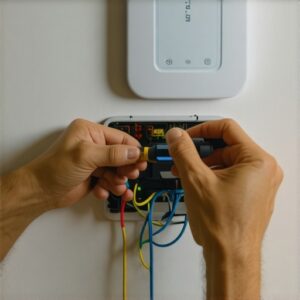
One of the biggest issues is the ‘Power Extender Kit.’ Many older homes only have four wires running to the thermostat. These smart devices need a fifth wire—the ‘Common’ wire—to provide a constant return path for the 24V juice. Without it, the thermostat has to ‘power steal’ from the heat or air conditioning circuit. It’s like trying to charge your phone by tapping into a light switch—it’s inconsistent. If your tech didn’t run a new wire or didn’t check the pilot light relighting assembly for proper grounding, your thermostat is basically starving for energy. This is a common failure point that leads people to think they need an entirely new HVAC repair when they just need a better wire pull.
The Math of Repair vs. Replace
Should you spend $300 on a draft inducer motor repair just to keep your Wi-Fi thermostat happy? If your furnace is 15 years old and the heat exchanger is looking crusty, maybe not. But if the system is solid, don’t let a ‘Sales Tech’ bully you into a replacement. Simple HVAC maintenance plans can prevent 90% of these digital headaches. Cleaning the furnace flame sensor ensures the board doesn’t cycle unnecessarily, and keeping up with preventative HVAC repair tips keeps the electrical load stable. If your thermostat is ghosting you, it’s a symptom, not the disease. It’s your furnace crying for help. Don’t ignore it until the suction line is freezing or the heat exchanger cracks. Get a real technician out there to look at the control board diagnostics and the static pressure. Comfort is physics, and physics doesn’t care about your Wi-Fi password. If you’re ready to stop guessing, it’s time to contact us for a real diagnostic. “