Why Your Fancy New Ductwork is Killing Your Furnace: The Static Pressure Manifesto
My old mentor, a guy who had R-22 tattooed on his forearm before it was even a phased-out refrigerant, used to scream at me in the back of a rattling work van: “You can’t heat or cool what you can’t touch!” This wasn’t some Zen riddle; it was a physics lesson. If the air isn’t moving across that heat exchanger or evaporator coil at the exact velocity the manufacturer intended, your system is just an expensive paperweight. Most tin knockers today think that if they slap some flex duct together and smear a little Pookie on the joints, they’re done. They’re wrong. Without a manometer and a proper static pressure test, you’re just guessing, and in this trade, guessing is how you end up with a cracked heat exchanger or a toasted compressor.
“The most expensive equipment in the world cannot overcome a bad duct system.” – Industry Axiom
The Physics of Resistance: Why Your Blower is Screaming
When we talk about static pressure, we’re talking about the resistance to airflow within your HVAC system. Think of it like blood pressure. If your blood pressure is too high, your heart works too hard and eventually gives out. In your home, the blower motor is the heart. If you modify your ductwork—maybe you added a run for a basement finish or tried a shop heater service integration—and you didn’t check the Total External Static Pressure (TESP), you might have just choked the life out of your unit. In our cold northern climates, where furnace repair is a winter bloodsport, high static pressure is the silent killer. When air moves too slowly because of restrictive ducting, the heat exchanger gets too hot. We call this high delta-T. The metal expands and contracts violently until—pop—you’ve got a crack and a carbon monoxide leak. Now you’re looking at an emergency furnace repair or, worse, a full replacement because you wanted an extra vent in the laundry room.
The Thermodynamic Zoom: Latent Heat vs. Sensible Heat
Let’s talk thermodynamics. If you’re running a hyper-heat heat pump, airflow is even more critical. These systems rely on high-volume air movement to transfer energy effectively. If your duct modification restricted the return air, the refrigerant doesn’t have enough load to boil off correctly. You end up with liquid refrigerant slugging back to the compressor. That’s a $3,000 mistake. Static pressure testing ensures that the sensible heat (the temperature we feel) and the latent heat (the moisture we’re removing or managing) are balanced. In the North, we deal with the danger of ice blocking the heat pump during a polar vortex. If your static pressure is out of whack, the defrost cycle won’t trigger correctly, and your unit becomes a literal block of ice. This is why preventative HVAC repair always includes a manometer check.
“Designers shall use a pitot tube and manometer or a calibrated anemometer to verify that the airflow rate is within 10 percent of the design value.” – ASHRAE Standard 62.2
The Anatomy of a Duct Modification Fail
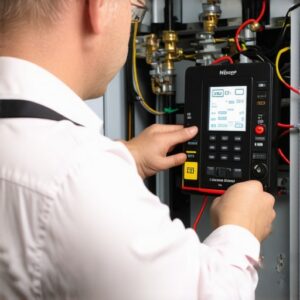
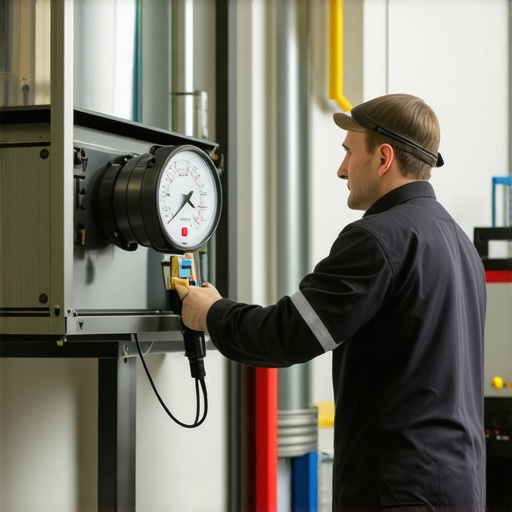
I see it every week: a homeowner or a cut-rate contractor adds a new run but forgets that for every cubic foot of air you push out, you have to pull a cubic foot back. It’s basic mass balance. They ignore the return air drop. When I show up for capacitor replacement services, I don’t just swap the part and leave. I want to know why that capacitor died. Usually, it’s because the blower motor was pulling 15% more amps than it was rated for because it was fighting a restrictive duct system. The heat kills the capacitor. If I just change the cap, I’m a parts-changer, not a technician. I’m going to pull out my probes, drill two tiny holes—one before the filter and one after the coil—and show you the TESP. If that needle hits 0.8 or 0.9 inches of water column on a motor rated for 0.5, we have a problem. This is especially true with flue pipe installation and venting; if the house is under too much negative pressure because of poor duct design, you can actually back-draft your water heater.
Modern Solutions: From Occupancy Sensors to Solar Thermal
We’re moving into an era of high-tech efficiency. Everyone wants occupancy sensor installation to save a buck, but if those sensors are closing dampers in a system that wasn’t designed for zoning, your static pressure is going to skyrocket. You’ll blow the seals right off your plenum. The same goes for solar thermal heating integration. You’re adding another heat exchange coil into the air stream. That coil is a giant obstruction. If you don’t upsize the ductwork to compensate for the pressure drop across that new coil, your “green” system is going to cost you more in blower motors and commercial furnace repair calls than you ever save in gas. Even something as simple as pilot light relighting can lead back to airflow; if a system is cycling on the high-limit switch because of air restriction, the turbulence can actually blow out a standing pilot on older units.
The Verdict: Don’t Let a ‘Sales Tech’ Near Your Trunks
If a guy walks into your house to quote a heat pump replacement and doesn’t look at your ductwork, kick him out. He’s a salesman, not a tech. A real pro knows that the equipment is only as good as the tin it’s attached to. Before you sign off on any AC installation or duct change, demand a static pressure report. It’s the only way to prove the system is breathing. If the “Gas” (refrigerant) isn’t flowing through the “Suction Line” at the right temperature because the air is restricted, you’re burning money. Trust the physics, not the pitch. Comfort isn’t magic; it’s a measurement. “,”image”:{“imagePrompt”:”A close-up, high-detail photo of a veteran HVAC technician’s weathered hands holding a dual-port digital manometer. The technician is inserting a stainless steel probe into a galvanized metal duct plenum. In the background, the blurred shape of a modern high-efficiency furnace and some mastic-sealed duct joints (Pookie) are visible. The lighting is focused on the manometer screen showing a reading of 0.52 in.wc.”,”imageTitle”:”Technician Measuring HVAC Static Pressure”,”imageAlt”:”HVAC technician using a manometer to check static pressure in a duct system”},”categoryId”:0,”postTime”:””} Ready to ensure your system is running at peak performance? Contact us today for a professional diagnostic.”}