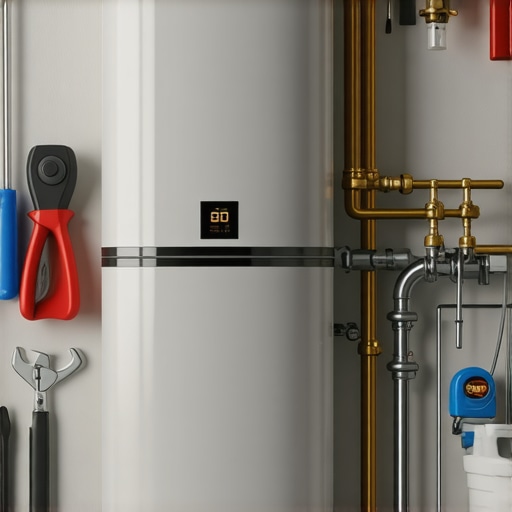
The Anatomy of a Twenty-Year System
Most homeowners treat their boiler like a toaster—they expect it to work every time they push a button until the day it suddenly doesn’t. But after thirty years of hauling pipe wrenches into freezing basements, I can tell you that a boiler is more like a living organism. It breathes, it circulates fluid, and it reacts to the chemistry of its environment. My old mentor used to scream at me, ‘You can’t heat what you can’t touch!’ He wasn’t talking about the radiators; he was talking about the heat transfer surface. If you’ve got a 1/16th inch of scale on your heat exchanger, you’re basically trying to boil water through a brick. That is the fundamental physics that kills systems long before their time. If you want two decades of service, you have to respect the thermodynamics of the machine.
The Forensic Diagnosis: Why Boilers Fail Prematurely
When a boiler dies at year twelve, it’s rarely a manufacturing defect. It’s usually a slow suicide caused by neglect. In the North, where the polar vortex turns your heating system into a 24/7 marathon runner, the enemy is twofold: chemistry and combustion. A boiler is a heat exchanger where the fire’s energy is transferred to water. If that water is ‘hard’ or full of oxygen, you’re growing stones inside your pipes. I’ve walked into church heating systems where the cast iron sections were so choked with sediment that the bottom of the boiler was essentially a solid block of mineral deposits. That’s why top hvac repair strategies always start with water quality. If you aren’t testing the PH and TDS (Total Dissolved Solids) of your system water, you aren’t maintaining it; you’re just watching it rot.
“The most expensive equipment in the world cannot overcome a bad duct system—or in the case of hydronics, a fouled heat exchanger.” – Industry Axiom
Then there is the burner. Whether you’re dealing with a furnace ignition repair or a high-efficiency boiler, the flame must be perfect. I’ve seen ‘Sales Techs’ look at a blue flame and say it’s fine. That’s a lie. Without a digital combustion analyzer, you’re just guessing. You need to know the CO2 levels, the stack temperature, and the excess air. If the mix is off, you’re either sending money up the chimney or coating your heat exchanger in soot. Soot is an incredible insulator—and in this business, insulation on the heat exchanger is the kiss of death.
The Thermodynamic Deep Dive: Sensible vs. Latent Heat
To keep a boiler running for twenty years, you have to understand the transition from sensible to latent heat. Modern high-efficiency condensing boilers are designed to capture the latent heat in the exhaust gases. In the old days, we let that 300°F steam go right out the flue. Now, we cool those gases down so much that the water vapor turns back into liquid, releasing extra BTUs. But here’s the rub: that condensate is acidic. If your oil to gas conversion wasn’t handled by a real tin knocker who knows how to pipe stainless steel or PVC correctly, that acid will eat the heat exchanger from the inside out. I’ve seen $15,000 systems turned into scrap metal in five years because the ‘Sales Tech’ didn’t understand the chemistry of condensation.
For those in drafty older homes, sometimes the boiler needs help. This is where ventless gas heater services come in for supplemental heat in workshops or mudrooms, or even crawl space heating solutions to prevent your hydronic lines from freezing when the wind-chill hits -20°F. If you’re adding an addition, don’t just tap into the old boiler and hope for the best. A ductless mini-split installation with inverter-driven compressors can handle the new load more efficiently than overworking an aging boiler. These modern units use the ‘juice’ (refrigerant) to move heat with surgical precision, allowing your main boiler to stay within its designed ‘sweet spot’ of operation.
The Math of Maintenance: Repair vs. Replacement
I hear it every winter: ‘My boiler is making a screeching sound.’ That’s usually a bearing in the circulator pump crying for mercy. A $500 pump replacement is a drop in the bucket compared to an $8,000 to $12,000 boiler swap. But when the heat exchanger cracks, the game is over. You can’t ‘Pookie’ (mastic) a cracked cast iron section back together. This is where choosing the right hvac fixes becomes critical. If your boiler is over 15 years old and the repair costs exceed 50% of its value, it’s time to pull the plug. However, if you’ve been on priority service memberships, your tech should have caught the scale buildup or the failing expansion tank years ago.
“Standard 155 defines the efficiency of commercial boiler systems, but no standard can compensate for a technician who doesn’t check the expansion tank charge.” – ASHRAE Standards Reference
We also see crossover in hydronics. Many of my clients have high-end residential setups that include pool heater repair or spa heater services tied into the main boiler via a heat exchanger. These are ‘secondary loops.’ If the pool water—which is full of chlorine—leaks into your main boiler loop, it will destroy the system in weeks. You need a sparky to wire the flow switches correctly and a tech who knows how to isolate these loops. It’s all about protecting the ‘gas’ (refrigerant or fuel) and the medium (water).
Strategies for the 2025 Regulatory Cliff
As we move into 2025, the industry is shifting. We are seeing a massive push toward electrification, but a well-maintained boiler remains the king of comfort in cold climates. If you’re looking at heating service innovations, look at outdoor reset controls. These sensors tell the boiler how cold it is outside so it can adjust its water temperature. Why run the boiler at 180°F when it’s 45°F outside? Running it at 140°F saves fuel and reduces the thermal stress on the metal. This is the ‘secret sauce’ to making a unit last twenty years. It’s not magic; it’s just reducing the number of expansion and contraction cycles the metal has to endure.
In conclusion, longevity is a choice. You can either pay for priority service memberships now or pay for a new boiler later. Make sure your tech is doing a full combustion analysis, checking the ‘beer can cold’ suction lines if you have a hybrid AC system, and flushing the low-water cut-off. For more technical deep dives, check out our preventative hvac repair tips. Don’t let a ‘Sales Tech’ talk you into a replacement you don’t need, but don’t be the person who ignores a leaking relief valve until your basement is a swimming pool.