The Deceptive Silence of a High-Tech Paperweight
I’ve spent three decades crawling through limestone foundations in Chicago and shivering in drafts inside century-old New England Victorians. I’ve seen every ‘innovation’ from the first programmable mercury switches to these new fancy glowing rectangles they call smart thermostats. But here is the cold, hard truth: technology doesn’t override physics. Most homeowners think they can just slap a $250 Nest or Ecobee on a wall that was wired when Truman was in office and expect it to work. Then, the first time the temperature drops below ten degrees, the screen goes black, the furnace dies, and I get a call at 3 AM. It’s not the thermostat’s fault—it’s the fact that your house is a 2-wire relic trying to host a 5-wire party.
The Mentorship of Physics: Why Power Matters
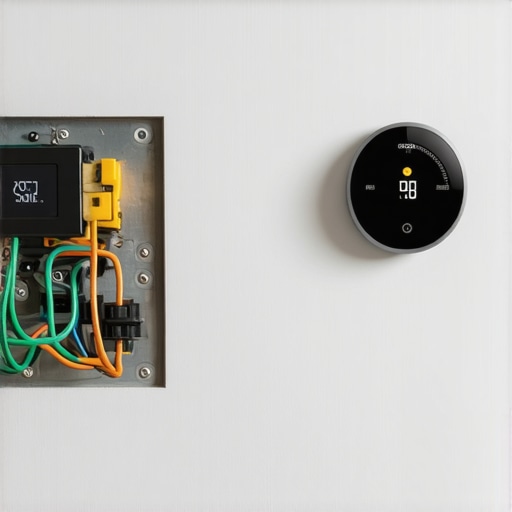
My old mentor, a grizzly guy we called ‘Iron Lung’ Pete, used to scream at me every time I reached for a multimeter without checking the ductwork first. ‘You can’t control what you can’t power, kid!’ he’d bark. He was a master of system performance testing before we even had a name for it. He taught me that airflow and voltage are the two lungs of any HVAC system. If one collapses, the other struggles. In these older homes, you’re usually looking at a simple heat-only setup: two wires—Red and White. One brings the juice, the other sends the signal to fire the burner. But these new smart thermostats? They are power-hungry. They need a ‘Common’ wire—the C-wire—to complete the circuit and keep their Wi-Fi radios and touchscreens alive. Without it, they try to ‘power steal’ from the equipment, and that’s where the nightmare begins.
“The most expensive equipment in the world cannot overcome a bad duct system or an inadequate control circuit.” – Industry Axiom
The Forensic Diagnosis: Why the ‘Power Steal’ Fails
When a smart thermostat tries to pull power from a 2-wire system, it’s essentially pulsing the gas valve or the transformer replacement unit just enough to stay awake without actually tripping the heat. In a dry, North-side winter, this causes ‘chatter.’ You’ll hear your furnace clicking like a nervous woodpecker. Eventually, that pulsing fries the control board or burns out the 24V transformer. It’s a classic case of a ‘Sales Tech’ move: selling a flashy interface without looking at the HVAC repair needs of the actual infrastructure. If you’re running geothermal heat pump systems or even an old cast-iron boiler, that control signal is the heartbeat of your home comfort.
[IMAGE_PLACEHOLDER]
The Danger of Combustion and Control
In our climate, we aren’t just worried about being chilly; we’re worried about combustion analysis. If your smart thermostat is short-cycling your furnace because it’s struggling for power, you’re looking at uneven heat exchanger expansion. That leads to cracks. Cracks lead to carbon monoxide. This is why remote thermostat access is a luxury that requires a professional foundation. If I’m out on a call for a pilot light relighting and I see a smart thermostat wired to a 60-year-old gravity furnace with no C-wire, I know I’m looking at a ticking clock. The system needs more than a gadget; it needs IAQ improvement services and a dedicated power path.
The Solution: Beyond the Band-Aid
Don’t let a ‘Sparky’ or a retail clerk tell you a ‘power extender kit’ is a permanent fix. If you want real reliability, you need a dedicated 24V line. This often involves a full transformer replacement to handle the increased load of the thermostat plus any whole-home humidifiers you’ve got piped in. Speaking of which, if you’ve noticed your house feels like a desert even with the heat on, you might need a bypass humidifier repair. These systems often share the same control logic as your thermostat, and a power-starved control circuit will neglect the humidifier every single time.
“All combustion-based heating appliances shall be tested for proper drafting and carbon monoxide levels after any change to the control system or venting.” – NFPA 54 / ANSI Z223.1
The Math of Comfort: Repair vs. Replacement
I’ve seen folks spend $8,000 on a new unit because a Sales Tech told them their ‘old system is incompatible with smart home tech.’ That’s a lie. Most of the time, for a fraction of that cost, we can perform efficient HVAC repairs that include pulling a new 18/5 thermostat wire and upgrading the transformer. It’s about top HVAC repair strategies rather than just swapping boxes. We look at the system performance testing data. Is the static pressure too high because some ‘Tin Knocker’ undersized the return air in 1954? Is your ‘Pookie’ (mastic) failing at the plenum, leaking all your expensive heated air into the crawlspace? These are the real questions.
Why 2025 is the Year of the Control Overhaul
As we move into 2025, the industry is shifting. We’re seeing more heating service innovations that demand stable, high-amperage control circuits. If you’re considering an upgrade, don’t just look at the AFUE rating of the furnace. Look at the ‘brain’ and the ‘nervous system’—the wiring. If you are experiencing weird shutdowns, it’s time to identify when furnace repair is urgent. A black thermostat screen in February isn’t a glitch; it’s an emergency. Don’t wait for the ‘Suction Line’ to freeze or the heat exchanger to pop. Real HVAC work isn’t about the app on your phone; it’s about the 24 volts pushing through the copper and the airflow moving through the vents. Anything else is just sales talk.