The Specific Reasons Your HVAC Tech Just Told You to Call a Licensed Electrician
Picture this: It’s the hottest day of the year in Washington, your living room feels like a sauna, and you’ve finally managed to get an HVAC technician to your front door. You’re ready to hand over your credit card just to feel a breeze of cold air again. But after fifteen minutes of poking around your outdoor unit and your indoor air handler, the tech climbs down the ladder, looks you in the eye, and says, “I can’t fix this. You need to call a licensed electrician.”
I know exactly how that feels. It’s frustrating, it’s confusing, and frankly, it feels like you’re being passed around while your house continues to bake. You’ve already paid for one service call, and now you’re being told you need to pay for another from a different trade. As someone who holds licenses as both an HVAC contractor and a Master Electrician, I’ve stood on both sides of this conversation. I’ve been the guy delivering the news, and I’ve been the guy who gets called in to finish the job.
There is a very firm “Line of Demarcation” in the home services world. It isn’t just about who has the right tools; it’s about legal licensing, insurance liability, and, most importantly, your family’s safety. When your HVAC pro hands you a business card for an electrician, they aren’t passing the buck. They’ve reached the limit of what they are legally and safely allowed to do. Let’s break down exactly why that line exists and why crossing it is a risk you don’t want anyone to take.
Section 1: The “Line of Demarcation”
In the world of home repairs, we talk about the “Line of Demarcation.” This is the invisible boundary where one trade ends and another begins. Think of it like a relay race: the electrician brings the “baton” (the power) from the city’s grid to your house and up to a specific point, and the HVAC tech takes that power from that point and uses it to run your cooling and heating systems.
Technically and legally, HVAC technicians are masters of refrigerant cycles, airflow dynamics, and low-voltage wiring. That low-voltage stuff is what connects your thermostat to your furnace – it’s usually only about 24 volts, which is enough to send a signal but not enough to cause a major house fire or a fatal shock. However, the power required to actually turn a massive compressor or a blower motor is “high-voltage” supply (usually 230 volts for central AC).
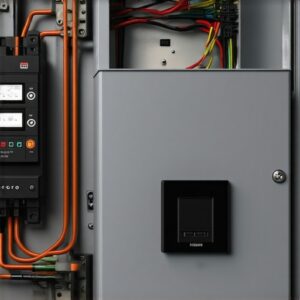
The legal boundary is almost always the **disconnect box**. This is the metal box mounted on the exterior of your home near your AC unit. An HVAC technician is generally licensed to handle everything *after* the disconnect box – the whip (the flexible cable) and the unit itself. However, an electrician is required for everything *behind* the disconnect box, going back to the main electrical panel and the street. If the wires feeding that box are undersized, or if the connection at the breaker is failing, your HVAC tech is legally prohibited from touching it in many jurisdictions. They are protecting their license and your home’s insurance policy by telling you to call a pro who specializes in high-voltage distribution.
If you aren’t sure where the trouble lies, you can read more about How to Tell if Your AC Problem is Actually a Faulty Electrical Disconnect to see which side of the line your issue falls on.
Section 2: Your Panel Can’t Handle the “Startup Surge”
Modern air conditioners are marvels of efficiency, but they have a “hunger” for power that most homeowners underestimate. When your AC compressor kicks on, it doesn’t just gently start sipping electricity. It requires a massive “Startup Surge,” often referred to in the industry as Locked Rotor Amps (LRA).
To put this in perspective, a standard central AC unit can require up to 5,000 watts at the moment of startup. That is roughly 4 to 5 times the power consumption of a high-end hair dryer or a microwave, all hitting your electrical system in a fraction of a second. Most residential systems require a dedicated circuit that can handle between 15 and 50 amps specifically to accommodate this initial surge.
If your home is older, or if your electrical panel is already crowded with modern luxuries like EV chargers, hot tubs, or high-end kitchen appliances, your AC might be the “straw that breaks the camel’s back.” When the compressor tries to pull those 5,000 watts and the panel can’t deliver, the voltage drops. This is why you might see your lights flicker every time the cooling kicks in.
If your HVAC tech notices that your panel is humming, smelling of ozone, or simply lacks the capacity to support your new system, they will recommend an electric panel upgrade Bothell WA. Trying to force a high-efficiency AC to run on an outdated or maxed-out panel will eventually burn out the expensive control boards in your HVAC unit, turning a “power problem” into a “replacement problem.”
For more on those annoying light flickers, check out Why Flickering Lights When the AC Starts is a Job for an Electrician.
Section 3: The Melting Disconnect Box
One of the most common “horror stories” we see in the field is the melting outdoor disconnect box. This is the safety switch located right next to your outdoor unit. It’s designed to allow a technician to cut power to the unit locally so they can work on it safely. But because it sits outside in the rain, wind, and heat, it is a prime candidate for failure.
Why do they melt? Usually, it’s one of three things: loose lugs (the screws holding the wires), undersized wire, or simple age-related corrosion. When a connection is loose, electricity has to “jump” the gap, creating an arc. This arc creates intense heat – enough to liquefy the plastic housing and char the copper wires.
When an HVAC tech opens that box and sees charred insulation or a puddle of melted plastic, they aren’t going to touch it. Why? Because that box is the “gateway” to your home’s main electrical system. If they try to “patch” it and your house has an electrical fire two weeks later, the insurance company will look at who performed the work. If it wasn’t a licensed electrician, the claim could be denied. It’s a massive liability risk that no reputable HVAC company will take. They want you to be safe, and safety means a proper repair by a high-voltage specialist.
You can learn more about the warning signs here: Why your outdoor AC disconnect box is melting and how to stop it.
Section 4: Dedicated Circuits and Code Compliance
In the “old days,” you might have been able to get away with “piggybacking” an appliance onto an existing circuit. Those days are long gone. The National Electrical Code (NEC) is very strict about HVAC systems: they must have a dedicated circuit. This means the wires go from the breaker in your panel directly to the HVAC unit and nowhere else. No lights, no outlets, and definitely no other appliances can be on that line.
When HVAC installers come to your home to put in a new, high-efficiency system, they often find that the old wiring is “grandfathered in” but doesn’t meet current safety codes for the new equipment. If the new unit requires a 30-amp circuit but your old one was only running on a 20-amp line, the wire inside your walls is literally too thin. Running too much power through a thin wire is like trying to force a fire hose worth of water through a straw – the friction creates heat, and heat creates fires.
Modern high-efficiency units are also much more sensitive to “dirty” power. If your circuit isn’t dedicated and clean, you risk frying the expensive inverter boards that make those units so efficient in the first place. This is why a dedicated line is a non-negotiable requirement. For a deeper dive, read Why Your High-Efficiency AC Installation Requires a Dedicated Electrical Circuit.
Section 5: When the Breaker is the Problem, Not the AC
Sometimes, the AC unit is perfectly healthy, but it keeps shutting off. You go to the garage, flip the breaker back on, and it works for an hour before “click” – it trips again. You call the HVAC guy, he checks the compressor, the coolant levels, and the fan motor, and everything is within spec.
The culprit is often a “weak” or “nuisance tripping” breaker. Over decades of use, the internal springs and bi-metal strips inside a breaker can wear out. They become overly sensitive, tripping even when the load is normal. Or, worse, the breaker has developed a poor connection to the “bus bar” in the panel, creating heat that causes it to trip.
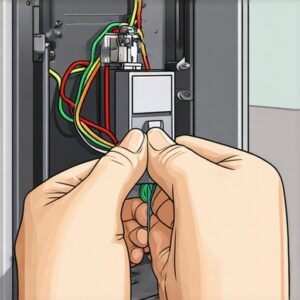
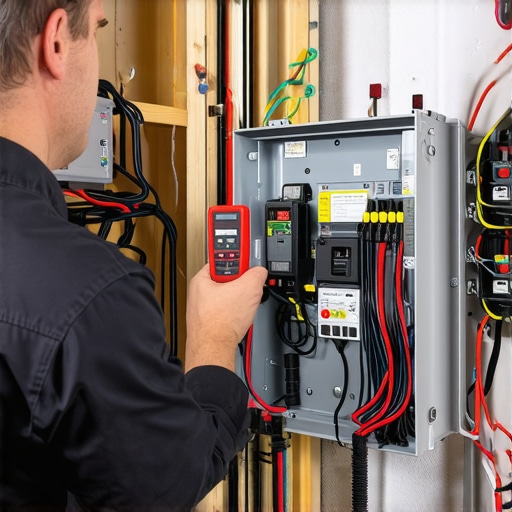
Replacing a breaker inside the main service panel is strictly **electrician** territory. It involves working inside the “hot” panel where a single slip of a screwdriver can be catastrophic. If your tech tells you the AC is fine but the “juice” is the problem, you need a pro to test the breaker’s health under load.
Find out more about this specific failure here: Why Your AC Breaker Trips Every Time the Compressor Tries to Start.
Conclusion
It’s never fun to hear that you need another contractor, but when your HVAC tech refers you to an electrician, they are doing you a favor. They are ensuring that your expensive HVAC investment – which can cost upwards of $10,000 to $15,000 – is supported by a safe, robust electrical system. They are preventing house fires, avoiding voided warranties, and making sure that when the next heatwave hits, your system stays running.
Whatever you do, don’t pressure your HVAC tech to “just swap the breaker” or “tape up those wires.” A professional who respects their trade will say no, and you should respect that “no” as a sign of their integrity. They are putting your safety above a quick fix.
If you’re in the Mill Creek or Bothell area and find yourself caught between an HVAC issue and an electrical mystery, you need someone who understands how these systems talk to each other. For expert help that covers all the bases, contact an electrician HVAC expert Mill Creek WA today. We’ll get the power flowing safely so your HVAC system can do what it does best: keep you cool.